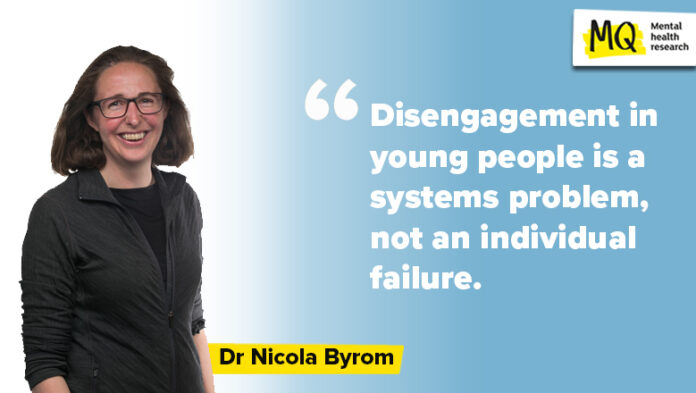
Systems problems require systems solutions
We need to move support earlier, before a young person reaches crisis point, stops attending or withdraws altogether. This means building systems that are proactive, relational and practical.
At the centre of these systems must be relationships.
Young people need adults in their lives who know them, accept them and value them. They need opportunities to participate in communities that expect them to show up and enable them to contribute. They need to experience responsibility for others, rather than being positioned only as recipients of adult concern and professional support.
Mattering comes partly from being cared for. But it also comes from knowing that other people need you.
This cannot be delivered through a referral pathway alone. Young people need adults who have the time and capacity to help them build real-world connections: teachers, youth workers, tutors, employers, coaches, community leaders and others who are present in their everyday lives.
Yet many of these adults are increasingly uncertain about their role.
“’Mental health’ has become one of the only ways available to young people, and to the adults around them, to describe distress.”
This has helped to reduce stigma and made many previously hidden experiences visible. But it can also encourage us to interpret every early sign of difficulty primarily through a clinical lens.
When distress is immediately understood as a mental health problem, the everyday adults around a young person may become nervous about leaning in. They may fear saying the wrong thing, crossing a professional boundary or interfering in something that should be left to an expert.
The result can be a damaging gap. The young person waits months, sometimes longer, to see a specialist. They may eventually receive an assessment and some advice, but little continuing support.
Meanwhile, an experienced teacher, youth worker or tutor who sees that young person regularly may have been well placed to offer some of that support. Had they been given enough time to build a relationship, and had we trusted their knowledge of the young person.
This is not an argument against specialist mental health care. Specialists provide expertise that cannot and should not be replicated by schools, families or community organisations. It is an argument against expecting specialist services to carry the entire burden of supporting young people. We cannot refer our way out of a crisis that is being created and sustained by the everyday functioning of our institutions.
“Getting the apparently simple things right, consistently, is difficult. It requires investment, leadership and sustained organisational change.”
Too often, however, we search for additional programmes that can be inserted into an unchanged system. We introduce a new intervention, training package or digital tool without asking whether the everyday conditions surrounding young people allow relationships to develop.
Do staff have time to notice when someone is struggling?
Can they get to know young people before a crisis occurs?
Are they supported to respond confidently and compassionately?
Do young people have physical places where they can spend time together, develop shared identities and contribute to community life?
Or have workloads, performance pressures, insecure provision and the loss of community spaces made meaningful connection increasingly difficult?
Whole-system approaches to youth mental health recognise that supporting young people also means supporting the adults around them.
Everyone within the ecosystem has a role, not as an amateur therapist, but as someone capable of offering recognition, consistency, practical help and human connection. For that to happen, staff must be properly resourced. Relational support cannot depend indefinitely on individual goodwill, unpaid labour or professionals finding additional time within already overstretched roles.
We must also confront the systems that actively generate distress. Academic and performance pressures can contribute to disengagement, making education feel like a continuous process of judgement rather than a place where young people can learn, belong and develop. We should ask whether our approach to assessment is always preparing young people for adult life or whether, in some cases, it is becoming a barrier to participation.
We must similarly protect the physical and social infrastructure of belonging. Young people cannot build community connections without places to meet, activities through which to contribute and adults with the capacity to bring people together.
The policy question should not simply be: how do we persuade young people to participate?
It should be: what kinds of institutions make participation possible?
The answer begins with systems in which young people are recognised, expected, supported and given meaningful opportunities to contribute. It requires us to invest in the everyday relationships and community structures that can prevent distress from escalating.
Young people need help when they are struggling. But they also need something more fundamental.
They need to know that they belong. They need to know that they matter. And they need systems designed to show them that they do.