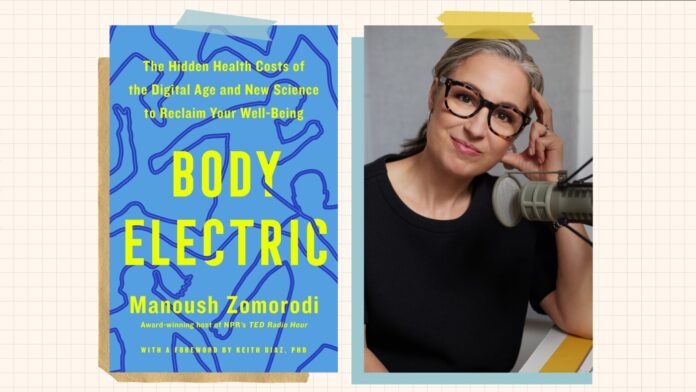
NPR journalist Manoush Zomorodi and her latest book, Body Electric: The Hidden Health Costs of the Digital Age and New Science to Reclaim Your Well-Being.
Flatiron Books/Tory Williams/NPR
hide caption
toggle caption
Flatiron Books/Tory Williams/NPR
The internet at my apartment went out last Saturday. For three full days!
I’m used to having several spigots of information turned on — and drinking from them all at once. The TV, the laptop, the phone and even my tablet, if I was feeling extra thirsty.
It felt terrible.
So you know what I did? I pulled one of my Shakespeare books off the shelf and started re-reading Othello. Because I wasn’t trying to use all my devices at once, I was able to relax and focus.
I’m used to “media multitasking,” a term I learned from TED Radio Hour host Manoush Zomorodi, that describes double- or triple-screening devices. But when you’re consuming too much information, it can be hard to take anything in. And you end up feeling tired and overwhelmed.
Zomorodi talks about how digital habits like this one can drain our attention and energy in Body Electric: The Hidden Health Costs of the Digital Age and New Science to Reclaim Your Well-Being, published in May. Co-authored with behavioral medicine scientist Keith Diaz, the book looks at the physiological effects of our digital lives and offers evidence-backed strategies to combat them.
Zomorodi, who also hosted the NPR podcast Body Electric, talks to Life Kit about the science of information overload. This interview has been edited for length and clarity.
What happens in our bodies when we multitask?
Every time you switch a task, you use glucose. And every time you use glucose in your brain, you’re burning through a finite amount of it, as well as the oxygen it takes to burn it.
Your brain has the ability to clear out the CO2 that’s the remnants from burning all that glucose and oxygen. But at a certain point, it starts to build up if you overload yourself. So that is when you start to feel tired and foggy, mentally fatigued, maybe even feel it in your body.

If you’re multitasking, do the opposite — single-task. One thing at a time, all the way through. Then take a break. Then tackle the next task.
What is the best way to regain focus?
Take a break, move. Not take a break on your phone, because that’s burning glucose again. Literally get up and walk around the room. That stimulates your muscles. Your muscles can then pump in more blood, which has oxygen and glucose, back up to your brain.
That moment in the afternoon where you’re like, “Oh, I just need chocolate so bad,” well, of course you do. Literally you are light on glucose in your brain. That makes total sense. But if you take a walk, you will refresh your cognitive capacity and protect your physical health as well.