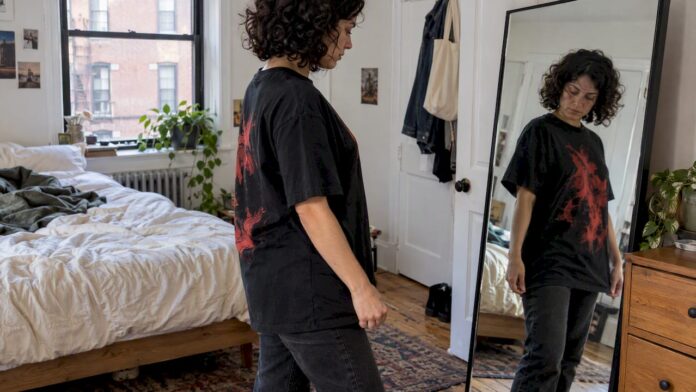
An oversized tee is a T-shirt cut to look big on purpose. It is wider through the chest and body, the shoulder seam sits down on your upper arm instead of on the shoulder bone, the sleeves run long and the hem falls around the hip or a little below. It is not simply a regular shirt in a bigger size, and that difference decides whether it looks like a style choice or like a hand-me-down.
Below, we explain what the label means, how to tell a true oversized cut from a badly fitting one, what size to order, where the look came from and why so many people, including many in the mental health community, reach for it first.
TL;DR
- “Oversized” describes a deliberate cut: boxy body, dropped shoulder seam, roomy sleeves and a hem near the hip.
- Buying a regular tee two sizes up is not the same thing. Sizing up usually leaves you with a low neckline and a seam that sags in the wrong place.
- For most people, your usual size is the right starting point for a shirt labeled oversized. Check the brand’s size guide first.
- The silhouette grew out of hip-hop and skate culture, where baggy shapes were a statement and a comfort.
- Comfort is part of the meaning. Plenty of people find loose clothing calming, and it makes a great canvas for a message you believe in.
Table of Contents
What “oversized” actually means on a T-shirt label
In everyday English, oversized things are simply bigger than usual, but in clothing the word has taken on a more exact job. When a brand writes “oversized” on a tee, it is telling you about the pattern, not only the size. The pattern pieces were drawn larger on purpose: more width across the chest, a longer body, wider sleeves, and a seam that is moved off the shoulder.
Think of it as three layers of meaning:
- A shape. Boxy and straight, with the fabric falling away from the body rather than following it.
- An attitude. Relaxed, unbothered, a little off-duty. The shirt says you did not dress to impress anyone.
- A feeling. Room to move and breathe, with nothing tugging at your neck, arms or waist.
That third layer matters more than fashion writers usually admit. We come back to it later.
Oversized vs. regular vs. relaxed fit
Brands use these words loosely, which is why shoppers get confused. Here is the practical way to read them. Exact measurements differ from label to label, so treat this as a map, not a rulebook.
| Fit | Shoulder seam | Body | Sleeves | Overall feel |
|---|---|---|---|---|
| Regular (classic) | On or very near the shoulder bone | Skims the body with a little ease | Ends on the upper arm, fairly snug | Neat and traditional |
| Relaxed | Slightly past the shoulder | Looser, still follows your frame | Slightly roomier | Comfortable, not baggy |
| Oversized | Clearly dropped onto the upper arm | Boxy, wide, often longer | Wide and long, often to mid-bicep or past | Deliberately big and slouchy |
The quickest tell is the shoulder. On a regular tee, the seam sits where your shoulder ends. On an oversized tee, it has slid down your arm. Many oversized shirts use this drop-shoulder construction, though a drop shoulder alone does not make a shirt oversized. The whole pattern has to be bigger.
Five signs you are looking at a true oversized tee
When you are shopping online or flipping through a rack, look for these markers:
- A dropped shoulder seam. It falls onto your upper arm, not on top of your shoulder.
- A chest that hangs straight. The fabric falls from the chest down without pulling across it or clinging.
- A hem near the hip. Not at mid-thigh, which tends to read as simply too big, and not cropped.
- Sleeves that stop around mid-bicep or a bit lower. They are wide enough to move freely and look intentional.
- A neckline that lies flat. It sits against the base of your neck without choking you or gaping open.
That fifth point is where cheap sizing-up goes wrong. A standard shirt in a much bigger size has a bigger neck hole too, so the collar stretches out and slides off one shoulder. A real oversized pattern keeps the neckline in proportion while widening everything else.
What size should you buy?
This is the question people ask most, and the answer surprises them: usually your normal size.
Because the pattern is already cut wide and long, your regular size gives you the full oversized effect. Going up one or two sizes on top of that can push the seam too far down the arm, make the sleeves swallow your hands and drop the hem well past where it was designed to fall. If you want the look to be extra dramatic, one size up is the most we would suggest, and only after reading the brand’s own measurements.
A simple way to decide:
- You want the look the designer intended: order your usual size.
- You are between sizes and like a slouchy drape: pick the larger one, and check the chest width in the size chart.
- You are petite and worry about being swallowed: stay with your usual size, or look at the length measurement before you buy.
- You are layering over a hoodie or long sleeve: your usual size still tends to work, since the room is built in.
The most reliable method is the oldest one. Lay your favorite tee flat, measure it across the chest and from the shoulder to the hem, then compare those numbers with the size chart of the shirt you want. Brands that publish measurements make this easy, and brands that do not are worth a question before you order. If you are shopping with us, our size guide page is the place to start.
Fabric matters as much as cut
An oversized silhouette needs fabric with some body. A thick, sturdy cotton drapes and keeps its boxy shape. A very thin jersey in the same pattern can look limp, cling in odd places or collapse into a sloppy shape. When you order online, read the product description for any mention of fabric weight or feel, and if there is none, ask. It is a small step that saves a lot of returns.
Where the oversized look comes from
The silhouette is not a new Instagram trend. It rose with streetwear, and African American streetwear in particular is known for baggy or oversized jeans, hoodies, T-shirts and jackets, alongside graphic tees. In hip-hop fashion, baggy shapes that disguise the contours of the body were introduced in the 1980s, and skate culture ran on the same idea of loose, durable clothes you could move in.
Those scenes used clothing to say something: that you belonged to a community, and that you did not plan to follow mainstream rules about how to dress. Academic work on skate merchandise shows how a graphic tee can become a badge of rebellion that later travels from the skate park into high fashion. The point for us is simple: the oversized tee began as a way to wear your identity, not hide it.

Why people love them
Ask ten people why they wear oversized tees and you will hear some version of the same answers.
- Comfort that lasts all day. More room means more freedom of movement and less fussing with fabric.
- Easy styling. One shirt works with leggings, shorts, jeans or under a jacket. It pairs well with fitted bottoms, because the contrast in volume is what makes the look.
- No gender rules. The cut does not assume a body type, so it works for nearly anyone.
- Privacy. A looser shape gives you a little distance between your body and the world.
- Space for a message. A boxy tee gives graphics and slogans a big, clear surface.
If you are building a wardrobe around pieces you actually wear, it helps to think in terms of anchors first. This clothing shopping list walks through buying your core pieces before the extras, and a well-cut oversized tee is exactly the sort of anchor that earns its place.
Oversized tees and mental health: why comfort is not a small thing
We want to be careful here. Clothing does not treat anything, and no shirt replaces care from a doctor, therapist or psychiatrist. If you are struggling, please talk to a licensed professional, and in the United States you can call or text 988 to reach the Suicide and Crisis Lifeline at any time.
What we can say is what many people with lived experience tell us: what you wear affects how you move through a hard day. Tags that scratch, tight waistbands and clingy fabric can be one more irritation when your nerves are already frayed. A loose, soft shirt with no pressure points removes one of those irritations. For some people, the roominess also feels like a layer of protection, a way to feel less on display.
The oversized shape has long carried that dual role. It has been a fashion statement and a way of disguising the body’s contours for people who did not want to be looked at too closely. In a mental health context, we would put it more gently: it can be a way of feeling safe enough to show up.
And once you feel comfortable, you can decide what you want your shirt to say.
Our perspective: a shirt that starts conversations
We started Schizophrenic.NYC because Michelle Hammer, who lives with schizophrenia, wanted to talk about it out loud instead of whispering. Clothing turned out to be the easiest way to open the door. When someone reads your shirt on the subway, a conversation can begin without anyone having to make a speech.
Here is what we believe about oversized tees and advocacy:
- Comfort keeps you going. Advocacy is a long road. A walk, a fundraiser, a day of talks or an ordinary Tuesday is easier in clothes that do not fight you.
- Bold graphics deserve room. A message about mental illness should be easy to read, and a roomy front panel gives it space.
- Fit is personal. There is no correct way to feel in your clothes. Some people want a snug tank top and some want a tee that hangs to the hip. Both are valid.
- Visibility lowers stigma. Every time a person wears words like these in public, mental illness looks a little more ordinary and a little less frightening.
If you want ideas for putting an outfit together, we have written about comfortable advocacy looks for walks and about outfits that spark conversations at fundraisers. Our guide to what to wear to support mental health covers the basics.
— Michelle
How to style an oversized tee
You do not need a formula, but a few ideas keep the look sharp rather than shapeless.
Balance the volume
Pair the big top with something closer to the body: leggings, slim or straight jeans, bike shorts. The contrast is what tells people the size is deliberate. Fashion writers have said this for years, and one classic beginner’s guide describes the key as contrasting what you wear below with the width of the top. If you go wide on both halves, the shape can disappear.
Show a little structure
A half tuck at the front, a belt over the shirt or rolled sleeves will define your waist without giving up comfort. A fitted tank underneath can also help, especially on warm days.
Let the graphic lead
When the shirt carries a message, keep the rest of the outfit quiet. Neutral bottoms and simple sneakers let the words do the talking. Accessories such as a pillbox, a button on a tote or a ring keep the theme going without clutter.
Mind the neckline and hem
If the collar gapes or the hem hits mid-thigh, the shirt is probably too big for the pattern. That is the moment to try your usual size instead.
Common mistakes to avoid
- Sizing up out of habit. The pattern is already large. Check the size chart.
- Judging by length alone. A shirt can be long without being oversized. The dropped shoulder and wide body are the real clues.
- Ignoring fabric. A flimsy knit will not hold the silhouette.
- Skipping the measurements. A “one size” claim tells you nothing. Real numbers do.
- Wearing the same volume everywhere. Give the outfit a shape somewhere.
Find an oversized-friendly tee with a message
If you want a shirt that is comfortable and says something, start with our mental health T-shirts. If you prefer layers, our hoodies and sweatshirts are a natural next step, and our tank tops work well when you want something lighter. Every design comes from Michelle’s own artwork and lived experience. Check each product page and our size guide for fit details, and for our full range, see the mental health clothing collection. For what each piece stands for, read about what a mental health clothing line is.
FAQ
Is oversized bigger than regular fit?
Yes. An oversized tee is cut with more width through the chest and body, longer sleeves and a dropped shoulder seam, so it hangs looser than a regular fit. The difference is built into the pattern, so it is not only a matter of a larger size number.
What is the difference between a normal T-shirt and an oversized T-shirt?
A normal T-shirt follows the body fairly closely, and its shoulder seam sits near the shoulder bone. An oversized one is boxy, with the seam on the upper arm, roomier sleeves and a hem that usually lands around the hip. Both can be the same fabric, but they are drawn from different patterns.
What size should I get for an oversized tee?
Usually your normal size, because the extra room is already designed in. If you want even more slouch, go up one size at most, and compare the chest and length measurements in the size chart before you order. Sizing up too far can leave the neckline and shoulders out of proportion.
Why are oversized tees so popular?
They are comfortable, easy to style and not tied to any one body type. They also carry a streetwear heritage, with roots in hip-hop and skate culture, that still feels relaxed and confident today.
Can an oversized tee be part of mental health advocacy?
Absolutely. A comfortable shirt makes it easier to show up at a walk, a talk or a fundraiser, and a clear message on the front starts conversations. It does not replace professional care, but it can help you feel like yourself while you advocate.
Sources
Recommended
Comments