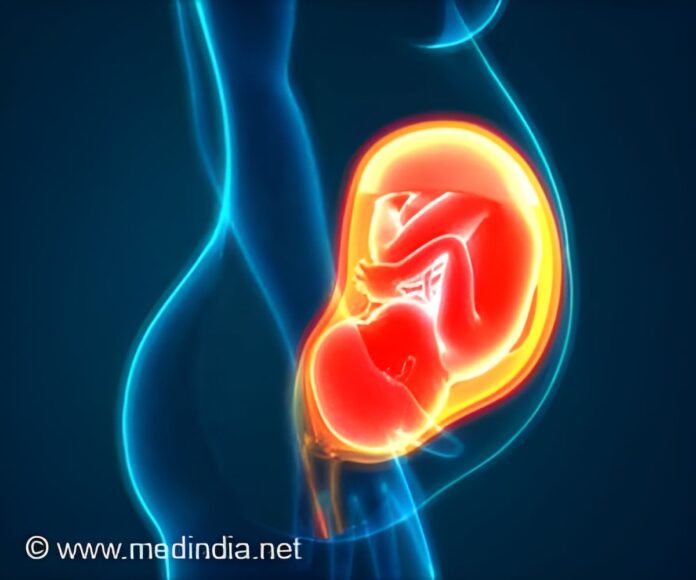
Understanding placental contractions in healthy pregnancy through AI-powered MRI analysis that tracks placental activity and transforms prenatal diagnostics.
In a study using MRI scans of 36 healthy pregnancies, about 60% showed that the placenta can contract on its own, separately from the rest of the uterus, according to a new study.
The findings of the study are published in the open-access journal PLOS One by Louise Dewick of the University of Nottingham, U.K., and colleagues (1✔ ✔Trusted Source
Placental contractions in uncomplicated pregnancies
Go to source
).
The Secret Life of the Placenta
The placenta is important in pregnancy, with placental dysfunction known to be a major cause of pregnancy complications and stillbirth. However, methods of placental monitoring are largely indirect, focusing on fetal growth and activity. In 2020, University of Nottingham researchers first used MRI to describe contractions isolated to the placenta and underlying uterine wall, but the basic characteristics of these contractions and how to distinguish them from uterine contractions remained unclear.
The Moving Placenta: Captured by MRI, Decoded by AI
In the new study, the researchers recruited 36 healthy pregnant women between 29 and 42 weeks of pregnancy to undergo 15- to 32-minute-long MRI scans of the uterus. An automated neural network was then used to analyze the MRI images and track changes in placental and uterine volume, area, and shape over time.
How Placental Contractions Differ From Uterine Contractions
Placental contractions occurred in at least 60% of these healthy pregnancies, with a median frequency of approximately 2 per hour and a median duration of 2.4 minutes. Compared to uterine contractions, placental contractions were more likely to change the shape of the placenta and lasted longer. All contractions, both placental and uterine, led to an increase in an MRI parameter linked to deoxygenated blood in the placenta. The researchers found that changes in the shape of the placenta—specifically how spherical the placenta became—could serve as a marker to automatically distinguish placental from uterine contractions.
The study was limited by its small sample size and short MRI scan duration, which may not reflect contraction patterns over longer periods and did not allow both types of contractions to be observed in every participant.
The researchers conclude that these findings lay the groundwork for future studies of the placenta; for example, investigating whether placental contractions differ in pregnancies complicated by conditions such as fetal growth restriction or pre-eclampsia.
Dr. Louise Dewick from the University of Nottingham’s School of Medicine adds: “This research is vital in furthering our understanding of exactly how the placenta works in pregnancy. Using MRI imaging we have, for the first time, clearly characterized placental contractions. We have shown that they occurred in at least 60% of our healthy pregnant participants with an average frequency of 2 per hour lasting for 2.4 minutes. This work forms the basis of further studies on placental contractions and we hope will unlock even more knowledge about this complex but crucial organ.”
Professor Penny Gowland from the University of Nottingham’s School of Physics and Astronomy adds: “Advances in MRI technology are allowing us to use imaging to pinpoint exactly what is happening inside a woman’s body during pregnancy. These new insights build on previous work and provide important markers for healthy placental function and could lead to improved ways to identify potential problems in a pregnancy.”
Amy Turnball adds: “The highlight of this project for me has been working as part of an interdisciplinary team with experts from different fields finding out something completely new. We’d like to thank all of the women and families who took part in the study for volunteering their time during a vulnerable period of their lives.”
Reference:
- Placental contractions in uncomplicated pregnancies – (https://journals.plos.org/plosone/article?id=10.1371/journal.pone.0344388)
Source-Eurekalert