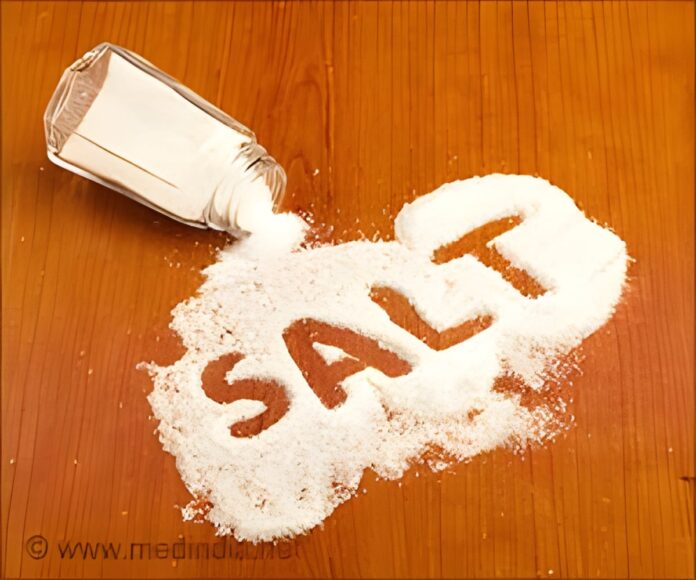
Adopting low sodium salt substitutes nationwide could prevent up to 14% of annual heart deaths in India, saving millions of lives.
Leading experts in clinical medicine and public health have released a consensus statement recommending potassium-enriched low-sodium salt substitutes (LSSS) to combat hypertension and heart disease in India.(1✔ ✔Trusted Source
Consensus on the Use of Potassium-Enriched Low-Sodium, Salt Substitutes (LSSS) as a Public Health Intervention in India
Go to source
)
With India committed to reducing the population level sodium intake by 30% by 2030, this strategy targets the 80% of salt consumed through household cooking.
The initiative was developed by The George Institute for Global Health India in association with ‘Resolve to Save Lives,’ promotes LSSS, which is a blend of sodium and potassium chloride, as a scalable solution to lower blood pressure without altering taste.(2✔ ✔Trusted Source
The George Institute for Global Health India
Go to source)(3✔ ✔Trusted Source
Resolve to Save Lives
Go to source)
This evidence-based public health intervention aims to reduce cardiovascular risks and prevent non-communicable diseases (NCDs) nationwide.
Blending Sodium and Potassium in Salt Substitutes Lowers Hypertension and Heart Risks
Indians daily consume 8–11g of salt, nearly double the WHO recommended limit. This high sodium and low potassium intake drives hypertension. Since 80% of salt is added during home cooking, using low-sodium substitutes (LSSS) is highly effective.
LSSS blends sodium and potassium chloride to reduce sodium while boosting potassium, lowering blood pressure and heart disease risks.
Evidence from India and around the world shows that switching to potassium-enriched low-sodium salt substitutes (LSSS) effectively lowers blood pressure and prevents heart-related emergencies. Key findings include:
- Clinical Success in India: A 2021 study in rural India found that hypertensive adults using LSSS saw their systolic blood pressure drop by 4.6 mm Hg.(4✔ ✔Trusted Source
Effects of a reduced-sodium added-potassium salt substitute on blood pressure in rural Indian hypertensive patients: a randomized, double-blind, controlled trialGo to source
) - Proven Global Results: A massive five-year study in China involving 21,000 people revealed that LSSS reduced strokes by 14%, major heart events by 13%, and total deaths by 12%.(5✔ ✔Trusted Source
Rationale, design, and baseline characteristics of the Salt Substitute and Stroke Study (SSaSS)-A large-scale cluster randomized controlled trialGo to source
)
- National Impact: Experts estimate that if everyone in India switched to these salt substitutes, it could prevent between 8% and 14% of cardiovascular deaths every year.(6✔ ✔Trusted Source
Estimated Benefits and Risks of Using a Reduced-Sodium, Potassium-Enriched Salt Substitute in India: A Modeling StudyGo to source
)
Five Strategic Recommendations to Nationalize Low-Sodium Salt Substitutes
The consensus statement outlines five priority actions to scale the use of potassium-enriched low-sodium salt substitutes (LSSS) for better heart health in India:(1✔ ✔Trusted Source
Consensus on the Use of Potassium-Enriched Low-Sodium, Salt Substitutes (LSSS) as a Public Health Intervention in India
Go to source
)
- Policy and Standards: Integrate LSSS into national hypertension and sodium reduction strategies, while updating FSSAI standards to approve its widespread use as edible salt.
- Widespread Adoption: Prioritize replacing regular salt with LSSS in households, government nutrition programs, and institutional kitchens. Additionally, mandate food industry reformulation for packaged snacks and restaurant meals.
- Public Awareness: Launch social marketing campaigns to build trust and demand. Use health leader endorsements and community outreach to address myths and promote the benefits of switching salts.
- Healthcare Integration: Train medical professionals to include LSSS in routine cardiovascular disease prevention. This includes simple screening to identify high-risk individuals and providing clear guidance for household salt replacement.
- Continued Research: Focus on gathering more data regarding high-risk groups, such as chronic kidney disease (CKD) patients, and monitoring real-world implementation across India.
India can achieve major health gains by targeting household salt use, which is the primary source of sodium intake. Scaling the use of potassium-enriched LSSS offers a unique chance to reduce hypertension and cardiovascular disease nationwide. This simple effort can lower blood pressure, prevent strokes and heart attack risks, and also decrease premature mortality rates across the population.
Call for FSSAI Standards to Support Nationwide Low-Sodium Salt Adoption
On February 3, 2026, The Minister of Health and Family Welfare told the Rajya Sabha that excessive salt is a ‘critical health crisis’.(7✔ ✔Trusted Source
GOVERNMENT OF INDIA, MINISTRY OF HEALTH AND FAMILY WELFARE, DEPARTMENT OF HEALTH AND FAMILY WELFARE
Go to source
) The government acknowledged that low-sodium salt substitutes (LSSS) can significantly combat cardiovascular diseases.
This aligns with WHO goals to reduce sodium intake. FSSAI’s national programs like ‘Eat Right India’ and ‘Aaj Se Thoda Kam’ are now being used to promote this transition.
Following the December 2025 conference, a webinar titled ‘From Consensus to Action’ was launched on April 17, 2026. Experts are urging the government to mandate LSSS in public kitchens, such as school mid-day meals and hospital canteens, to normalize its use.
There is also a push for food industry policies requiring the partial replacement of sodium with potassium in high-salt packaged foods, including instant mixes, snacks, and restaurant meals.(8✔ ✔Trusted Source
Webinar: Low-sodium salt substitutes in India
Go to source)(9✔ ✔Trusted Source
Low-sodium salt substitutes as a key intervention for prevention, control & management of hypertension and other cardiovascular diseases in India
Go to source)
On average, Indians consume 3,873 mg of sodium (9.8g of salt) daily, doubling the WHO limit and creating a severe health risk. To combat this, WHO established sodium benchmarks for 18 food categories and provides tools to help countries meet reduction targets.
Reaching these goals could lower cardiovascular casualties by 3.1% by 2030.(10✔ ✔Trusted Source
India is far behind in reaching the target of the mean population sodium intake by 2025
Go to source) Experts recommend potassium-enriched salt substitutes to bridge this gap and prevent up to 14% of annual heart-related deaths.
Scaling Low-Sodium Salt Substitute as a Routine Pillar of National Heart Health Care
New clinical guidance confirms that nearly 90% of the population can safely benefit from LSSS, urging doctors to overcome ‘therapeutic inertia’ and actively prescribe these substitutes.
To ensure wide availability, priority is being placed on updating FSSAI standards to classify potassium-enriched LSSS as standard edible salt. These safety and policy updates aim to improve market accessibility, making this life-saving intervention a routine part of heart health care.
References:
- Consensus on the Use of Potassium-Enriched Low-Sodium, Salt Substitutes (LSSS) as a Public Health Intervention in India – (https://www.georgeinstitute.org/sites/default/files/2026-04/Consensus%20Statement_Print%20version.pdf)
- The George Institute for Global Health India – (https://www.georgeinstitute.org/about-us/india)
- Resolve to Save Lives – (https://resolvetosavelives.org/)
- Effects of a reduced-sodium added-potassium salt substitute on blood pressure in rural Indian hypertensive patients: a randomized, double-blind, controlled trial – (https://pubmed.ncbi.nlm.nih.gov/33782684/)
- Rationale, design, and baseline characteristics of the Salt Substitute and Stroke Study (SSaSS)-A large-scale cluster randomized controlled trial – (https://pubmed.ncbi.nlm.nih.gov/28577665/)
- Estimated Benefits and Risks of Using a Reduced-Sodium, Potassium-Enriched Salt Substitute in India: A Modeling Study – (https://pubmed.ncbi.nlm.nih.gov/35880525/)
- GOVERNMENT OF INDIA, MINISTRY OF HEALTH AND FAMILY WELFARE, DEPARTMENT OF HEALTH AND FAMILY WELFARE – (https://sansad.in/getFile/annex/270/AS32_lTWs4K.pdf?source=pqars)
- Webinar: Low-sodium salt substitutes in India – (https://resolvetosavelives.org/timeline/webinar-low-sodium-salt-substitutes-in-india/)
- Low-sodium salt substitutes as a key intervention for prevention, control & management of hypertension and other cardiovascular diseases in India – (https://resolvetosavelives.org/wp-content/uploads/2026/04/White-Paper_Print-Version.pdf)
- India is far behind in reaching the target of the mean population sodium intake by 2025 – (https://enewsroom.in/india-sodium-intake-by-2025-who-salt/)
Source-Medindia