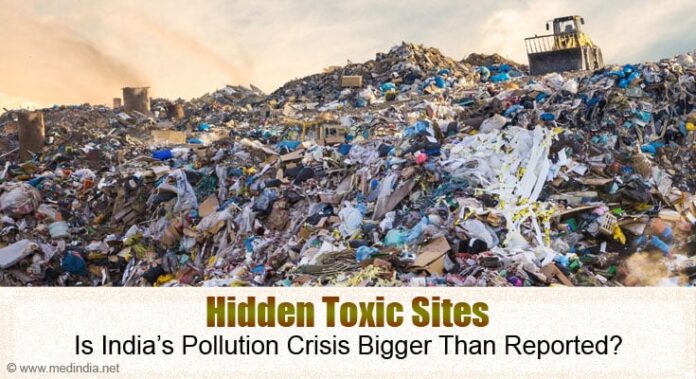
India’s toxic hotspots may be far more widespread than reported, quietly polluting soil, water, and air without full visibility.
- India’s contaminated sites may be just the tip of the iceberg, with widespread pollution going undetected
- Toxic chemicals from waste and industry are silently entering water, soil, and the food chain
- Experts call for an integrated CS-MAR approach to improve pollution tracking, assessment, and cleanup
India’s contaminated sites crisis is far deeper than official numbers suggest, with just 103 sites recorded as of March 2025 despite massive industrial waste generation—highlighting a dangerous gap between visible data and hidden pollution risks.
These toxic hotspots are silently affecting soil, water, and air, raising long-term concerns for public health and sustainability.
Experts increasingly point to the need for integrated frameworks like Contaminated Site Monitoring, Assessment, and Remediation (CS-MAR) to improve tracking and response (1✔ ✔Trusted Source
Advancing global standards: Integrating policies for effective management of contaminated sites in India
Go to source).
Why Are Contaminated Sites In India Turning Into A Silent Environmental Emergency?
Contaminated sites (CS) are areas where harmful chemicals exceed safe levels in soil, water, or air, often requiring urgent cleanup or containment. In India, rapid industrialization, urban expansion, mining, and poor waste-disposal practices have significantly increased the risk of such pollution.
What makes the situation more concerning is that contamination is not always visible—it slowly seeps into groundwater, crops, and ecosystems, eventually entering the food chain.
Soil pollution alone can disrupt agricultural productivity and food security, hindering progress toward global sustainability goals such as the UN Sustainable Development Goals.
Real-world examples, such as Delhi’s Ghazipur landfill, show how untreated waste releases toxic substances like lead, arsenic, and methane, as well as dangerous air pollutants from recurring fires. Despite generating around 7.46 million metric tonnes of hazardous waste annually from nearly 44,000 industries, India has identified only a small fraction of contaminated sites, suggesting that the true scale of the crisis remains largely unrecognized and underestimated.
What Is Holding Back Effective Action Against Contamination In India?
The challenge is not the absence of environmental laws but their fragmented implementation. Multiple regulations—ranging from the Environment Protection Act to various waste management rules—exist, but they are managed by different authorities with overlapping roles, leading to gaps, delays, and weak enforcement.
Even identifying contaminated sites is complex, as it involves distinguishing between confirmed sites and “probable contaminated sites,” where pollution is suspected but not fully assessed.
Adding to this complexity is the limited list of officially recognized pollutants, which currently includes only a few heavy metals like lead, arsenic, and mercury, leaving out emerging contaminants such as microplastics and complex industrial chemicals. Pollution sources are also diverse and often unclear, including:
- Industrial leaks and chemical spills
- Illegal waste dumping
- Agricultural runoff and fertilizer residues
- Legacy pollution from older industrial activities
These pollutants interact, spread across environmental pathways, and create combined risks that are difficult to assess using traditional methods. Although advanced technologies like remote sensing, GIS mapping, and real-time monitoring systems can improve tracking, their use is limited by a shortage of skilled professionals.
A lack of integrated risk assessment and poor data transparency further weaken response efforts, as there is no centralized, accessible database to guide policy or inform the public. These gaps highlight the urgent need for a more coordinated and unified system—such as the Contaminated Site Monitoring, Assessment, and Remediation (CS-MAR) framework—designed to streamline identification, data sharing, and cleanup efforts.
Can the CS-MAR Framework Solve India’s Contaminated Sites Crisis?
Experts are increasingly advocating for a unified framework known as Contaminated Site Monitoring, Assessment, and Remediation (CS-MAR), which connects all stages of contamination management into a single, coordinated system. This approach focuses on comprehensive site identification, real-time data collection, and centralized databases that track pollutants, industries, and environmental risks.
By enabling better data sharing and collaboration across scientific, regulatory, and public domains, it aims to improve decision-making and prioritize high-risk sites.
Public participation is another key pillar, with awareness campaigns, community monitoring, and NGO involvement helping bridge the gap between policy and ground reality. Financial innovation is equally critical; as cleanup efforts are costly. Key solutions include:
- National remediation funds to support cleanup efforts
- Public-private partnerships to share expertise and resources
- Green bonds to finance environmentally sustainable projects
Incentive-based systems, similar to carbon trading, could also encourage industries to reduce pollution by rewarding cleaner practices and penalizing excessive emissions.
Global examples from countries like the US, UK, and Australia show that integrated policies, transparency, and strong regulatory frameworks can significantly improve outcomes.
While frameworks like CS-MAR aim to strengthen long-term monitoring and remediation, the health impacts of contamination are already being felt—particularly through polluted water sources.
What Do Contaminated Water Risks Reveal About India’s Larger Pollution Crisis?
The impact of contamination is no longer theoretical—it is already visible in communities exposed to polluted water sources.
Studies from industrial regions in India show that people who consume contaminated surface water, hand-pump water, or well water report higher rates of gastrointestinal issues, such as frequent loose stools, abdominal pain, and gastric discomfort.
In one such assessment involving over 500 individuals, surface water users were significantly more likely to experience digestive problems, while well water users reported higher levels of gastric distress (2✔ ✔Trusted Source
Human Health Risk Assessment due to Heavy Metals in Ground and Surface Water and Association of Diseases With Drinking Water Sources: A Study From Maharashtra, India
Go to source).
These health effects are closely linked to exposure pathways, particularly through drinking water and, to a lesser extent, skin contact.
Even when contaminants are present at low or undetectable levels in water, long-term exposure and accumulation through food or environmental contact can still pose risks.
Alarmingly, risk assessment models indicate that certain contaminants—especially arsenic—can exceed safe exposure thresholds, increasing the likelihood of adverse health effects when exposure persists over time.
These findings underscore that contamination is not a distant or isolated issue—it is already affecting everyday health outcomes across communities. What remains unseen beneath the surface may carry even greater long-term risks as pollutants accumulate over time.
Addressing these impacts requires moving beyond fragmented responses toward coordinated, large-scale action.
Strengthening monitoring systems, improving data transparency, and accelerating cleanup efforts will be critical to reducing exposure.
Frequently Asked Question
Q: What are contaminated sites (CS) and why are they dangerous?
A: Contaminated sites are areas where harmful chemicals pollute soil, water, or air, posing risks to human health and the environment.
Q: Why is India’s contamination problem considered underestimated?
A: Only a limited number of sites are officially recorded, while large-scale industrial waste suggests many more polluted areas remain unidentified.
Q: How does pollution from these sites affect daily life?
A: Toxins can enter drinking water, crops, and air, increasing the risk of illnesses over time.
Q: Which health problems are linked to contaminated water?
A: Exposure can lead to digestive issues, organ damage, and long-term risks like cancer due to heavy metals such as arsenic and lead.
Q: Why is it difficult to manage contaminated sites in India?
A: Fragmented regulations, lack of data, and limited monitoring systems make identification and cleanup challenging.
Q: What is the proposed solution to tackle this issue?
A: Experts recommend an integrated system to track, assess, and clean contaminated sites more effectively.
References:
- Advancing global standards: Integrating policies for effective management of contaminated sites in India – (https://www.sciencedirect.com/science/article/pii/S221146452600045X?via%3Dihub#sec2)
- Human Health Risk Assessment due to Heavy Metals in Ground and Surface Water and Association of Diseases With Drinking Water Sources: A Study From Maharashtra, India – (https://pmc.ncbi.nlm.nih.gov/articles/PMC9793032/)
Source-Medindia