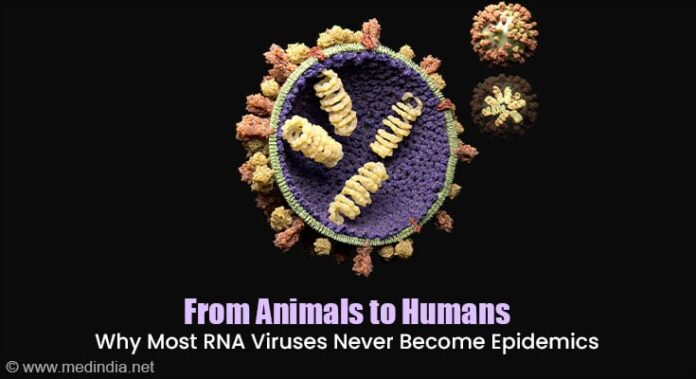
Most human RNA viruses come from mammals, rarely reach epidemic levels; new catalog helps predict which pose future threats.
- 239 RNA virus species now known to infect humans, up 25 from 2018
- 62% of these viruses are strictly zoonotic with no human-to-human spread
- Only 60 species reach epidemic or endemic levels in humans
A total of 239 ribonucleic acid viruses are now known to infect humans, with 25 newly identified species since 2018, offering deeper insight into how these viruses emerge and spread globally(1✔ ✔Trusted Source
A complete catalogue of human-infective RNA viruses
Go to source
).
A review published in the journal Scientific Data presents an updated global catalog that increases the number of known human-infecting ribonucleic acid viruses to 239 species. This updated figure includes 25 additional species compared to 2018, providing improved understanding of viral emergence and transmission patterns.
Instead of appearing randomly, most viruses are grouped within a limited number of families and are commonly associated with non-human hosts, especially mammals. Their detection rates have changed over time due to advancements in taxonomy, reporting systems, surveillance, and sequencing technologies.
Clustering Patterns and Host Associations
Although spillover into humans occurs frequently across the world, only a small proportion of viruses’ progress to epidemic or endemic levels in humans. This indicates a significant barrier between initial exposure and widespread transmission.
Ribonucleic acid viruses continue to pose a growing global health threat, contributing to diseases such as measles, influenza, and acquired immunodeficiency syndrome caused by human immunodeficiency virus.
Recent outbreaks involving Oropouche virus and severe acute respiratory syndrome coronavirus two further highlight their potential to trigger epidemics, while the overall viral landscape continues to evolve rapidly.
Continuous Discovery of New Human Infecting Viruses
New human-infecting virus species are identified almost every year, while classifications are continuously revised and genomic as well as ecological data expand. As more evidence becomes available on transmission patterns, host range, and spread, maintaining an updated catalog becomes essential for monitoring current knowledge and anticipating future risks.
Researchers developed a comprehensive and expanded dataset of ribonucleic acid viruses known to infect humans, incorporating information available through December 2024. This work builds upon earlier catalogs from 2001 and 2018.
Use of Global Surveillance and Genome Data Sources
The dataset was created through systematic literature searches conducted every one to three years using databases such as Web of Science, PubMed, Scopus, and Google Scholar. Additional sources included the World Health Organization, Centers for Disease Control and Prevention, ProMed, and genome records from the National Center for Biotechnology Information.
Only peer-reviewed primary reports were included, ensuring strong evidence that viruses recognized by the International Committee for the Taxonomy of Viruses infect humans under natural conditions. Experimental infections and laboratory-only evidence were excluded.
Integrating Genome Data With Geographic Information
Ambiguities in data were addressed through independent evaluation and consensus among researchers, and missing traits were occasionally inferred from closely related viruses. Species-level data were compiled by integrating information from known subtypes and linking each virus to its first documented human case, genome sequence, and geographic origin.
Key characteristics such as transmissibility, host range, and transmission routes were recorded using standardized criteria. Transmissibility was categorized into Levels two, three, and four, ranging from zoonotic infections without human-to-human spread to viruses capable of causing epidemics or becoming endemic in humans.
The dataset maps both the timing and location of virus discoveries, enabling detailed temporal and spatial analysis. By combining genomic, ecological, and epidemiological data, it offers a strong framework for studying viral diversity, evolution, and public health risks.
The updated catalog includes 239 ribonucleic acid viruses classified by the International Committee for the Taxonomy of Viruses, reflecting 25 additional species since 2018 due to new discoveries and updated classifications.
These viruses belong to 61 genera and 23 families, although most diversity is concentrated within a few groups. Many share common genomic features, particularly single-stranded ribonucleic acid genomes.
Virus discovery increased significantly from the mid-20th century onward, following slow growth in earlier decades. Peaks were observed in the 1960s and early 2000s, although most newly identified viruses extend existing genera and families rather than forming entirely new taxonomic categories.
Global Distribution of First Human Virus Cases
Initial human cases have been reported across all inhabited continents, with clusters appearing in regions that have stronger surveillance systems. This pattern reflects both the widespread nature of viral spillover and the role of detection capacity in identifying new viruses.
From an ecological perspective, most viruses, about 62%, are strictly zoonotic and do not sustain human-to-human transmission.
Transmission Routes and Epidemic Barriers
Only 60 species reach the highest transmissibility level, meaning they can cause epidemics or become endemic in human populations, and many of these still rely on animal reservoirs. Most viruses are linked to non-human mammals, emphasizing their importance in viral emergence.
Transmission pathways vary widely, but vector-borne spread through mosquitoes and ticks is the most common, followed by inhalation and direct contact. Some viruses still have unclear transmission routes, highlighting ongoing gaps in knowledge.
Shift Toward Targeted Surveillance of Viral Threats
The findings suggest a shift toward more focused and proactive approaches to emerging viral threats. Instead of broadly searching for entirely new pathogens, efforts can prioritize high-risk viral families, mammalian hosts, and regions with limited surveillance where unnoticed spillover may occur.
Advances in genomic sequencing, metagenomics, and real-time monitoring are essential to address knowledge gaps, particularly in understanding transmission and host range.
The dataset also supports modeling trends and identifying traits linked to epidemic potential, helping improve early warning systems and risk prediction.
Ultimately, the key challenge lies not only in discovering new viruses but also in determining which are most likely to adapt, spread, and pose future global health risks.
In conclusion, the updated global catalog of 239 human-infective RNA viruses reveals that while spillover from animals is common, only a minority achieve epidemic or endemic spread. The findings point to a more targeted approach for emerging viral threats, emphasizing high-risk families, mammalian reservoirs, and regions with limited surveillance.
Frequently Asked Questions
Q: How many RNA viruses are known to infect humans?
A: A total of 239 species are recognized, which is 25 more than were known in 2018.
Q: Do most RNA viruses spread easily from person to person?
A: No, 62% are strictly zoonotic and cannot sustain human-to-human transmission.
Q: Which animals are most often the source of these viruses?
A: Most RNA viruses infecting humans are associated with non-human mammals.
Q: How do these viruses usually spread to people?
A: Vector-borne spread through mosquitoes and ticks is the most common route, followed by inhalation and direct contact.
Q: Why is this updated catalog important?
A: It helps track known viruses, anticipate future risks, and focus surveillance on high-risk viral families and regions.
References:
- A complete catalogue of human-infective RNA viruses – (https://www.nature.com/articles/s41597-026-07281-5)
Source-Medindia