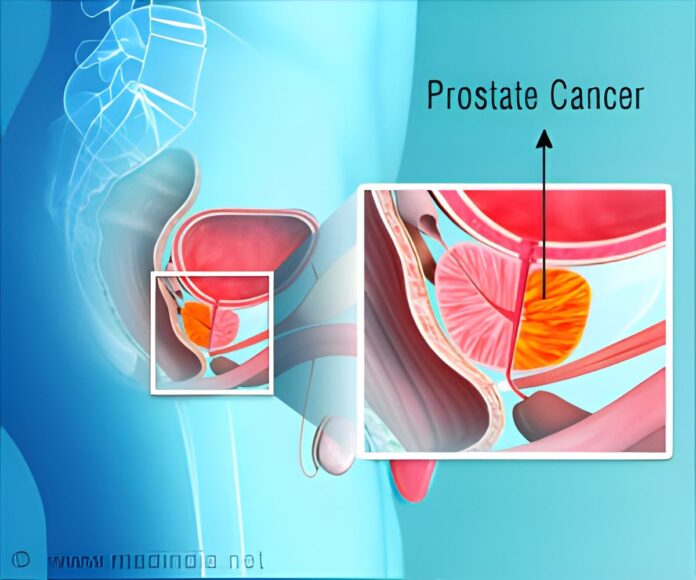
Prostate-Specific Membrane Antigen (PSMA) therapy delays hormone treatment for prostate cancer patients, preventing the cancer spread.
Men with early-stage metastatic prostate cancer may soon be able to postpone the debilitating side effects of hormone therapy through targeted internal radiotherapy.(1✔ ✔Trusted Source
[177Lu]-PSMA-617-PSMA-617 in oligometastatic hormone sensitive prostate cancer (BULLSEYE): an open-label, randomised, phase 2 study
Go to source
)
The precise liquid radiation treatment, known as ‘Prostate-Specific Membrane Antigen’ (PSMA) therapy, effectively halts disease progression and significantly out-performs standard monitoring in preventing disease spread.
While prior research focused on late-stage cases where other treatments had failed, this latest breakthrough from Radboudumc demonstrates how the injectable radioactive drug delivers radiation directly to cancer cells and destroys metastasis.(2✔ ✔Trusted Source
PSMA therapy delays hormone therapy in prostate cancer
Go to source
) The PSMA therapy preserves patient well-being while keeping the disease in check.
By utilizing this groundbreaking nuclear medicine, patients can postpone the significant side effects associated with standard hormone care, such as fatigue and loss of muscle strength, while successfully managing metastasis. This shift in cancer therapeutics marks a major advancement in oncology and precision medicine, offering a better quality of life for thousands of men.
What are the Benefits of PSMA Internal Radiation Therapy for Prostate Cancer Patients?
Each year, approximately 15,000 men in the Netherlands are diagnosed with prostate cancer. Various treatments exist for this condition, including radiation, hormone therapy, and chemotherapy.
A new treatment is irradiating the tumor from within using lightly radioactive PSMA. This therapy shows positive effects in about two out of three patients who have no remaining treatment options: longer survival and improved quality of life.
Researchers investigated in a recent study whether this PSMA therapy also works in an earlier stage of prostate cancer. They used the therapy in cases of limited metastatic prostate cancer, with a maximum of five metastases.
The therapy was administered after targeted radiation or surgery, but before the more burdensome hormone therapy. The study was led by Radboudumc with participation from many other hospitals, including Amsterdam UMC and UMCG.
“More and more men want to avoid hormone therapy because of the unpleasant side effects that can occur,” says Nuclear Medicine Physician and project leader James Nagarajah. These side effects resemble menopausal symptoms, such as hot flashes, loss of muscle strength, and fatigue.
Using PSMA Therapy to Enable Future Targeted Prostate Cancer Radiation
“We therefore wanted to investigate whether PSMA therapy could delay hormone therapy, and whether it might become a suitable alternative in the future.”
A total of 58 men participated in the study. Half received PSMA therapy immediately. The other half, the control group, was treated only when the disease progressed. Normally, the next step would be hormone therapy, but in this study, these men also received PSMA therapy.
The treatment consisted of four sessions. All participants were monitored for at least two years. Among the men who received PSMA therapy, 52% experienced disease progression after 27 months. In the control group, this was 97%. PSMA therapy delayed the need for follow‑up treatments, such as hormone therapy, by an average of twenty months.
The therapy caused few side effects and preserved quality of life. These results are now published in Lancet Oncology. According to the publication’s first author, Bastiaan Privé, PSMA therapy may play a significant role in treating limited metastatic prostate cancer.
“We see that we can postpone more burdensome hormone therapy. In addition, PSMA therapy sometimes reduces the cancer enough for men to become once again eligible for targeted radiation. This may further contribute to delaying hormone treatment in the future.”
References:
- [177Lu]-PSMA-617-PSMA-617 in oligometastatic hormone sensitive prostate cancer (BULLSEYE): an open-label, randomised, phase 2 study – (https://www.thelancet.com/journals/lanonc/article/PIIS1470-2045(25)00762-4/abstract)
- PSMA therapy delays hormone therapy in prostate cancer – (https://www.radboudumc.nl/en/news-items/2026/psma-therapie-stelt-hormoontherapie-bij-prostaatkanker-uit#:~:text=Radiation%20therapy%20again,please%20contact%20your%20treating%20specialist)
Source-Eurekalert