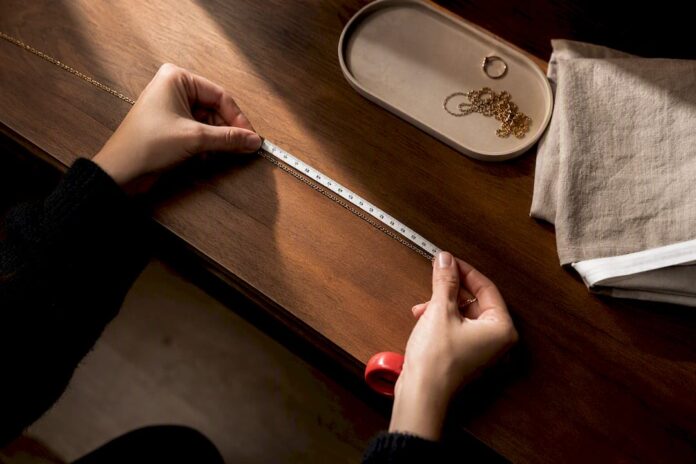
Start with an 18-inch princess chain. It sits at or just below the collarbone and works with almost every neckline, making it the safest default if you’re unsure. To confirm it’s right for you, wrap a tape measure or a piece of string where you want the necklace to fall, then add 2 to 4 inches for comfort or a pendant. Standard lengths run from a snug 14-inch collar up to a dramatic 36-inch-plus rope, so once you know your placement, you can move up or down from there.
TL;DR:
- The standard 18-inch princess chain is the most versatile and universally flattering necklace length, sitting just below the collarbone.
- Necklace lengths are measured including the clasp, so adding 2 to 4 inches is recommended when selecting a chain for comfort or pendants.
- For necklines, longer chains like matinee or opera lengths suit crew necks, v-necks, and formal events, while shorter chains work better with turtlenecks and strapless styles.
- Adjusting necklace length based on body height, bust size, and face shape ensures a better fit and enhances overall appearance.
- An adjustable necklace provides flexibility for different outfits and circumstances, making it the best choice if uncertain about the perfect length.
Table of Contents
Necklace Length Chart: Names, Inches, and Where They Fall
Every necklace length has a name, a rough inch range, and a spot on the body where it’s designed to sit. Once you know these, sizing charts stop looking like a foreign language.
- Collar (14 inches): Sits high and tight at the base of the neck, like a fitted band.
- Choker (16 inches): Rests right at the neck, just above the collarbone.
- Princess (18 inches): Falls at or just below the collarbone, the most universally flattering length.
- Matinee (20–24 inches): Lands at or just above the bust, good for layering under blouses.
- Opera (28–36 inches): Reaches the breastbone or lower, often worn doubled.
- Rope (36+ inches): Falls past the bust, sometimes to the waist, and can be knotted or wrapped.
The princess length of 18 inches is the most common and versatile choice for women’s necklaces, which is exactly why so many jewelers default their product photos to that size. One detail trips people up constantly: the listed length always includes the clasp, not just the visible chain. If you add a pendant, expect the piece to hang lower than the chain length alone suggests, since the drop adds to the overall visual length even though the chain size on the tag doesn’t change.
How to Measure Necklace Length at Home
You don’t need special tools to get this right. A flexible tape measure works best, but a piece of string and a ruler will do the job just as well.
- Tape method: Wrap a soft tape measure around your neck at the exact spot where you want the necklace to sit, then read the number directly in inches.
- String method: Loop a piece of string or ribbon around your neck at that same spot, mark where it overlaps, then lay it flat against a ruler to measure.
- Measuring an existing favorite: Lay a necklace you already love flat and measure end to end, including the clasp, since that’s the number manufacturers use on every size listing.
Once you have that base measurement, adjust it. Add 2 to 4 inches to your neck measurement if you want a pendant to hang free or want extra breathing room. For chokers specifically, leave about one finger’s width of space between the chain and your skin so it doesn’t feel like it’s choking you the moment you sit down.
Pro Tip: If you’re measuring for a gift and can’t ask the recipient to try anything on, go with 18 inches or an adjustable chain. Both are nearly impossible to get wrong.
Which Necklace Length Suits Which Neckline?
The rule stylists come back to again and again: match your necklace to the neckline or contrast it clearly, but avoid a length that stops exactly at the edge of the collar. That in-between spot draws the eye to an awkward point instead of completing the look.
- Crew neck: A matinee (20–24 inches) or longer piece works better than a short chain, which gets swallowed by the fabric.
- V-neck: A pendant that echoes the V shape, typically an 18 to 20 inch chain, follows the line naturally.
- Scoop neck: A choker or princess length fills the open space without disappearing.
- Square neckline: A princess or matinee length contrasts nicely against the straight line.
- Turtleneck: Skip short chains entirely. An opera length (28 inches or longer) sits over the fabric instead of underneath it.
- Strapless: A choker or collar draws attention to the collarbone and shoulders.
- Button-down shirt: A layered look with a shorter chain peeking above the collar and a longer one below tends to read as intentional, not accidental.
For everyday wear, princess and matinee lengths cover the most ground. Save chokers for evening looks and opera or rope lengths for formal events where the drama is the point.
Height, Body Type, and Face Shape Adjustments
Standard charts assume an average frame, so a few quick adjustments help the necklace land where it’s supposed to.
- Taller frames: Add roughly 1 to 2 inches to the standard recommendation, since height changes where a given length visually falls.
- Petite frames: Subtract 1 to 2 inches so the necklace doesn’t overwhelm a smaller torso.
- Bust consideration: Avoid lengths that land right at the fullest part of the bust. Either keep the necklace above it or let it drop clearly below.
- Round faces: Longer pendants create a slimming vertical line.
- Long, slender necks: Chokers and collar lengths look intentional rather than tight, since there’s more neck to showcase.
Layering Rules and Example Combos
Layering looks effortless when the spacing is right and chaotic when it isn’t. The fix is simpler than most people expect.
- Keep at least 2 inches of space between each chain length so the pieces don’t overlap and tangle every time you move.
- Try classic combos like 16 + 18 inches for a subtle layer, or 16 + 18 + 22 inches for a fuller look with more visual range.
- Vary chain width and pendant size across the layers. A thin chain paired with a chunkier one reads as styled, not accidental.
- Mix textures, such as a smooth chain with a beaded one, to reduce tangling and help each piece stay visually distinct.
Buying Checklist and Common Pitfalls
A few minutes checking a product listing before you buy saves a return down the line.
- Confirm the stated length includes the clasp, not just the chain, since most manufacturers measure end to end.
- Check whether the listing includes an extender, which adds flexibility if your first guess is off by an inch.
- Note the pendant drop separately from the chain length if the piece has one.
- Remember that a heavy pendant can pull the whole necklace down an extra 1 to 2 inches once it’s actually being worn.
- When in doubt, default to 18 inches or an adjustable chain, and compare the new piece to a necklace you already own and like.
Pro Tip: Lay a necklace you already love next to the product photo of the one you’re considering. Side-by-side comparison catches sizing mismatches that reading a number on a screen never will.
Why Comfortable, Adjustable Lengths Matter for Wearable Advocacy
Michelle Hammer built the brand on the idea that what you wear can open a conversation most people avoid. That only works if the piece is comfortable enough to wear all day, at a rally, a gallery opening, or just walking through the city. An adjustable chain that shifts from choker to princess length in seconds means one necklace fits into every part of that schedule, and every neck. Comfort and flexibility aren’t afterthoughts here. They’re what makes advocacy wearable in the first place.
— Michelle
Find Adjustable Necklaces and Matching Accessories
Sizing charts only get you so far when the goal is a piece that fits several outfits, several moods, and possibly several people you’re buying for. The brand offers jewelry and accessories built around that same flexibility, so you’re not locked into a single length that might miss the mark. If a fixed-length necklace makes you nervous about gifting, an adjustable design solves that problem outright, since it can move between choker and princess range without a second thought. Pair it with coordinated wearable-art pieces that carry the same mental health advocacy message, whether that’s a mental health awareness tank top or another piece from the collection. Browse the current jewelry and accessory lineup and pick a length that works whether you’re heading to work, a gallery, or a community event.
Sources
FAQ
How Do I Know What Length Necklace to Get?
Measure where you want the necklace to sit using a tape measure or string, then add 2 to 4 inches for comfort or a pendant. If you’re still unsure, 18 inches (princess) fits the widest range of necklines and body types.
Is 16 or 18 Inches Better for Everyday Wear?
An 18-inch princess length works with more necklines and sits comfortably below the collarbone, while a 16-inch choker rests tighter against the neck and suits scoop necks or strapless tops better. For general everyday versatility, 18 inches is the safer pick.
Does a Pendant Change the Necklace Length I Need?
Yes. A heavy or long pendant can pull the chain down by an extra 1 to 2 inches once worn, so size up slightly if you want the pendant to land at a specific point on your chest.
What’s the Simplest Rule for Layering Necklaces?
Keep at least 2 inches of space between each chain length, such as 16 and 18 inches or 16, 18, and 22 inches together, so the pieces hang at distinct levels instead of tangling.
Should I Buy an Adjustable Necklace If I’m Not Sure of My Size?
An adjustable chain removes most of the guesswork, since it can shift between choker and princess range depending on the outfit or occasion, making it a practical choice for gifting or everyday variety.
Recommended
Comments