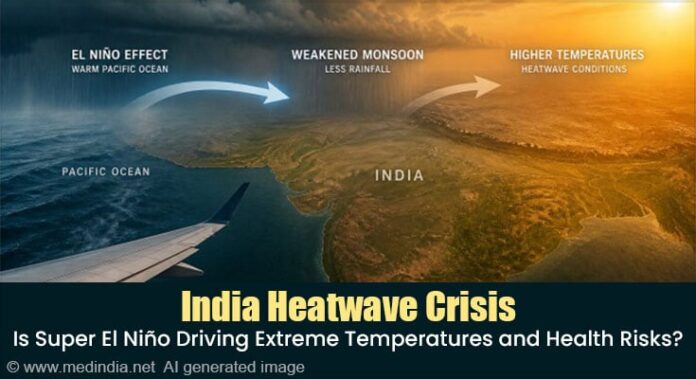
India’s ongoing heatwave is becoming more severe than usual, with experts warning that a possible Super El Niño could intensify heat stress, health risks, and climate instability.
- India is witnessing extreme temperatures above 47°C, possibly linked to a developing Super El Niño
- El Niño conditions can weaken monsoon rainfall and increase drought and heat risks across India
- Heatwaves are raising risks of dehydration, heatstroke, and heart-related complications, even in young adults
India is facing an intense and unusual heatwave this year, with temperatures already crossing 47°C in several regions and expected to climb even higher.
While heatwaves are not new to the country, experts say this situation feels different. The possible emergence of a
At the same time, scientists are debating whether a “heat dome” over northern India is also contributing.
With rising heat stress, increasing health risks, and warnings from authorities like the India Meteorological Department and the World Meteorological Organization, the situation is becoming a growing public health and climate concern (1✔ ✔Trusted Source
WMO: Likelihood increases of El Niño
Go to source).
Is India Entering a Super El Niño Phase?
A Super El Niño is an extreme version of the El Niño climate cycle, which happens every two to seven years when ocean temperatures in the Pacific Ocean rise significantly. This warming disrupts global weather systems, often leading to higher temperatures and irregular rainfall.
Scientific research published in the Global and Planetary Change shows that El Niño events can significantly weaken India’s monsoon system, with rainfall deviations of up to 26% in some regions, increasing the risk of drought-like conditions (5✔ ✔Trusted Source
Impact of El Niño onset timing on Indian Monsoon Rainfall patterns
Go to source).
According to the World Meteorological Organization, climate models now strongly suggest that El Niño conditions are likely to develop by mid-2026, with a possibility of becoming a strong event. This could lead to widespread warming across land surfaces globally.
In India, the India Meteorological Department has not officially confirmed a full El Niño phase yet, but current conditions are already showing similar patterns. Government forecasts also indicate that monsoon rainfall in 2026 could fall below normal, with estimates around 92% of the long-period average, partly due to developing El Niño conditions (2✔ ✔Trusted Source
Long Range Forecast For the 2026 Southwest Monsoon Season Rainfall
Go to source).
Why Is India Experiencing Such Extreme Heat Right Now?
Temperatures in India have already crossed dangerous levels early in the season. Reports suggest that out of the 100 hottest cities globally, around 95 are in India, making it one of the most heat-affected regions right now (3✔ ✔Trusted Source
Severe Heatwave grips India with 95 of World’s Hottest Cities reportedly located in country
Go to source
).
However, experts are divided on the exact cause. Some believe that the heat is linked to El Niño-like conditions, while others point to an anti-cyclonic system, often called a “heat dome.” This occurs when high-pressure air traps heat over a region, preventing it from escaping and causing temperatures to rise continuously.
At the same time, long-term climate trends are worsening the situation. A study by the Council on Energy, Environment, and Water shows that extreme heat events in India have increased steadily over the past four decades, with over 57% of districts now facing high to very high heat risk (4✔ ✔Trusted Source
How Extreme Heat is Impacting India
Go to source).
Urbanization, reduced green cover, and expanding concrete infrastructure are also trapping heat, especially at night, making it harder for the body to recover from daytime exposure.
Can Heatwaves Trigger Heart Attacks in Young Adults?
One of the most worrying aspects of this heatwave is its impact on heart health, especially among younger people.
Doctors report a noticeable rise in cardiac events during extreme heat. When the body is exposed to high temperatures, it tries to cool down by widening blood vessels. This forces the heart to pump harder. At the same time, dehydration thickens the blood, increasing the risk of clot formation—a major cause of heart attacks.
Experts also point out that heart disease is no longer limited to older adults. In India, nearly one in five cardiac deaths globally occur, and cardiovascular diseases account for about 25% of all deaths in the country.
A contributing factor is the “thin fat” phenomenon, in which individuals may appear lean but carry high levels of internal fat, increasing their vulnerability to heart disease.
Is the Heatwave Making People Across India Fall Sick?
Yes, and the impact is widespread.
Extreme heat is not just uncomfortable—it can be dangerous. It increases the risk of:
- Heatstroke
- Severe dehydration
- Respiratory issues
- Vector-borne diseases like dengue and malaria
Health experts warn that during intense heat, the body loses fluids and essential salts through sweating. This imbalance can lead to fatigue, dizziness, and even serious complications like strokes or cardiac arrest.
The situation becomes worse when the humidity rises. Research shows that high humidity prevents sweat from evaporating effectively, making it harder for the body to cool itself and increasing heat stress.
What Is the Government Doing to Handle This Crisis?
Authorities in India have started taking preventive measures to deal with the growing heat threat.
The Ministry of Health and Family Welfare has advised states and Union Territories to:
- Set up heatwave management units
- Issue early warnings
- Track heatstroke cases in real time
Meanwhile, the India Meteorological Department continues to release advisories urging people to stay hydrated, avoid peak heat hours (12 pm to 5 pm), and take precautions during prolonged exposure.
Heatwaves are now also being recognized as a serious disaster risk. Studies highlight that these events can strain healthcare systems, increase electricity demand, reduce water availability, and even impact economic productivity.
In fact, research suggests that extreme heat could significantly affect livelihoods, agriculture, and overall economic output if not addressed with stronger adaptation strategies.
The Bottom Line
India’s current heatwave is not just another summer—it reflects a deeper shift driven by climate patterns like El Niño, combined with local factors such as urbanization and environmental stress.
Whether this evolves into a full Super El Niño or remains a heat dome-driven event, the risks are clear: rising temperatures, increasing health emergencies, and growing pressure on infrastructure.
As experts and agencies like the India Meteorological Department and World Meteorological Organization continue to monitor the situation, one thing is certain—India must prepare for more frequent and intense heatwaves in the years ahead.
Frequently Asked Questions
Q: Is the current heatwave in India caused by Super El Niño?
A: Not entirely confirmed yet. Experts say current conditions resemble El Niño effects, but some also attribute the heat to a “heat dome” system trapping hot air. However, global forecasts suggest El Niño may develop in 2026.
Q: What is a Super El Niño and why is it important for India?
A: A Super El Niño is a stronger-than-usual warming of ocean waters in the Pacific Ocean that disrupts global weather patterns. For India, it often means higher temperatures and weaker monsoon rainfall, increasing the risk of drought and heatwaves.
Q: How does extreme heat affect the human body?
A: Extreme heat forces the body to work harder to cool itself. This can lead to dehydration, heat exhaustion, and heatstroke. It also puts stress on the heart, increasing the risk of heart attacks and strokes.
Q: Why are younger people also at risk during heatwaves?
A: Heatwaves can affect anyone, including young adults. Factors like dehydration, stress, poor lifestyle habits, and hidden fat accumulation (“thin fat”) can increase the risk of heart-related complications even in younger individuals.
Q: What precautions should people take during extreme heat?
A:
- Drink 2-3 litres of water daily
- Avoid going out between 12 pm and 5 pm
- Wear light, breathable clothing
- Maintain electrolyte balance
- Seek medical help if symptoms like dizziness or fatigue appear
References:
- WMO: Likelihood increases of El Niño – (https://wmo.int/media/news/wmo-likelihood-increases-of-el-nino)
- Long Range Forecast For the 2026 Southwest Monsoon Season Rainfall – (https://www.pib.gov.in/PressReleasePage.aspx?PRID=2251594®=3&lang=2)
- Severe Heatwave grips India with 95 of World’s Hottest Cities reportedly located in country – (https://www.newsonair.gov.in/severe-heatwave-grips-india-with-95-of-worlds-hottest-cities-reportedly-located-in-country/)
- How Extreme Heat is Impacting India – (https://www.ceew.in/publications/mapping-climate-risks-and-impacts-of-extreme-heatwave-disaster-in-indian-districts)
- Impact of El Niño onset timing on Indian Monsoon Rainfall patterns – (https://www.sciencedirect.com/science/article/abs/pii/S0921818124003369)
Source-Medindia