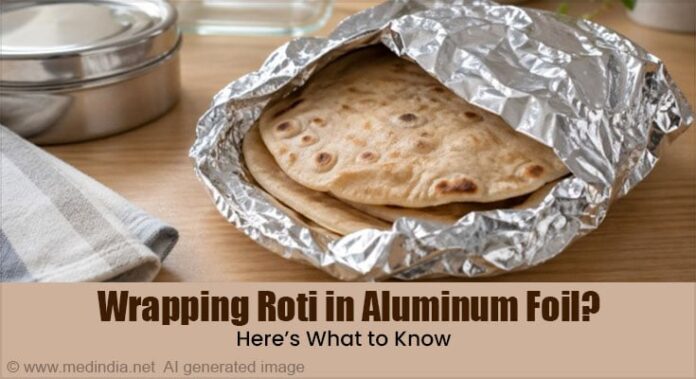
Heat and food composition can increase aluminum transfer from foil to food. Evidence supports cautious use for hot food storage.
- Hot roti wrapped in aluminum foil may increase aluminum migration due to heat and moisture
- Salty or spicy foods can further increase aluminum transfer from foil
- Most absorbed aluminum is eliminated via kidneys in healthy individuals
Wrapping hot roti in aluminum foil is a common kitchen practice, but laboratory-based studies show that this can increase aluminum levels in food under certain conditions (1✔ ✔Trusted Source
Effect of an aluminum foil-processed diet on internal human aluminum burden
Go to source
).
Research measuring food prepared or stored in foil has reported higher aluminum concentrations when exposed to heat, acidic or salty foods, and longer contact duration. These findings reflect measurable exposure, not proven health harm, but highlight a preventable source of dietary aluminum.
What Research Shows About Aluminum Migration in Hot Roti
Experimental studies on food-contact materials, including those in Food Additives & Contaminants and Food Science & Nutrition, demonstrate that aluminum migration increases under specific conditions (2✔ ✔Trusted Source
Aluminum contamination of food during culinary preparation: Case study with aluminum foil and consumers’ preferences
Go to source
).
- Higher temperature significantly increases aluminum release
- Acidic and salty foods enhance leaching into food
- Longer contact time leads to higher measured aluminum levels
In controlled experiments, foods cooked or stored in aluminum foil showed a measurable rise in aluminum content compared to baseline levels.
Measured Exposure Does Not Equal Proven Health Risk
Current scientific evidence focuses on exposure levels rather than direct disease outcomes.
Studies confirm that aluminum intake can increase when foil is used with hot and reactive foods. However, no direct causal link has been established between typical dietary exposure and health disorders.
Regulatory assessments indicate that most individuals remain within safe intake limits under normal usage conditions (3✔ ✔Trusted Source
EFSA Advises on the Safety of Aluminium in Food
Go to source).
How the Body Processes Aluminum Intake
Only a small fraction of ingested aluminum is absorbed in the body. Most passes through the digestive system unabsorbed. The absorbed portion is eliminated mainly through the kidneys, maintaining low levels in healthy individuals.
Higher accumulation is typically seen only with prolonged exposure or in individuals with impaired kidney function.
Potential Concerns with Repeated or Improper Use
Frequent use of foil with hot, acidic, or salty foods may increase cumulative aluminum intake. While still generally within safety thresholds, minimizing unnecessary exposure is considered a precautionary food safety practice.
Food Storage Risks Beyond Aluminum Exposure
Aluminum foil does not provide an airtight seal, which can affect safe food storage.
Food kept between 5°C and 60°C falls within the temperature danger zone, where bacterial growth may occur.
Keeping hot roti wrapped in foil at room temperature for extended periods may therefore increase microbial risk.
Do’s and Don’ts for Using Aluminum Foil with Roti
| Do’s | Don’ts |
|---|---|
| Use aluminum foil for short-term wrapping only | Avoid wrapping very hot roti immediately |
| Let roti cool slightly before wrapping | Do not store roti in foil for long durations |
| Transfer to glass or steel containers for storage | Avoid using foil with acidic or salty foods |
| Refrigerate if not consumed soon | Do not keep foil-wrapped roti at room temperature for long |
| Use foil as a temporary covering | Avoid frequent use for daily hot food storage |
What This Means for Everyday Roti Storage
Aluminum foil can increase metal migration into food when used with hot or reactive items like fresh roti. However, current evidence does not show harm from occasional use in healthy individuals (4✔ ✔Trusted Source
Aluminium in foodstuff and the influence of aluminium foil used for food preparation or short time storage
Go to source
).A practical approach is to avoid prolonged contact between hot food and foil. Using alternatives such as glass or stainless-steel containers may help reduce unnecessary exposure while improving food safety.
Frequently Asked Questions
Q: Does wrapping hot roti in aluminum foil increase aluminum exposure?
A: Yes, laboratory studies show increased aluminum migration under heat and certain food conditions.
Q: Is aluminum from foil harmful to health?
A: Current evidence shows increased exposure but does not confirm harm at typical dietary levels.
Q: Why do heat and salt increase aluminum transfer?
A: They enhance chemical reactions between foil and food, increasing metal release.
Q: How does the body remove aluminum?
A: Most absorbed aluminum is eliminated through the kidneys in healthy individuals.
Q: Should aluminum foil be avoided for hot food storage?
A: Evidence suggests limiting prolonged use with hot or reactive foods to reduce exposure.
References:
- Effect of an aluminum foil-processed diet on internal human aluminum burden – (https://www.sciencedirect.com/science/article/pii/S0160412023002738)
- Aluminum contamination of food during culinary preparation: Case study with aluminum foil and consumers’ preferences – (https://pmc.ncbi.nlm.nih.gov/articles/PMC6804775/)
- EFSA Advises on the Safety of Aluminium in Food – (https://www.efsa.europa.eu/en/news/efsa-advises-safety-aluminium-food)
- Aluminium in foodstuff and the influence of aluminium foil used for food preparation or short time storage – (https://www.tandfonline.com/doi/abs/10.1080/19393210.2018.1442881)
- Special Focus – Aluminium Foil – (https://www.alufoil.org/aluminium-foil-and-health)
Source-Medindia