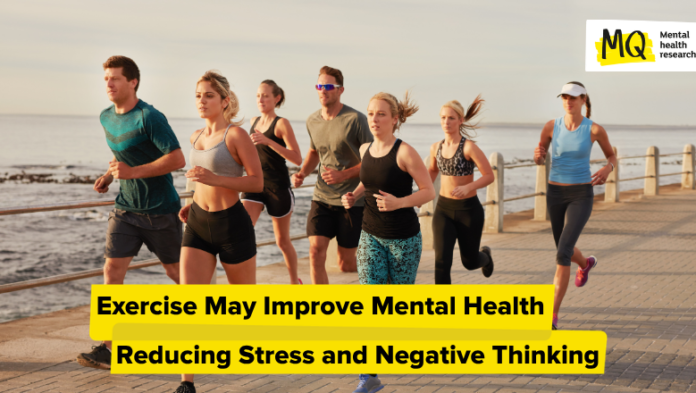
New research suggests that exercise may improve symptoms across several mental health conditions by reducing perceived stress and repetitive negative thinking.
Understanding how exercise affects mental health
Exercise is increasingly recognised as a way to support both physical and mental health. Research has shown that physical activity can reduce symptoms associated with conditions including depression, anxiety, post-traumatic stress disorder and insomnia. However, researchers are still working to understand exactly how exercise produces these benefits.
A new study published in Psychological Medicine suggests that two factors may be particularly important: how much stress people perceive in their lives and how often they experience repetitive negative thoughts.
Studying exercise across different conditions
The researchers conducted a secondary analysis of data from the ImPuls trial, which involved 400 physically inactive people experiencing major depressive disorder, agoraphobia, panic disorder, PTSD or insomnia.
Participants were randomly assigned either to receive standard treatment alongside an exercise programme, or standard treatment alone. The exercise programme involved supervised group sessions and 30 minutes of moderate-to-vigorous aerobic exercise, such as outdoor running, two to three times a week.
After four weeks of supervised exercise, participants were encouraged to continue exercising independently for a further five months.
The researchers assessed participants’ overall mental health symptoms, perceived stress, repetitive negative thinking and sleep quality at the beginning of the study and again after six and 12 months.
Stress and negative thinking may be key
After six and 12 months, participants who took part in the exercise programme reported significantly lower levels of perceived stress and repetitive negative thinking than those in the control group.
However, the exercise programme did not significantly improve sleep quality. The researchers suggest this may be because previous evidence for exercise improving sleep is stronger for depression than for some of the other conditions included in the study, such as PTSD and anxiety disorders.
The researchers then examined whether changes in stress, negative thinking and sleep could explain the overall effect of exercise on mental health symptoms.
They found that reductions in perceived stress and repetitive negative thinking fully explained the relationship between the exercise programme and improvements in overall symptom severity.
“Our results suggest that changes in perceived stress and repetitive negative thinking may be key transdiagnostic mechanisms underlying the treatment effect of exercise on global symptom severity,” the study authors concluded.