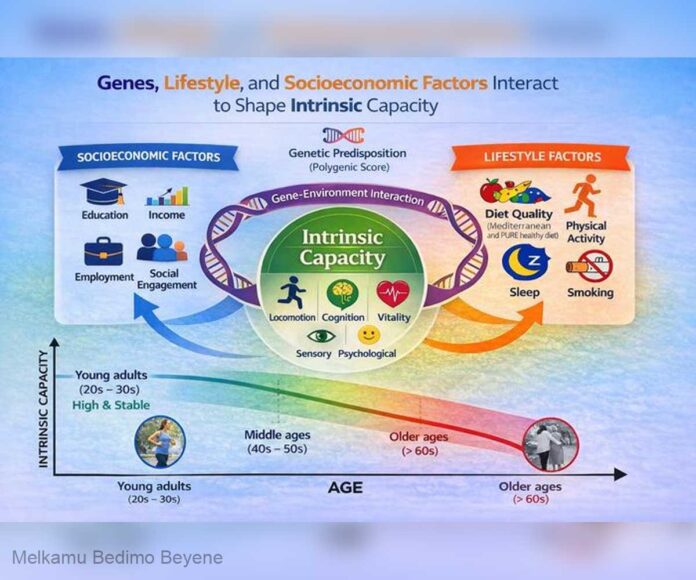
Live Smarter, Age Better: Genes and lifestyle factors like diet, sleep, exercise, and education all work together to shape how well we age and how healthy we stay throughout life.
Aging well is a lifelong equation of genes and habits.
Lifestyle habits and socioeconomic status are important for healthy ageing, but their impact can vary depending on your genes, reports a new international study led by Adelaide University researchers.
Lifestyle Habits + Genes = How You Age
The study is the first of its kind to show that diet quality, physical activity, sleep, smoking, education, employment and social engagement all influence how we age, with the effects varying based on a person’s genetic predisposition.
The findings of the study are published in The Journals of Gerontology: Biological Sciences (1✔ ✔Trusted Source
Associations and interaction effects of socioeconomic, lifestyle, and genetic factors on intrinsic capacity
Go to source).
Intrinsic Capacity: The Secret Behind Aging Well
Researchers focused on a key indicator of healthy aging, “intrinsic capacity”, which represents the composite of all physical and mental capacities drawn upon throughout life. This enables individuals to maintain healthy functioning and perform daily tasks, such as personal care, household and living tasks, and communication and social engagement activities.
Using data gathered from more than 13,000 participants in the Canadian Longitudinal Study on Ageing (CLSA), they found that healthier aging (i.e. higher intrinsic capacity) was associated with greater physical activity, a better diet, higher educational attainment, employment and social engagement.
In contrast, lower intrinsic capacity – or reduced functionality with age – was associated with smoking and suboptimal sleep duration, including both shorter and longer than recommended sleep.
“Intrinsic capacity, a proxy indicator of healthy aging, is influenced by a complex interplay between genetics and modifiable socioeconomic and lifestyle factors,” said senior author Associate Professor Azmeraw Amare, who is a researcher at Adelaide University’s School of Medicine.
Healthy Aging: It’s a Mix of Habits and Heredity
“Our findings suggest that genetic predisposition can shape how strongly socioeconomic status and lifestyle-behavioural factors influence intrinsic capacity, highlighting the gene–environment interplay underlying healthy aging.”
Sleep Smart, Age Better
Both short and long sleep duration were found to be detrimental to healthy aging. The negative effect of short sleep was reduced among individuals with a genetic advantage (higher genetic loading for intrinsic capacity). In contrast, the negative effect of long sleep for middle-aged people (ages 45–64 years) was more pronounced, although they had a higher genetic predisposition for intrinsic capacity.
Healthy Diet + Good Education = Longevity
Following a Mediterranean-type diet and higher educational attainment were highly advantageous for healthy longevity, with sustained benefits even among individuals with lower genetic predisposition to intrinsic capacity.
What Matters More with Age: Genes or Lifestyle?
“The genetic effects were more evident in midlife than in later life, suggesting that accumulated lifestyle and social exposures may play an increasingly important role in determining functional ability as people age,” said first author Melkamu Bedimo Beyene, a Ph.D candidate at Adelaide University’s School of Medicine.
This is the first study to identify how the interactions between genes and modifiable lifestyle factors, such as diet quality, level of education and sleep duration, are linked to intrinsic capacity.
“The good news is that some of these factors are modifiable. Our research findings can help to design more targeted prevention and health promotion approaches for healthy aging,” said Adelaide University Professor Renuka Visvanathan, who is an expert in Geriatric Medicine.
“By focusing on maintaining functional ability rather than waiting for disease to develop, we can better support independence and quality of life across adulthood and later life.”
The team now plans to evaluate clinical and public health strategies targeting modifiable lifestyle factors, and hope this will promote healthy longevity and earlier intervention to prevent functional decline.
“Uncovering how healthy aging trajectories are shaped across the life course by both biology and lifetime exposures is essential for developing policies that support functional ability in older adults,” said Professor John Beard, Irene Diamond Professor of Productive Aging at Columbia University.
Reference:
- Associations and interaction effects of socioeconomic, lifestyle, and genetic factors on intrinsic capacity – (https://academic.oup.com/biomedgerontology/article/81/4/glag057/8495119)
Source-Eurekalert