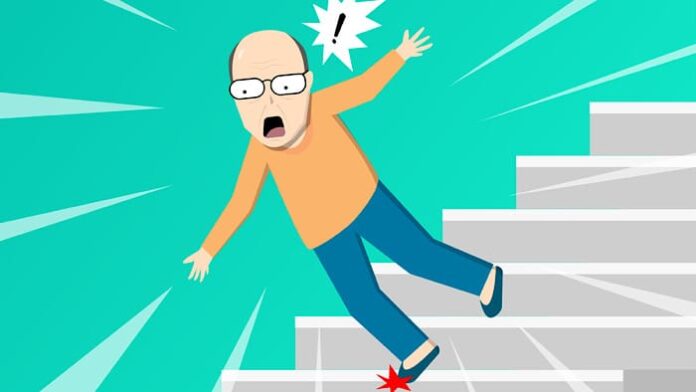
Like thousands of times before, I put my foot on the first of four steps. Contrary to those thousands of times, I looked for a handrail. When I didn’t see one, a loop video of me falling began playing in my head. My response: “Oh no, fear of falling — another phobia?”
Climbing a few stairs shouldn’t require the same nerve as walking a tightrope. NeuroLaunch
Introduction
I began having worsening gait issues three years ago. At times, it felt like my right leg was going to give out — and down I’d go. I was diagnosed with osteoarthritis in my hip, which, of course, called for hip replacement surgery (which, of course, I haven’t had).
it’s gotten to the point where I’m experiencing the “What if’s?” and thoughts of avoidance when I need to be out and about. And my history of generalized anxiety disorder and panic disorder with agoraphobia tells me the phobia version of fear of falling is on premise — and I’d better get to work.
NeuroLaunch
During a recent topic search, I bumped into an article that for obvious reasons immediately hit home. “Phobia of Falling: Causes, Symptoms, and Treatment Options” appeared on NeuroLaunch.
I’ve been spending more and more time there. NeuroLaunch is a psychology and brain science site, so you’ll always find interesting information on topics such as neurodiversity, understanding the mind — and, go figure, fear of falling.
I’m using the NeuroLaunch piece as our primary info source. It’s loaded with insightful and helpful information — so much that I can’t accommodate all of it. That’s why I linked to the article below.
Let’s get after it…
What is fear of falling?

Fear of falling most often meets diagnostic criteria for a specific phobia. But it can be a symptom of a diagnosed condition.such as a balance impairment.
It makes sense that fear of falling affects 20-85% of older adults who’ve previously fallen. But if you’re at all familiar with the goofy twists of phobias, you’ll have no problem believing it can also strike younger people who’ve never fallen.
The folks at NeuroLaunch refer to fear of falling as the phobia of falling. Clinically, it’s known as basophobia (in Spanish, “baso” is a form of the verb “basar,” meaning “to base” or “to ground on”) and categorized as a specific phobia in the ICD-10-CM and the DSM-5-TR.
The primary identifying feature of fear of falling is an intense, persistent fear of falling that goes far beyond ordinary caution on stairs or icy sidewalks. If you’ve experienced fear of heights, confined spaces, or public speaking, you know how intense the fear can be.
The NeuroLaunch team nailed it with this observation…
Climbing a few stairs shouldn’t require the same nerve as walking a tightrope.
There are exceptions
They also point out that fear of falling doesn’t always meet the formal diagnostic criteria for a specific phobia. Sometimes it’s a symptom of, say, a broader anxiety disorder or a consequence of a balance impairment.
Keep in mind, a specific phobia has to include a marked, persistent fear that’s disproportionate to actual danger, lasts six months or longer, and causes real interference with daily functioning.
Does fear of falling overlap with anxiety disorders?
Given my vast personal experience with anxiety disorders, seemingly everything — including the kitchen sink — overlaps with them. But, yes, clinically, fear of falling as a symptom frequently overlaps with anxiety disorders, The physical symptoms, racing heart, shallow breathing, trembling, muscle tension, are identical to what happens during any anxiety response.
Fact: the brain’s threat-detection system, centered in the amygdala, treats a wobbly step the same way it would treat a genuine emergency.
As you may imagine, the fear of falling package resembles agoraphobia symptoms and avoidance behaviors. After all, both involve avoiding situations where losing control or being unable to escape feels catastrophic.
How do you overcome a fear of falling?
I’ll say right from the get-go that believing you can overcome fear of falling — even if you don’t know how yet — is always the first order of business.
And a complete cessation of misery isn’t the goal. I’ve learned that as long as I’m giving recovery all I have, I take the measure of relief I’m given.

“This isn’t about gritting your teeth and hoping the fear disappears. It’s a specific, staged process.”
Okay, according ti the NeuroLaunch crew, the most effective way to overcome a fear of falling combines cognitive-behavioral therapy with gradual, structured exposure to feared situations. It’s often paired with physical balance training when there’s an underlying mobility component.
Another NeuroLaunch gem…
This isn’t about gritting your teeth and hoping the fear disappears. It’s a specific, staged process.
How it works
Cognitive-behavioral therapy helps identify and challenge the catastrophic thoughts driving the fear, the automatic leap from “I feel unsteady” to “I am about to fall and get seriously hurt.”
Exposure therapy then puts that recalibration into practice, starting with low-stakes situations (standing on a low step) and building toward harder ones (walking down a full flight of stairs unaided) over weeks or months.
Virtual reality exposure has shown strong results across anxiety disorders and specific phobias, letting people practice feared scenarios in a controlled environment before facing them in real life.
Other considerations
For older adults or anyone with an actual balance impairment, physical therapy and structured balance training address the physical side of the equation, building genuine stability that makes the fear less accurate — not just less loud.
Medication (benzodiazepines/antidepressants) may be used to reduce baseline anxiety symptoms. For the long-term, medication should be considered only with therapy.
When to seek professional help

Professional help is there for the taking. Don’t be hesitant or feel undeserving.
Never, ever feel embarrassed or ashamed for reaching out for help. Fear of falling deserves professional attention when it starts dictating choices, rather than just being occasionally worrying. Specific signs worth acting on include…
- Avoiding stairs, ladders, uneven ground, or leaving the house altogether because of the fear
- Panic attacks, racing heart, or a sense of impending doom triggered by ordinary movement
- Turning down social events, jobs, or family occasions specifically because of the fear
- Symptoms lasting six months or longer and interfering with daily functioning
The NeuroLaunch crew submit that seeing a primary care doctor is a reasonable first stop, particularly to rule out or address a genuine balance or vestibular issue. A referral to a psychologist or therapist experienced in treating specific phobias, ideally one who uses cognitive-behavioral therapy or exposure-based approaches, is the most well-supported next step.
Older adults or anyone with a history of falls should also ask about a physical therapy evaluation alongside psychological care.
Crisis time?
It’s not unusual for thoughts of hopelessness, self-harm, or an inability to function day to day to accompany fear of falling. If any of them present, it’s time for immediate action (family members and close friends need to know and be ready to act).
Contact with a member of one’s treatment team, a call or text to the 988 Lifeline (U.S), dialing 911, a trip to the closest ER are excellent options.
It ain’t over until you say it is
I was totally caught off guard by the onset of a fear of falling. But I feel fortunate because my anxiety and panic history allowed me to understand what was going on fairly quickly — and get after it.
If you’re experiencing, or suspect you’re experiencing, a fear of falling — any specific phobia — reach out for help now. It ain’t over until you say it is.
As mentioned earlier, I can’t anccommodate all of the original material, So be sure to check out the full article on NeuroLaunch: “Phobia of Falling: Causes, Symptoms, and Treatment Options.” And do some exploring while you’re there — lots of interesting info.
Yep, go ahead and peruse the Chipur emotional and mental illness info and inspiration titles on the articles page — or by category below, right sidebar on desktop. We’ll both appreciate it.

After a decades-long wrestling match with emotional and mental illness, Bill finally found his professional and personal passion – life’s meaning. He wanted to lend a hand to those struggling as he did, so off he went to grad school at age 49 and earned his counseling credentials. He continues his service through Chipur and other projects.