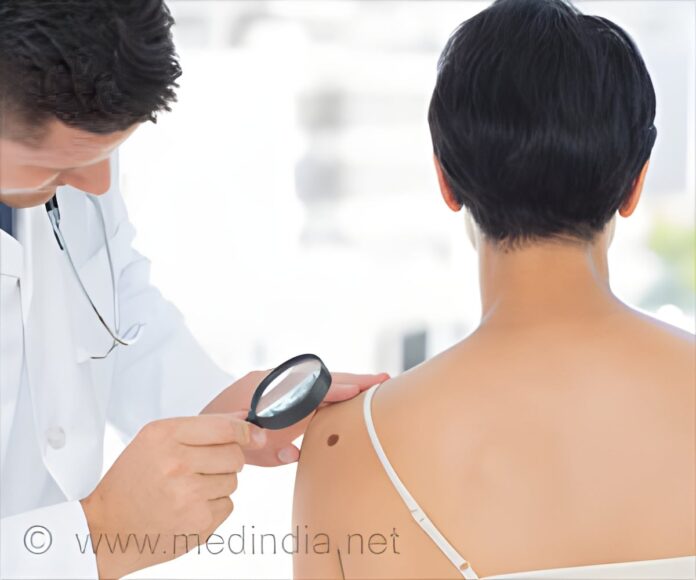
Can artificial intelligence (AI) spot skin cancer risk in routine health records? Yes, AI can use routinely collected healthcare data to help identify people at higher risk of melanoma (skin cancer).
Is artificial intelligence (AI) better at detecting skin cancer risk?
AI-driven analysis of large-scale healthcare data improves melanoma risk prediction, enabling personalized screening and early skin cancer detection strategies, according to a new study.
Can AI Predict Melanoma Risk Using Routine Health Records?
This study used routinely collected data from national records covering all adults in Sweden. It included details such as age, gender, health conditions, medications, and socioeconomic background. Among the 6,036,186 people studied, 38,582 (0.64%) developed melanoma over a five-year period.
The findings of the study are published in the journal Acta Dermato-Venereologica (1✔ ✔Trusted Source
Predicting Melanoma Impact on the Swedish Healthcare System from the Adult Population Using Machine Learning on Registry Data
Go to source).
How Registry Data Can Help Detect High-Risk Melanoma Patients
Martin Gillstedt was responsible for much of the analysis:
“Our study shows that data which is already available within healthcare systems can be used to identify individuals at higher risk of melanoma,” says Martin Gillstedt, a doctoral student at the University of Gothenburg’s Sahlgrenska Academy and a statistician at Sahlgrenska University Hospital’s Department of Dermatology and Venereology. “This is not a form of decision support that is currently available in routine healthcare, but our results give a clear signal that registry data can be used more strategically in the future.”
AI Identifies 33% Melanoma Risk
When the researchers compared different AI models, the differences became clear. The most advanced model was able to distinguish individuals who subsequently developed melanoma from those who did not in about 73% of cases, compared with about 64% when only age and sex were used. The combination of diagnoses, medications and sociodemographic data made it possible to identify small, high-risk groups for whom the risk of developing melanoma within five years was around 33%.
Targeted Screening for Skin Cancer Could Boost Early Detection
The study was led by Sam Polesie, Associate Professor of Dermatology and Venereology at the University of Gothenburg and a dermatologist at Sahlgrenska University Hospital:
“Our analyses suggest that selective screening of small, high-risk groups could lead to both more accurate monitoring and more efficient use of healthcare resources. This would involve bringing population data into precision medicine and supplementing clinical assessments.”
Future Skin Cancer Screening May Rely on AI Risk Models
The researchers emphasize that more research and policy decisions are needed before the method can be introduced in healthcare. However, the results show that AI models trained on large amounts of registry data can become an important source of support for more personalized risk assessments and future screening strategies for melanoma.
Thus, AI could become a key tool in future melanoma prevention strategies.
Reference:
- Predicting Melanoma Impact on the Swedish Healthcare System from the Adult Population Using Machine Learning on Registry Data – (https://medicaljournalssweden.se/actadv/article/view/44610)
Source-Eurekalert