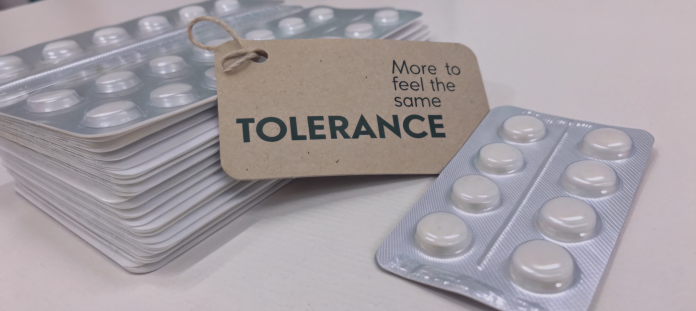
Bipolar medication may work well for months or years and then seem to lose its effect. People often call this “medication tolerance” or say they have become “immune” to the drug. I know how frustrating this is. You’re going along, things seem to be fine, the medication is working, and then, bam, out of nowhere, an episode hits. Medication tolerance is one explanation, but there are others as well. Let’s take a look at medication tolerance evidence, mood episode recurrence, and the likelihood of you staying in remission.
Tolerance Article Sections
- What Is Medication Tolerance in Bipolar Disorder?
- How Common Is Medication Tolerance in Bipolar Disorder?
- Why Do Bipolar Medications Stop Working?
- Which Bipolar Medications Are Most Likely to Stop Working?
- What Should You Do When a Bipolar Medication Stops Working or Seems Less Effective?
- TL;DR
What Is Medication Tolerance in Bipolar Disorder?
Medication tolerance means that repeated exposure to a drug produces a smaller effect from the same dose. Your body needs more of the drug for you to feel the same effect. We see this with street drugs all the time. The first time you take cocaine is never like the 10th time. Tolerance is both complicated and dangerous.1
In depression research, a related term is antidepressant tachyphylaxis: the return of depressive symptoms during continued treatment with an antidepressant that previously worked. This phenomenon is sometimes informally called antidepressant “poop-out.”
Tolerance should not be confused with these medication situations:
- Treatment resistance: This is when a medication never produces an adequate response.
- Relapse or recurrence: This is when symptoms return after a period of improvement. (Tolerance can play a role here.)
- Withdrawal: This is when symptoms develop after a medication is reduced or stopped.
- Rebound: This is when the original symptoms return temporarily, sometimes more intensely, after medication discontinuation. (This is commonly seen with sleeping medications, among others.)
Researchers do not always separate these phenomena consistently. That is one reason estimates of psychiatric medication tolerance vary so widely.
How Common Is Medication Tolerance in Bipolar Disorder?
True tolerance is neurochemical. It is your body compensating for the drug such that it no longer has the same effect. We know this happens with many (maybe all?) drugs. However, without a better window into the brain, we can’t really measure this. We can only look at what appears to be tolerance. Most studies measure recurrence, reduced response across successive treatment trials, or failure to respond after stopping and restarting a medication. None of these automatically proves that the brain has become tolerant.
The strongest bipolar-specific evidence involves antidepressants in bipolar II depression.
- In a 2016 study of 129 people, each previous antidepressant trial was associated with 25% lower odds of responding and 32% lower odds of remission during treatment with venlafaxine or lithium.
- A 2018 exploratory study of 148 people treated with fluoxetine found that each additional previous adequate antidepressant trial was associated with 25% lower odds of response and 22% lower odds of remission.
As I mentioned, this is evidence that tolerance may be taking place, but it’s not conclusive.2
Research in major depressive disorder finds highly variable rates of antidepressant tachyphylaxis. A 2019 review reported estimates ranging from approximately 9% to 57%, depending on how loss of response was defined, the population studied, the medication, and the length of follow-up.
Lithium provides another useful—but different—statistic. A 2024 review covering 403 patients found that 3.6% to 27.7% did not respond adequately when lithium was restarted after discontinuation, with an average of 17.3%. This phenomenon is called lithium-discontinuation-induced treatment refractoriness. This is not the only study to illustrate this issue, and lithium is not the only medication to show it either.
I think this is extremely important to understand because it means that even if lithium or an antidepressant works for you today, if you stop and restart it, it may not work for you tomorrow. Consider this before discontinuing your treatment. (And consider that this may happen with other medications we haven’t studied yet.)
I suspect the above is part of the tolerance phenomenon that we don’t really understand.
Why Do Bipolar Medications Stop Working?
There are many reasons that bipolar medications may stop working. Tolerance is one reason, but there are others.
1. Bipolar Disorder Can Break Through Treatment
Maintenance medication lowers the risk of future episodes; it does not guarantee that no episode will ever occur.
A 2020 meta-analysis of 21 lithium trials found that 39.8% of participants experienced some mood recurrence during an average follow-up of approximately 78 weeks. Depressive recurrence occurred in 25.6%, while 18.5% experienced a manic, hypomanic, or mixed recurrence. These findings demonstrate the limitations of preventive treatment—not that almost 40% of patients developed lithium tolerance. (And keep in mind, lithium is Food and Drug Administration (FDA)-approved for bipolar maintenance treatment, which means it’s proven to work when compared with a placebo.)
Sleep disruption, severe stress, substance use, physical illness, changes in daily routine, among other things, increase your vulnerability to an episode despite a previously effective regimen.
2. The Medication May Not Protect Against the Current Episode
Bipolar treatments are not equally effective against mania and depression. A medication that has controlled mania for years may provide less protection against bipolar depression, or the reverse.
Current medical guidance (and FDA approval) ranks treatments separately for acute mania, acute bipolar depression, and maintenance because medications have different strengths. A change in the pattern or polarity of someone’s episodes can therefore look like tolerance even when the medication is still accomplishing part of its intended job.
3. Medication Levels May Have Changed
A medication can become less effective because less of it is reaching the bloodstream or brain.
Missed or irregular doses are an important possibility. A review of bipolar medication adherence found that approximately half of people were nonadherent with lithium or another maintenance medication over a 12-month period (they didn’t take their medication as prescribed). I would say this means that not taking your medication as prescribed is a major cause of medications not working.
Nonadherence is not necessarily deliberate. Side effects, cost, complicated schedules, impaired insight, depression, mania, and forgetfulness can all interfere with consistent treatment.
Interactions and changes in metabolism can affect medication levels, too.
4. The Original Response May Have Been Incomplete
A person may feel dramatically better without achieving full remission. And we do know that if you haven’t been treated to full remission, your chances of recurrence increase.
Residual problems with sleep, anxiety, energy, concentration, irritability, or mood instability may persist and later intensify.
5. Stopping and Restarting Can Affect the Response
Reducing or discontinuing a psychiatric medication can produce withdrawal symptoms, rebound effects, or an early mood recurrence. These changes may be mistakenly interpreted as proof that the medication no longer works.
As noted in the above section, patients may also not regain the same protection immediately after restarting.
6. True Tolerance (Neuroadaptation) May Occur
The nervous system adapts to repeated drug exposure. It’s one of the beautiful things about the body—it adapts to intrusion, and usually this is a good thing. It protects us. In the case of tolerance to treatment, though, it can be harmful.
Some of the strongest evidence for classic tolerance among medications used in psychiatric care involves benzodiazepines. Tolerance can develop to some benzodiazepine effects, while physical dependence may also occur. (Note that dependence is not the same as addiction.3)
Researchers have also proposed that long-term antipsychotic treatment may produce tolerance or adaptations that reduce effectiveness or increase vulnerability following discontinuation.
It’s worth remembering that tolerance may be far more widespread than thought; we just don’t have the data to know for sure.
Which Bipolar Medications Are Most Likely to Stop Working?
It’s hard to say exactly which medications are likely to develop tolerance. It’s a hard thing to study, and not enough study has been done, period. That said, here are some thoughts on tolerance based on medication class. (Links to the evidence can be found in the above sections.)
Antidepressants
Antidepressants have the strongest bipolar-specific evidence for reduced response across repeated treatment trials. However, the relevant studies involved bipolar II depression and were relatively small. Researchers could not rule out illness progression, increasingly difficult-to-treat depression, or differences between patients who had received many previous treatments.
Benzodiazepines
Benzodiazepines have the clearest evidence of classic tolerance to at least some of their effects. In fact, I would say that everyone who takes a benzodiazepine experiences tolerance to some degree.
Lithium
Lithium cannot prevent every recurrence, and a minority of patients may respond less well after stopping and restarting it. Current evidence does not prove that most patients gradually develop tolerance to continuously taken lithium, although some likely do.
Antipsychotics, Valproate, and Lamotrigine
There is no established bipolar-specific tolerance rate for antipsychotics, valproate, or lamotrigine. When one of these medications appears less effective, recurrence, episode polarity, adherence, dosing, interactions, and changes in health should be investigated before assuming tolerance.
What Should You Do When a Bipolar Medication Stops Working or Seems Less Effective?
I’m going to tell you the obvious. Do not alter how you take a medication without talking to the prescriber. It may be that increasing your dose can help if tolerance really is at fault, but you need to discuss that possibility with your doctor.
The discussion with your doctor should include information like:
- When the change began, and whether it was sudden or gradual
- Which symptoms returned first
- Whether any doses were late, missed, or changed
- Whether medications or supplements were added or stopped
- Changes in caffeine, nicotine, or substance use
- Changes in sleep, stress, physical health, or daily routine
- Whether blood levels or laboratory tests are appropriate
- Whether the medication targets the type of episode developing
Make sure to be honest when you talk to your doctor. Their job is not to judge you; it’s to help you, but they can’t do that without all the information.
Depending on the cause, a clinician might correct an interaction, address adherence barriers, check serum levels, optimize the dose, treat a physical or sleep problem, add psychotherapy, augment the medication, or switch treatments. The appropriate response to apparent tolerance is not automatically a higher dose.
TL;DR
Medication tolerance in bipolar disorder is possible, but it may sometimes be overused as an explanation. There is no solid prevalence statistic for true tolerance across bipolar medications. Yes, I absolutely think it happens, but we don’t know when or how often due to a dearth of study, especially in bipolar disorder.
Antidepressants show the clearest evidence of diminishing response across repeated bipolar II treatment trials. Benzodiazepines produce classic tolerance to some effects. Lithium may be less effective after discontinuation and reintroduction in a minority of patients. For most mood stabilizers and antipsychotics, recurrence is much better documented than true tolerance.
When a medication seems to stop working, it likely shows that something has changed and needs careful review. Determining whether the problem is recurrence, adherence, medication level, an interaction, episode polarity, withdrawal, or genuine tolerance can lead to a more useful—and safer—treatment decision.
Footnotes
1 Tolerance has been shown to occur in many drug classes, including organic nitrates and opioids. Tolerance actually costs people their lives every day. As a person becomes addicted to a substance, they use more and more of it because of tolerance. Seeking the same high can make it easy to overdose. Additionally, tolerance wanes with periods of non-use. This is why, when a person addicted to a substance goes back to substance use after a period of abstinence, they are more likely to overdose when using the same dosage they used before they stopped. Suddenly, they have lost their tolerance, and the drug kills them.
2 Yes, this does mean that the more antidepressants you try, the more likely you are to fail your next antidepressant trial. I’m sorry, but this is something we have known for a long time. Don’t mistake this as meaning there is no hope, however. Hard-to-treat people do still respond positively to treatment every day, but it often takes more work.
3 Many people are dependent on medication for functioning. This includes people who are dependent on substances like insulin. Addiction occurs when people who are dependent on medication also abuse their medications, such as taking greater dosages of benzodiazepines than are prescribed, snorting them, etc.
Other Posts You Might Enjoy