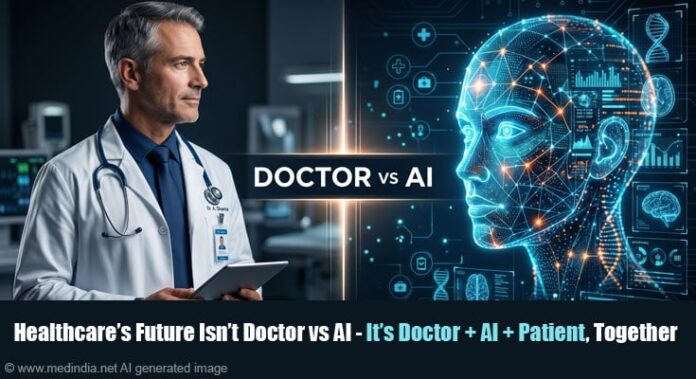
Patients are more inclined to rely on AI than on an actual doctor, but only 4% of the AI information is accurate, says a new study
- Patients now consult AI before visiting doctors, shifting care dynamics
- AI offers answers with only 4% accuracy
- Doctors are evolving from authority figures to collaborative guides
For over a decade, clinicians have lived with “Dr Google”, leaving patients curious, sometimes misinformed, and often anxious. That phase is now evolving rapidly.
A new West Health–Gallup (2026) study shows that 1 in 4 Americans (about 66 million people) now use AI tools for health advice, not just occasionally, but as a routine step in their care journey (1✔ ✔Trusted Source
Millions of Americans Now Consult AI Before, After, and Sometimes Instead of, Seeing a Doctor
Go to source
).
The Rise of Digital Consultations
The question is no longer whether patients use AI. The real question is, what does this mean for doctors?
The shift has gone from information to interaction. First, it was “Dr Google” with static search results, fragmented information and giving patients confusion. Now, it is Dr AI with more conversational and personalised chatbots, simulating clinical reasoning and immediate context-aware guidance.
Patients are no longer just searching or learning about their condition; they are actually consulting.
Why People Are Turning to AI for Health Answers More Than Ever
The results are based on a nationally representative survey of over 5,500 U.S. adults conducted from October to December 2025.
The participants were asked several questions. Based on the responses that were provided, the study released statistical data on the precise cause of people’s increased reliance on artificial intelligence, which is,
| Category | Key Reasons for Choosing AI for Health Advice (%) |
|---|---|
| Quick answers & self-research |
● 71% wanted fast answers ● 71% wanted more detailed information ● 67% were curious about what AI would say ● 59% prefer to look things up themselves before seeing a doctor ● 56% prefer to research more after a doctor visit |
| Cost concerns |
● 27% didn’t want to pay for a doctor’s visit ● 14% couldn’t afford a doctor’s visit |
| Access issues |
● 21% didn’t have time to book an appointment ● 16% couldn’t easily reach a doctor or provider ● 42% wanted help outside regular clinic hours |
| Past experiences & personal comfort |
● 21% felt ignored or not taken seriously by a doctor before ● 18% felt too embarrassed to talk about their issue in person |
From this study, it is even more evident that AI is emerging as a new layer in the care pathway, which can be
How AI is Changing Patient Behaviour: The Rise of the “Prepared Patient”
1. Patients Arrive Pre-Diagnosed
With easy access to AI-driven insights, patients are now forming their own hypotheses, asking more informed questions, and sometimes even drawing conclusions, which can be riskier than it seems.
As a result, the consultation dynamic is shifting from “What is wrong with me?” to “I think this is what I have—what do you think?”
2. Increased Confidence, but Not Always Accuracy
Regardless of the reason, nearly half of Americans who have used AI to obtain healthcare information, 46%, claim that the chatbot or AI tool increased their confidence when speaking with a medical professional.
The most frequently reported AI tools used for these purposes are,
- AI systems like ChatGPT or Copilot (61%)
- AI tools embedded within web searches, like Google AI summaries (55%)
3. Selective Healthcare Utilisation
- 19% said using AI helped them avoid unnecessary medical tests or procedures
- 22% said it helped them identify health issues earlier
Drivers include:
- Cost barriers
- Access issues
- Time constraints
- Previous negative healthcare experiences
4. The Convenience Economy of Care
Patients choose AI because it is:
- Instant
- Perceived as informationally rich
- Available 24/7
How AI Is Redefining the Role of Physicians
The role of the doctor is not disappearing—but it is being redefined.
1. From Information Provider to Interpreter
Patients no longer depend on doctors for basic information.
2. From Authority to Collaborator
The traditional hierarchy was doctor to patient, but now the hierarchy has evolved as patient, AI, and then doctor.
3. From Gatekeeper to Guide
Doctors increasingly act as navigators of complexity, filtering truth vs noise and therefore doctors become the final safety layer, because
- Only 4% strongly trust AI accuracy
- Approximately 11% report receiving unsafe advice from AI
4. From Episodic Care to Continuous Engagement
AI fills the gaps between consultations by helping patients prepare before visits and providing clarification after visits (2✔ ✔Trusted Source
Americans Turning to AI to Supplement Healthcare Visits
Go to source
).
Doctor Vs AI: Empowerment vs Risk
| Opportunity | Risk |
|---|---|
|
● Better-informed patients ● Improved doctor–patient dialogue ● Reduced unnecessary visits ● Greater access to information ● Reduced OPD burden (specifically minor symptoms) |
● Misinformed confidence ● Erosion of trust ● Missed critical diagnoses ● Inequity in digital literacy ● Not applicable for managing serious or complex medical conditions |
When Patients Come with AI Answers: Smart Strategies for Doctors
The doctor’s value shifts to the following:
- Interpret and contextualise AI-generated insights brought in by patients
- Adapt to patients who are continuously engaged with health information
- Validate or correct patient interpretations
- Negotiate shared care decisions
- Apply clinical judgment to real-world scenarios
- Build trust, not just deliver expertise
- Embrace a shift toward ongoing, not episodic care
- Serve as a trusted human guide in an AI-mediated healthcare journey
The Bigger Picture: A System in Transition
This is not just a technology shift; it is a behavioural transformation.
AI is helping patients better understand their symptoms, explore possible conditions, and even learn about medications. But is it always accurate? Not really!
AI can provide a quick approach to current information, but it lacks the real-life experience or clinical judgement that doctors develop over years of treating patients. It can help the process, but it cannot replace a doctor.
“In healthcare, human expertise and empathy still matter, as ultimately only a human can heal another human.”
AI can give answers, but only doctors can earn trust!
AI May Deliver Answers, But Only Doctors Earn Trust!
Frequently Asked Questions
Q: Are people really using AI instead of doctors?
A: Yes, many use AI before or after visits, but not as a complete replacement.
Q: Is AI accurate for medical advice?
A: AI can provide useful information, but it is not always accurate and should not replace professional diagnosis.
Q: Why are patients turning to AI for health advice?
A: For quick answers, convenience, cost savings, and 24/7 availability.
Q: Can AI replace doctors in the future?
A: No, AI supports healthcare, but doctors provide clinical judgment, empathy, and trust.
Q: What is the biggest risk of using AI for health?
A: Misinformation and overconfidence can lead to delayed or incorrect treatment.
Q: How are doctors adapting to AI-informed patients?
A: By validating information, guiding decisions, and collaborating more with patients.
Q: What is the future of AI in healthcare?
A: A collaborative model where AI supports doctors and patients, not replaces them.
References:
- Millions of Americans Now Consult AI Before, After, and Sometimes Instead of, Seeing a Doctor – (https://westhealth.org/news/millions-of-americans-now-consult-ai-before-after-and-sometimes-instead-of-seeing-a-doctor/)
- Americans Turning to AI to Supplement Healthcare Visits – (https://news.gallup.com/poll/707789/americans-turning-supplement-healthcare-visits.aspx)
Source-Medindia