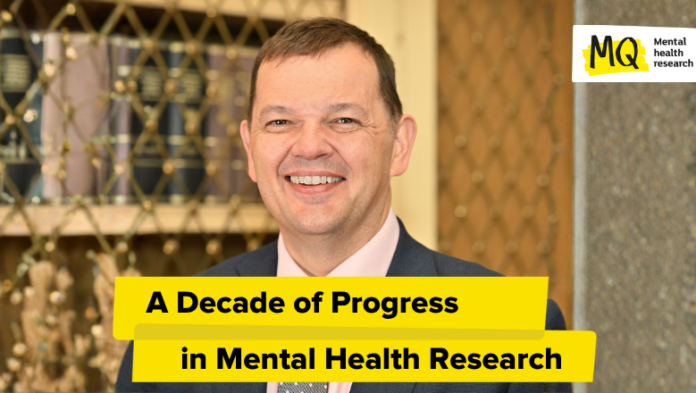
After several years on MQ’s Science Council, Professor Andrew McIntosh is stepping down and shares his reflections on his time supporting the charity’s research.
Andrew is currently a Professor of Psychiatry at the University of Edinburgh’s Division of Psychiatry, Centre for Clinical Brain Sciences, where he is Director of the UKRI Mental Health Platform, a Wellcome Trust Principal Investigator, and Sustainability Lead for DATAMIND, the HDR-UK Hub for Mental Health Data Science. His research focuses on identifying the causes and consequences of depression, drawing on genetic approaches within large population-based studies.
How did you first get involved with MQ?
I first became involved through Cynthia Joyce, who was then MQ’s Chief Executive. I had already seen the impact of organisations such as Cancer Research UK and the British Heart Foundation, and I was very aware that mental health research lacked a comparable major UK charity. I was therefore delighted to support MQ when it was established.
What made you want to join the Science Council?
MQ had the potential to bring researchers together, support ambitious work and raise the profile of mental health research. Joining the Science Council offered an opportunity to help shape its scientific direction and ensure that its funding supported rigorous and innovative research.
How has the data science landscape changed over the last 10 years?
Ten years ago, the data landscape was much more fragmented. Datasets were often held separately, access was difficult, and sharing was less common.
We now have national infrastructure for mental health data science, much larger and better-connected datasets, and a growing expectation that research data should be made available for wider public benefit wherever this can be done safely and responsibly.
The methods have also changed rapidly. Machine learning and artificial intelligence can now help researchers analyse information at a scale and level of complexity that would previously have been impossible.