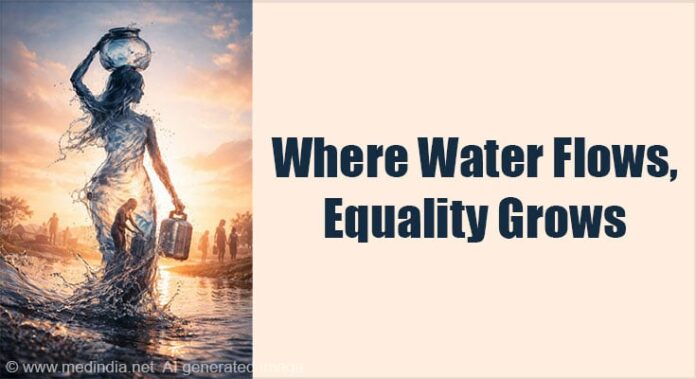
World Water Day 2026 highlights gender disparities in water access, emphasizing women’s role in water management and sustainability.
- Over 1 billion women globally lack safely managed drinking water access
- Women and girls spend nearly 250 million hours daily collecting water
- Global campaigns emphasize women’s leadership in water governance
World Water Day 2026, observed on March 22, centers on the theme “Water and Gender,” highlighting the strong link between gender inequality and water access (1✔ ✔Trusted Source
UNESCO World Water Day
Go to source
).
Global estimates indicate that more than 1 billion women lack safely managed drinking water, while about 1.8 billion people do not have water available on their premises.
Women and girls collectively spend nearly 250 million hours each day collecting water, in regions with limited infrastructure. These figures are based on aggregated global monitoring data rather than a single clinical study, underscoring the scale of inequality and the need for inclusive water solutions (2✔ ✔Trusted Source
United Nations World Water Day
Go to source).
Global Water Access Inequality and Gender Burden
The global water crisis affects populations unevenly, with women and girls bearing a disproportionate burden due to social roles and infrastructure gaps. In households without piped supply, women are responsible for water collection, which directly affects education, employment, and overall well-being..
- Women are the primary water collectors in most households without direct access
- Girls may miss school due to water-related responsibilities or lack of sanitation
Globally, around 2.1 billion people still lack access to safe drinking water, highlighting the magnitude of the issue. These findings are based on large-scale observational datasets; therefore, a defined sample size or study duration is not applicable.
The campaign aligns with Sustainable Development Goal 6 (SDG 6), which aims to ensure universal water and sanitation access by 2030.
Global Campaigns and Events for World Water Day 2026
World Water Day 2026 is supported by coordinated global campaigns built around the official slogan “Where Water Flows, Equality Grows,” emphasizing how improved water access can contribute to gender equality and inclusive development.
A key global highlight is the launch of the United Nations World Water Development Report 2026, which examines the relationship between water access and gender equality and provides policy guidance for inclusive governance. The report reinforces that safe and affordable water is a human right and a foundation for sustainable development.
In addition, international activities include policy dialogues, webinars, and community-level awareness programs that encourage governments, organizations, and communities to adopt gender-inclusive water strategies. These initiatives promote a rights-based approach, emphasizing the need for women’s participation in leadership, planning, and decision-making (3✔ ✔Trusted Source
World Water Day 2026
Go to source).
Why Gender Inclusion Matters in Water Governance
The 2026 theme highlights that women are not only affected by water scarcity but are also essential contributors to sustainable water management. Policy-level evidence suggests that inclusive governance is associated with improved efficiency, accountability, and long-term system sustainability.
Women’s experiences contribute to practical, community-based solutions, while inclusive leadership can improve resource allocation and service delivery. However, women remain underrepresented in water governance systems globally, indicating a gap between policy commitments and implementation.
Health and Safety Risks Linked to Water Inequality
Limited access to safe water and sanitation is associated with multiple public health risks, particularly for women and girls involved in water collection.
- Increased exposure to waterborne diseases due to unsafe water sources
- Physical strain from carrying heavy water loads over long distances
- Increased vulnerability during long-distance water collection
These associations are based on observational public health data, and their impact varies depending on infrastructure, geography, and regional policy implementation (4✔ ✔Trusted Source
World Water Day
Go to source
).
Limitations of Current Global Evidence
While global estimates provide important insights, several limitations should be considered. Data collection methods vary across countries, and region-specific quantitative data remains limited. Additionally, most findings rely on aggregated observational data rather than controlled research designs, which may affect comparability and precision.
Bridging the Water Gap: Why Gender Equality Drives Lasting Change
World Water Day 2026 highlights that improving water access requires addressing gender inequality at both policy and community levels.
Global campaigns and policy initiatives emphasize inclusive governance, infrastructure development, and women’s leadership as key drivers of sustainable progress.
Although the current evidence is observational, it consistently indicates that gender-responsive approaches are essential for achieving long-term water security and improved public health outcomes.
Frequently Asked Questions
Q: What is the theme of World Water Day 2026?
A: The theme is “Water and Gender,” focusing on the relationship between gender equality and water access.
Q: How many women lack access to safe drinking water?
A: More than 1 billion women globally lack safely managed drinking water services.
Q: What campaigns are part of World Water Day 2026?
A: Campaigns include global awareness drives, policy dialogues, and the UN World Water Development Report launch.
Q: What is SDG 6?
A: SDG 6 aims to ensure clean water and sanitation for all by 2030.
Q: Why is gender equality important in water management?
A: It supports equitable access, improves efficiency, and promotes sustainable water systems.
References:
- UNESCO World Water Day – (https://www.unesco.org/en/days/world-water)
- United Nations World Water Day – (https://www.un.org/en/observances/water-day)
- World Water Day 2026 – (https://www.ecocommunications.org/event/world-water-day/)
- World Water Day – (https://www.unwater.org/our-work/world-water-day)
Source-Medindia