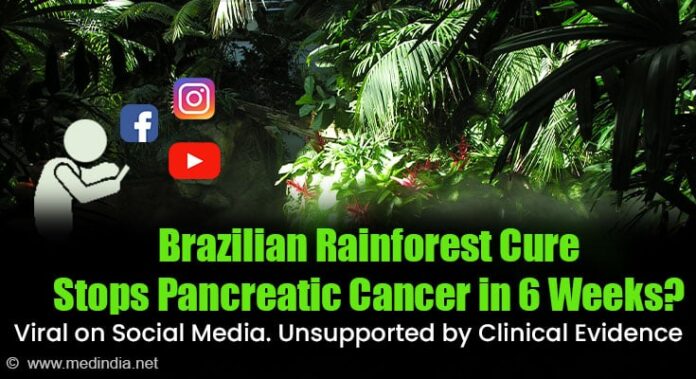
A viral claim about a Brazilian rainforest compound curing pancreatic cancer has no clinical evidence to support it.
- No human clinical trials support the Brazilian rainforest bacteria cancer cure claim
- Rainforest research is limited to early-stage drug discovery
- Copaiba may act as an adjuvant, not a cancer cure
A widely circulated social media post claims that a Brazilian rainforest compound can arrest pancreatic cancer growth in about 90% of the patients within 6 weeks of time, with 34% experiencing significant tumour shrinkage—presenting the finding as a ready-to-use medical breakthrough!
None of these assertions is backed by clinical or scientific research! Let’s examine the claim-and what the data actually demonstrates. Evidence always takes precedence over hype at Medindia.
TOP INSIGHT

Did You Know?
Brazilian biodiversity inspires drug discovery—but no rainforest compound has cured #pancreaticcancer or shown a 90% success rate in treatment within 6 weeks!
#viralfbpost #amazon #cancer_cure#rainforest #pancreaticcure #cancer_misinformation #fakemedicalnews #medindia
When Hope Goes Viral Faster Than Science
Riding on fear, urgency, and hope, the viral post claims that a supposed Brazilian rainforest treatment is already available locally but deliberately withheld from patients elsewhere due to the government and pharmaceutical industry. It indicates that thousands of cancer patients around the globe are being deprived of life-saving natural enzyme therapy, which puts the situation into perspective as a case of profit-making at the expense of the patients.
Pancreatic Cancer “Breakthrough”: Viral Claims vs Medical Reality
| Viral Claims | Medical Reality |
| A Brazilian rainforest compound cures pancreatic cancer (90%) | No proven scientific evidence. |
| Clinical trials showed tumor growth arrest within 6 weeks, with 34% experiencing significant tumor shrinkage | No evidence with respect to clinical trials on humans |
| Natural products sometimes show promise in labs | True – early research exists, but these are not cures in humans |
“Cure in 6 Weeks”? What Amazon Research Actually Shows
The Federal University of Para and CNPEM in Brazil worked together to recover bacteria from the soil of the Amazon rainforest, which has significant unrealized biosynthetic potential. The mapping of the DNA of Streptomyces, Rhodococcus and Brevibacillus species has found that more than half of the genes associated with bioactive compound production were not known before.
Using advanced metabologenomics and Nanopore DNA sequencing, the team identified gene clusters that could one day help develop new antibiotics and antitumor molecules, with possible applications in health, agriculture, and sustainable biotechnology.
Crucially, the study emphasizes the potential for early-stage drug discovery rather than an established or proven cancer treatment (specifically, stopping the growth of pancreatic cancer in roughly 90% of patients). These bacteria may help identify new molecules that could someday be developed into medicines, after years of testing, as per the CNPEM report (1✔ ✔Trusted Source
Bacteria isolated in the Amazon can be used in development of new antibiotics and antitumor treatments
Go to source).
Viral Pancreatic Cancer Cure Claim: No Human Trials, No Approval
Apart from the claims circulating in the viral news, there is no credible clinical evidence to support the assertion that a Brazilian bacterium is effective against pancreatic cancer. No registered or published clinical trials report a “cure within six weeks”, a “34% tumor shrinkage”, or any comparable outcomes.
Moreover, no authoritative medical journals, regulatory bodies, or recognized cancer research institutions have published data validating these claims. The absence of such evidence strongly indicates that the viral social media reports are misleading and not supported by science.
Copaiba in Cancer Care: Adjuvant Potential, Not a Cure
The viral post also states that Brazilian oncologists are administering copaiba extract together with reduced-dose chemotherapy, which is far superior for the quality of life and better than chemotherapy alone, and treatment with the pharmaceutical-grade extract costs about $180 per month.
According to studies, copaiba shows scientifically supported potential as a cancer adjuvant, particularly through anti-inflammatory, antioxidant, and cytotoxic mechanisms, but robust clinical trials are urgently needed before its integration into evidence-based oncology practice.
The anticancer relevance of copaiba is strongly linked to its chemical composition, especially:
| Chemical Components of Copaiba | What it does? |
| β-Caryophyllene |
|
| Kaurenoic acid |
|
| Clerodane diterpenoids |
|
Interestingly, such compounds tend to work synergistically, which correlates with the hypothesis that the whole oil-resin preparations may be better than the individual compound – a key rule in adjuvant therapy.
The excellent anti-inflammatory and anticancer effects of copaiba favour copaiba as a supportive or complementary agent, but not an anti-cancer agent on its own (2✔ ✔Trusted Source
Evaluation of the biological activities of Copaiba (Copaifera spp): a comprehensive review based on scientometric analysis
Go to source).
Copaiba’s Safety and Toxicological Evidence
- Low toxicity
- Good biocompatibility
- Absence of severe adverse effects in experimental models
This safety profile is particularly relevant for adjuvant use, where long-term tolerability is essential.
Although the findings were promising, the review shows clearly that there is very little clinical evidence, and no cancer-specific clinical trials were found. Much of the anticancer data are obtained in cell-based in vitro and animal models.
Thus, copaiba cannot be suggested as an anticancer therapy but, perhaps, can become a promising topic of study as an adjuvant therapy (2✔ ✔Trusted Source
Evaluation of the biological activities of Copaiba (Copaifera spp): a comprehensive review based on scientometric analysis
Go to source).
Recent Advancement in Pancreatic Cancer Research: Targeting SPP1
Researchers discovered an important protein (SPP1), which contributes to the growth and diffusion of the most aggressive pancreatic cancer. The presence of this protein in high levels is associated with poor patient outcomes.
The inhibition of SPP1 prevented the spread of cancer in lab and animal models, resulting in a reduction in the number of tumors, and the cancer did not spread to other organs such as the liver and lungs. The survival rate of mice when SPP1 was silenced or neutralized with an antibody increased significantly, and some of them survived significantly longer than untreated mice.
SPP1 works against a protective protein (GREM1). When SPP1 is blocked, GREM1 levels rise, keeping cancer cells in a less aggressive and more treatable state. This discovery opens the door to new targeted treatments, such as antibodies or precision drugs, offering fresh hope for a cancer that has seen little survival improvement in decades (3✔ ✔Trusted Source
SPP1 is required for maintaining mesenchymal cell fate in pancreatic cancer
Go to source).
Why False Cancer Cures Are Dangerous
Pancreatic cancer is one of the deadliest forms of cancer, with a 5-year survival rate of less than 5%. As a result, it is a critical topic to address.
The Brazilian rainforest is still among the least studied biological ecosystems on the globe and has a significant potential for making discoveries that would revolutionize medicine. Researchers are still discovering bacteria with distinct genetic profiles that will form novel bioactive molecules, and some of them will one day be used to develop new antibiotics or cancer therapies.
Nevertheless, in the case of pancreatic cancer, this research is in its infancy and remains in its exploration phase, and there is no treatment that has yet passed to human testing.
Amazon Science Holds Promise-But Not a Pancreatic Cancer Cure
These technological advancements provide researchers with a significant opportunity to discover new previously unknown genes and metabolic pathways, which lead to new horizons in drug discovery and biotechnology. Nevertheless, it would take years before these molecular discoveries could be applied in cancer treatment as safe and effective treatment.
To conclude, Brazilian rainforest bacteria are scientifically promising but not a proven cure for pancreatic cancer. The significance of the context is that it broadens the basis of innovation in medicine in the future, rather than providing a direct clinical solution.
The viral Facebook post confusing early-stage research with a “miracle cure” does real harm, especially to patients and families facing life-threatening illnesses. The Brazilian rainforest bacteria may inspire future medicines, but they have not cured pancreatic cancer.
Frequently Asked Questions
Q: Is there a proven Brazilian rainforest cure for pancreatic cancer?
A: No. There is no clinical evidence or approved treatment supporting this claim.
Q: Are Brazilian doctors using rainforest compounds to cure cancer?
A: No verified medical or regulatory data confirms such treatments in clinical practice.
Q: Can copaiba oil cure pancreatic cancer?
A: No. It may show adjuvant potential in labs but is not a cancer cure.
Q: Why do such cancer cure claims go viral?
A: They exploit hope, misuse early research, and spread faster than verified science.
References:
- Bacteria isolated in the Amazon can be used in development of new antibiotics and antitumor treatments – (https://cnpem.br/en/bacterias-amazonia-desenvolvimento-novos-medicamentos/)
- Evaluation of the biological activities of Copaiba (Copaifera spp): a comprehensive review based on scientometric analysis – (https://www.frontiersin.org/journals/pharmacology/articles/10.3389/fphar.2023.1215437/full)
- SPP1 is required for maintaining mesenchymal cell fate in pancreatic cancer – (https://www.nature.com/articles/s41586-025-09574-y)
Source-Medindia
Editorial Note:The growing spread of health misinformation, particularly on social media, is a serious concern. Medindia is committed to exposing medical misinformation and providing evidence-based clarity on what is real and what is not.