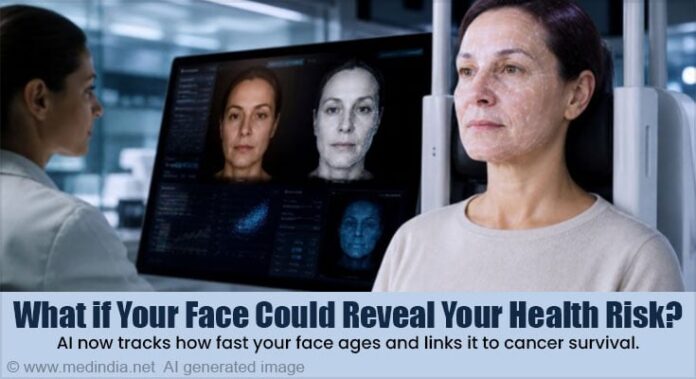
AI analysis of facial ageing in 2,276 cancer patients showed that faster ageing was linked to up to 65% higher risk of death.
- Faster facial ageing detected by AI linked to 25% to 65% higher death risk.
- The study included 2,276 cancer patients undergoing treatment.
- Tracking ageing over time provided stronger risk insight than a single measure.
How fast your face appears to age may reveal more than you think. In a retrospective study of 2,276 cancer patients, those with faster AI-detected facial ageing had a 25% to 65% higher risk of death during follow-up. In simple terms, the faster the face appeared to age over time, the higher the risk of poorer outcomes. (1✔ ✔Trusted Source
Face aging rate quantifies change in biological age to predict cancer outcomes
Go to source
)
This matters because people of the same age can have very different levels of health. The study suggests that biological ageing, reflected through facial appearance, may offer additional insight into survival beyond chronological age alone. However, this method does not diagnose cancer or predict outcomes by itself.
Face Age vs Real Age: How AI Reveals Hidden Cancer Risk
Chronological age tells how many years a person has lived. Biological age reflects how well the body is functioning. The two are not always the same.
Researchers used an AI system called FaceAge, trained on more than 40 million facial images, to estimate biological age from features such as skin texture and facial structure.
Earlier findings showed that when a person’s facial age appears about 5 years older than their actual age, the risk of death increases by around 21%. This supports the idea that facial appearance can reflect underlying health.
How AI Facial Analysis Measures Ageing Rate in Cancer Patients
Instead of relying on a single image, researchers compared two facial photographs per patient, taken at different stages of radiation therapy.
The patients had an average age of about 63 years, and many had advanced cancer. By comparing these images, researchers calculated the face ageing rate, which shows how quickly biological age changes over time.
This method focuses on change, not just a snapshot. It helps show whether a patient’s condition is stable, improving, or worsening.
Faster Ageing Face? Cancer Death Risk May Rise 25% to 65%
The results showed a clear and consistent pattern. Faster facial ageing was linked to worse outcomes.
Patients with higher face ageing rates had a 25% higher risk of death over shorter follow-up periods, 37% higher risk over medium periods, and up to 65% higher risk over longer follow-up periods. These findings remained significant even after adjusting for age, sex, and cancer type (1).
Tracking how quickly ageing changes occur provided more useful insight than a single estimate. Patients who appeared older and continued to age faster had the highest risk.
Why Faster Facial Ageing May Reflect Underlying Cancer Health Changes
Cancer and its treatment can place stress on the body. This can lead to cell damage, ongoing inflammation, and physical strain.
Over time, these internal changes may affect the skin and facial structure, making a person appear older. AI tools can detect these subtle changes more precisely than the human eye.
More broadly, research shows that AI-based image analysis is increasingly used to identify patterns associated with cancer outcomes, underscoring its growing role in clinical research (2✔ ✔Trusted Source
Artificial Intelligence Performance in Image-Based Cancer Identification: Umbrella Review of Systematic Reviews
Go to source).
Face Ageing Rate vs Single Biological Age in Cancer Risk Prediction
|
Method |
What It Shows |
Clinical Value |
|
Single facial age |
One-time estimate |
Limited insight |
|
Face aging rate |
Change over time |
Stronger risk indicator |
What this means in simple terms:
A single facial age is like taking one photo and estimating how old someone looks at that moment. It gives only a limited view.
In contrast, the face ageing rate compares images taken at different times to measure how quickly the appearance is changing. This helps show whether the body is ageing faster than expected and may reflect changes in overall health.
What AI Face Ageing Could Mean for Cancer Care
AI-based facial ageing analysis may help doctors identify patients who need closer monitoring or additional support during treatment. Because it is simple and noninvasive, it can be repeated over time to track changes.
However, this study shows an association, not a cause. Faster facial ageing does not directly lead to worse outcomes. The study also has limitations, including limited population diversity and the possibility that treatment-related effects may influence facial changes. (1✔ ✔Trusted Source
Face aging rate quantifies change in biological age to predict cancer outcomes
Go to source, (2✔ ✔Trusted Source
Artificial Intelligence Performance in Image-Based Cancer Identification: Umbrella Review of Systematic Reviews
Go to source)
Further research is needed before this approach can be used in routine medical care.
Frequently Asked Questions
Q: Can AI predict cancer survival from your face?
A: AI can help estimate survival risk by analysing how quickly facial ageing occurs. It cannot predict outcomes with certainty or replace medical evaluation.
Q: What is the AI face ageing rate in cancer patients?
A: It is a measure of how quickly a person’s face appears to age over time using artificial intelligence. It reflects biological ageing.
Q: How accurate is AI facial analysis for cancer prognosis?
A: Studies show a strong link with survival, but it is not yet validated for routine clinical use.
Q: Why does faster facial ageing indicate a higher risk?
A: It may reflect underlying stress in the body caused by disease or treatment, which can affect overall health.
Q: Can AI face analysis replace medical tests?
A: No. It is a supportive tool and cannot replace standard medical tests or doctor’s evaluation.
References:
- Face aging rate quantifies change in biological age to predict cancer outcomes – (https://www.nature.com/articles/s41467-025-66758-w)
- Artificial Intelligence Performance in Image-Based Cancer Identification: Umbrella Review of Systematic Reviews – (https://pmc.ncbi.nlm.nih.gov/articles/PMC12000792/)
Source-Medindia