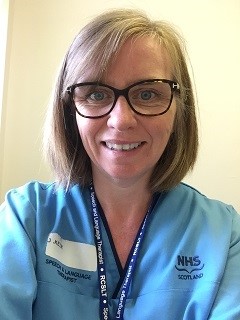
Rehabilitation is a big word with a range of nuanced meaning for all involved. As a speech and language therapist I cannot reverse the presenting language problem such as word-finding difficulty, repetition or difficulties processing longer utterances. So instead, how can I work around these symptoms to improve quality of life and maintain connections in a new way? This means I won’t work only with the person with lived experience – rehabilitation needs a strong carer/ family support system to learn, replicate and maintain these connections. Working in this way can help to restore confidence, support meaning and preserve dignity.
Why don’t we consider the opinion of someone with lived experience of my idea of rehabilitation ….
Let me introduce Barbara (name changed for anonymity) who was referred for an assessment of word-finding difficulties in suspected new mild cognitive impairment. I visited her at home where we explored assessment options together to identify language strengths and weaknesses. We looked closely at ways that increased conversation success. We considered specific conditions that enhanced or hindered conversation and shared this with family. We agreed that it was a good idea to save these baseline scores for future comparison.
We created a ‘communication profile’ based on assessment findings. Barbara had ownership of this document and could choose to share it with anyone she wished. This was a way for her to request direct support from friends or family and how they might offer help. I suggested some direct work on the strategies we talked about in the profile. Barbara agreed to 5 domiciliary sessions with speech and language therapy clinical support worker and a programme of rehabilitation was developed based on assessment results. Our goal was to develop ways to ‘talk around the word’ in order to keep the conversation moving, to use a multi-modal approach when she felt ‘stuck’ and to encourage family members to allow extra time/ space to maximise support.
This is what Barbara said in a focus group following our rehabilitation programme: ‘I have noticed a change in how I speak. I am now more relaxed and then things feel easier. It’s easier now to say what I want. I have noted that as long as people do not hurry me, talking feels easier. It feels better now talking with friends and family. People understand me better than before. I’m even feeling less anxious on the phone! I don’t need to work on anything more in therapy and I have been supported. I feel as if I am more relaxed but also my life with this doesn’t seem so dreadful. The way the therapist handled things has been great fun! I wouldn’t have changed anything and none of it felt hard or confusing. It wrote a thank you card to them for all aspects of wonderful treatment.’
We used a range of approaches that included activities, interventions and information resources to support Barbara and her family as per original Scottish Government rehabilitation definition*. She felt confident that she had reached her full potential and that our work together was realistic, achievable and meaningful. Collaboration in rehabilitation fostered ownership, independence and connection.
Contributor
Jenny Keir, speech and language therapist, Royal Victoria Hospital out-patient unit, Dundee

Since the publication of our first allied health professional dementia policy document in Scotland, Connecting People Connecting Support (Alzheimer Scotland 2017) we have debated, advocated and delivered dementia rehabilitation informed by three sources of evidence: research, clinical practice and the voice of lived experience. We shared in our second report (Alzheimer Scotland 2020) examples of dementia rehabilitation and in our third report (Alzheimer Scotland 2024) we highlight there is a rehabilitation gapthatmust be filled, with a need to increase awareness of what dementia rehabilitation is, how it has a positive impact on people with lived experience and also services, and there is a need to apply the evidence of dementia rehabilitation in practice. As an allied health professional dementia community, with our many partners, colleagues and friends, we are therefore going to share a number of blogs posts over the next 12 months on rehabilitation and dementia, answering the simple question
“What does rehabilitation mean to you?
You can read our first blog in the series here
*“Rehabilitation means different things to different people. Here rehabilitation refers to a wide range of approaches that include activities, interventions and information resources that support individuals to recover or adjust to achieve their full potential. It includes approaches that focus on early intervention for prevention, prehabilitation and supported self-management. Rehabilitation should be outcome focused and support individuals to work towards goals that are realistic, achievable and meaningful to them in order for them to live well and feel more in control of their own health and wellbeing. Good rehabilitation is multifaceted and the individual should feel empowered and supported to explore what is important to them. It should be personalised and support the whole person, their physical and mental health, and should take into account their desired lifestyle. (Scottish Government 2022)”