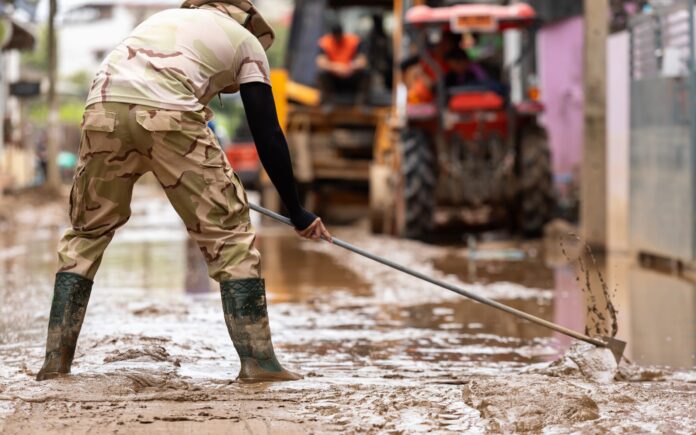
When thinking about climate change, we often picture record-breaking heatwaves, unprecedented floods and devastating droughts. Whilst these visible impacts dominate headlines, another consequence often goes unnoticed: the impact on mental health. The World Health Organisation (WHO) has described climate change as one of the greatest threats to global health in the twenty-first century (WHO, 2023), yet its psychological consequences often receive far less attention.
Extreme weather events can leave emotional scars long after the immediate danger has passed. People affected by floods, hurricanes, wildfires and heatwaves may experience anxiety, depression or post-traumatic stress disorder (PTSD) (Heanoy & Brown, 2024). The 2018 Camp Fire in Paradise, California, one of the deadliest and most destructive wildfires in the state’s history, illustrates this psychological toll. Survivors described losing not only their homes, but also their sense of identity, safety and community (Hughes, 2018). For many, the emotional effects lasted long after the fires had been extinguished.
These mental health impacts are not shared equally. People with fewer financial, social or housing resources are often more exposed to climate-related disasters, have fewer opportunities to evacuate safely and face greater challenges rebuilding their lives afterwards (Sharma et al., 2026).
Mahmood and colleagues (2025) asked whether these inequalities also extend to mental health. Their systematic review examined whether socially disadvantaged groups were more likely to experience poorer mental health following climate-related events.
Methods
The authors searched multiple databases for studies exploring the impact of climate change on mental health in vulnerable groups. They included research published up to 17 July 2023 that examined a range of climate-related events, including floods, hurricanes, wildfires, heatwaves, droughts and long-term exposure to rising temperatures. Most included studies, however, concerned acute events, particularly tropical cyclones.
Rather than looking at the general population, the review focused on groups who may already face social or economic disadvantage. This included people with lower incomes, minoritised ethnic groups, indigenous populations, and people experiencing housing insecurity.
The authors compared these groups with less disadvantaged or general populations to examine whether they experienced poorer mental health following climate-related events. They included studies measuring depression, anxiety, psychological distress and PTSD.
To assess the quality of the evidence, two reviewers independently screened studies and rated their methodological quality using the Joanna Briggs Institute critical appraisal tools.
Results
Out of 2,179 records initially identified, 32 studies were included in the review and narratively synthesised. Overall, 18 studies reported poorer mental health outcomes among disadvantaged groups following climate-related events, while 5 reported mixed findings and 9 found no evidence of worse outcomes.
The evidence therefore suggests a possible pattern of greater mental health risk among disadvantaged populations. However, the findings were not consistent across all studies, and the authors advise caution because the included studies varied considerably in their populations, climate exposures, study designs and measures of mental health.
Lower income groups
Evidence for lower-income groups was strongest following acute climate-related events, although findings varied across studies. One study found that lower-income participants were nearly four times more likely to experience severe mental health problems compared with the study’s reference group (Stukova et al., 2023). Similar patterns were reported following tropical cyclones, with higher levels of depression, anxiety, psychological distress and PTSD, although evidence following floods was more mixed.
In one study of long-term heat exposure, people with lower monthly incomes reported more severe psychological symptoms than those with higher incomes (Yuan et al., 2022). However, evidence relating to droughts and combined climate exposures remained limited and inconsistent.
Minoritised ethnic groups
A similar pattern emerged for minoritised ethnic groups, particularly after acute climate-related events. In one study, 9.5% of participants from minoritised ethnic minority groups met the criteria for PTSD, compared with 4.4% of participants from other ethnic groups (Tracy et al., 2011), although the difference was not statistically significant. Higher rates of depression were also reported following wildfires (Silveira et al., 2021).
Indigenous populations
While evidence exploring indigenous populations remains scarce, findings suggest the emergence of patterns of PTSD and depression in the 12 months following a tropical cyclone (Chen et al., 2014). However, these findings were not compared with other populations.
In the case of flood-like events, indigenous populations were about twice as likely to experience probable anxiety (1.89x) and depression (1.84x) than non-indigenous groups (Matthews et al., 2019).
Housing-insecure groups
One study found that participants living in informal settlements had a larger increase in depression scores following floods.

Conclusions
Mahmood and colleagues concluded that climate change may disproportionately affect the mental health of socially disadvantaged groups. The review suggests that these inequalities are driven by a combination of greater exposure to climate-related disasters, greater material and personal losses when disasters occur, and fewer financial and social resources available to support recovery.
Although the evidence was not consistent across every study, the overall findings suggest that climate change has the potential to widen existing mental health inequalities. The review reinforces the need to view climate change not only as an environmental challenge, but also as a mental health and social justice issue.

Strengths and limitations
This review makes an important contribution to a growing and highly relevant area of research. Its biggest strength is its focus on vulnerable populations, helping to highlight how climate change may widen existing mental health inequalities. It also considered a broad range of climate-related events and mental health outcomes, providing a useful overview of the current evidence.
The findings should, however, be interpreted with caution. The included studies differed considerably in the climate events they examined, the populations they studied, the mental health measures they used and their study designs, making direct comparisons difficult. Limiting the review to studies published only in English could also have contributed to missing out on relevant literature from low- and middle-income countries which may be most affected by climate change. The review also did not explicitly examine how overlapping disadvantages, such as low income, ethnicity and housing insecurity, may combine to affect mental health. Most included studies were cross-sectional, limiting conclusions about causality and leaving potential confounding as an important concern.
Finally, some important gaps remain in the evidence. The available evidence also relied largely on quantitative studies, meaning lived experiences and the wider cultural and community impacts of climate-related disasters were less well represented. In addition, people from lower-income communities are more likely to be displaced, die or be lost to follow-up after disasters, meaning studies may underestimate the long-term mental health impacts on the most vulnerable groups. In addition, four included studies drew on the same sample of low-income mothers who survived Hurricane Katrina, which may have influenced the overall findings.

Implications for practice
This review has important implications for mental health practice, policy and future research.
For mental health professionals, the findings highlight the importance of recognising climate-related distress and trauma, particularly among people already facing social and economic disadvantage. Understanding how climate-related disasters interact with existing inequalities may help clinicians assess risk and tailor support more effectively. Strengthening community resilience and social support before and after climate-related disasters may also help reduce longer-term psychological harm.
The findings also have important implications for policy. Climate resilience planning should consider mental health alongside physical infrastructure and emergency responses, with particular attention given to communities most at risk from both climate-related disasters and existing social inequalities.
The review highlights several important gaps in the evidence. Future research should place greater emphasis on the mental health effects of long-term climate change, such as droughts and rising temperatures, and on repeated or cumulative climate exposures; include more studies from low- and middle-income countries; use longitudinal designs to better understand causal pathways; and incorporate lived experience perspectives.
As climate change continues to intensify, understanding its impact on mental health will become increasingly important for mental health services, public health systems and those responsible for planning climate adaptation.

Statement of interests
As MSc Clinical Mental Health Sciences students at UCL, we want to clarify that although some individuals involved in the research discussed are UCL faculty, we have no direct involvement in the study, its review, or its publication. This blog was created independently for our coursework and reflects our interpretation. We have no conflicts of interest beyond our academic relationship with the study.
Contributors
Thanks to the UCL Mental Health MSc students who wrote this blog from the Bisby Student Group: Mahi Kashyap, Lara Melville, Janine Ramchandani, Hui Jiajun, and Bolin Zhu.
UCL MSc in Mental Health Studies
This blog has been written by a group of students on the Clinical Mental Health Sciences MSc at University College London. A full list of blogs by UCL MSc students can be found here.
We regularly publish blogs written by individual students or groups of students studying at universities that subscribe to the National Elf Service. Contact us if you’d like to find out more about how this could work for your university.
Edited by
Dr Dafni Katsampa.
Links
Primary paper
Ridha Mahmood, Philippa Clery, Justin Yang, Liying Cao & Jennifer Dykxhoorn (2025). The impact of climate change on mental health in vulnerable groups: a systematic review. BMC Psychology, 13(1), 1208.
Other references
Anxiety – Every Mind Matters. (n.d.).
Chen, Y., Hsu, W., Lai, C., Tang, T., Wang, P., Yeh, Y., Huang, M., Yen, C., & Chen, C. (2014). One‐year follow up of PTSD and depression in elderly aboriginal people in Taiwan after Typhoon Morakot. Psychiatry and Clinical Neurosciences, 69(1), 12–21.
Depression (major depressive disorder) – Symptoms and causes. (n.d.). Mayo Clinic.
Heanoy, E. Z., & Brown, N. R. (2024). Impact of Natural Disasters on Mental Health: Evidence and Implications. Healthcare, 12(18), 1812.
Hughes, R. (2018, November 16). California wildfires: The day Paradise burned down. BBC News.
Matthews, V., Longman, J., Berry, H. L., Passey, M., Bennett-Levy, J., Morgan, G. G., Pit, S., Rolfe, M., & Bailie, R. S. (2019). Differential Mental Health Impact Six Months After Extensive River Flooding in Rural Australia: A Cross-Sectional Analysis Through an Equity Lens. Frontiers in Public Health, 7, 367.
Sharma, N., Kuskoff, E., Parsell, C., & Middlebrook, N. (2026). A longitudinal study of the impact of disasters on individual wellbeing. International Journal of Disaster Risk Reduction, 133, 105999.
Silveira, S., Kornbluh, M., Withers, M. C., Grennan, G., Ramanathan, V., & Mishra, J. (2021). Chronic Mental Health Sequelae of Climate Change Extremes: A Case Study of the Deadliest Californian Wildfire. International Journal of Environmental Research and Public Health, 18(4), 1487.
Stukova, M., Cardona, G., Tormos, A., Vega, A., Burgos, G., Inostroza-Nieves, Y., & Carl, Y. (2023). Mental health and associated risk factors of Puerto Rico Post-Hurricane María. Social Psychiatry and Psychiatric Epidemiology, 58(7), 1055–1063.
Tracy, M., Norris, F. H., & Galea, S. (2011). Differences in the determinants of posttraumatic stress disorder and depression after a mass traumatic event. Depression and Anxiety, 28(8), 666–675.
United Nations. (n.d.). What Is Climate Change? | United Nations.
VA.gov | Veterans Affairs. (n.d.).
What is the difference between a hurricane and a typhoon? (n.d.).
World Health Organization: WHO. (2023, October 12). Climate change.
Yuan, W., He, B., Yang, L., Liu, X., & Yan, L. (2022). Heat-induced health impacts and the drivers: implications on accurate heat-health plans and guidelines. Environmental Science and Pollution Research, 29(58), 88193–88212.
Photo captions