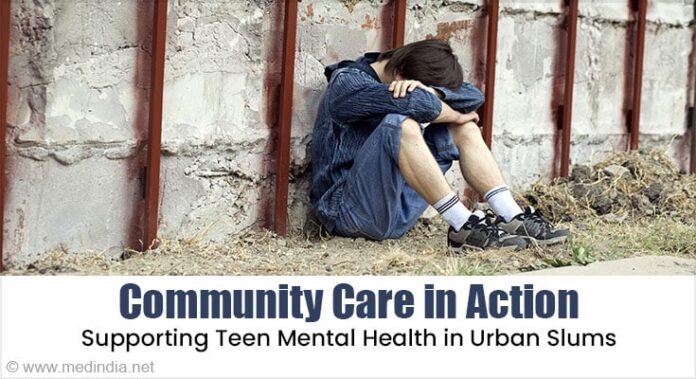
What if mental health care could reach even the most underserved communities? A new India-based study shows it might be possible.
- Nearly 47.1% of adolescents were identified as high-risk for depression or self-harm
- Around 86% of high-risk adolescents were able to access care through trained providers
- The ARTEMIS model helped reduce stigma and improve help-seeking behavior
A landmark India-based study has shown that a community-driven and digitally enabled mental health model can significantly reduce depression, self-harm, and suicide risk among adolescents living in urban slums.
The research—called the ARTEMIS (Adolescents’ Resilience and Treatment Needs for Mental Health in Indian Slums) study—demonstrates that combining awareness campaigns with accessible primary care support can transform mental health outcomes in some of the country’s most underserved communities (1✔ ✔Trusted Source
Adolescent Mental Health Care and Stigma
The ARTEMIS Randomized Clinical Trial
Go to source
).
What Is the ARTEMIS Study and Why Is It Important?
The ARTEMIS study, led by The George Institute for Global Health and published in JAMA Psychiatry, is the first large-scale research of its kind in India focusing on adolescents in urban slums.
It was conducted across 60 slum communities in New Delhi and Vijayawada, involving 3,739 adolescents aged 10 to 19 years, with nearly half (47.1%) identified as being at high risk for mental health conditions such as depression or self-harm.
This study is particularly important because millions of adolescents in India grow up in environments where mental health support is limited or absent.
In the broader context, India has nearly 250 million adolescents, many of whom are vulnerable to common mental disorders, which are among the leading causes of death and disability in this age group.
Alarmingly, suicide rates among adolescents are among the highest globally, with estimates from rural India showing 148 per 100,000 in females and 58 per 100,000 in males.
Despite this burden, only 1 in 27 individuals with depression receive effective treatment in low- and middle-income countries like India, highlighting a massive treatment gap
Around 12 million adolescents live in slum settings, and broader data from UNICEF (United Nations Children’s Fund) shows that 7.3% of young people (18–29 years) experience mental health issues.
The ARTEMIS trial addresses a major gap—how to deliver effective, affordable mental healthcare in low-resource settings—something that has largely been missing from previous research.
How Community-Based and Digital Care Was Delivered
The ARTEMIS project used a carefully designed, real-world approach that combined community awareness with clinical care.
At the community level, adolescents and families were exposed to locally tailored multimedia campaigns to reduce stigma. In simple terms, stigma refers to the fear, shame, or social judgment associated with mental illness, which often prevents people from seeking help.
The study highlights that
Alongside this, a digital mental health system was introduced. This system allowed trained health workers to screen adolescents using tools like the PHQ-9 questionnaire (a standard method used globally to assess depression severity). Those identified as high-risk were then connected to trained primary healthcare providers for further support and treatment.
Importantly, this was not a hospital-based model—it worked within the community itself, making care more accessible and less intimidating for adolescents.
What Improvements Were Seen in Depression and Care Access
After 12 months, the results showed clear and measurable improvements in the group that received the intervention compared to those who did not.
Adolescents exposed to the ARTEMIS model demonstrated better knowledge, attitudes, and behavior toward mental health, meaning they were more aware, less judgmental, and more open to seeking help. This shift is crucial because changing how people think about mental health is often the first step toward improving outcomes.
There was also a significant reduction in depression scores, measured using the PHQ-9 scale. Lower scores indicate fewer or less severe symptoms of depression. The intervention group recorded lower average scores than the control group, confirming real improvement.
Another key outcome was increased access to care. Around 86% of high-risk adolescents in the intervention group received care from trained providers, a major achievement in settings where access is usually limited.
The study also found improved community behavior scores, indicating that stigma had reduced and acceptance had increased. While remission rates (recovery from depression) were higher in the intervention group, the difference was not statistically strong, but still pointed toward a positive trend.
Overall, the findings clearly show that this combined approach works—not just clinically, but socially as well (2✔ ✔Trusted Source
ARTEMIS: Adolescents’ Resilience and Treatment nEeds for Mental health in Indian Slums
Go to source).
What Challenges did Adolescents in Slums Face?
The study gives a deeper human insight into the everyday struggles of adolescents in these communities. As explained by Dr. Sandhya Kanaka Yatirajula, many adolescents reported stress from multiple sources, including family expectations, academic pressure, peer relationships, gender restrictions, and uncertainty about the future.
Beyond personal stressors, there were also systemic barriers that made accessing care difficult. These included stigma within families and communities, hesitation from parents, long distances to healthcare centers, and scheduling issues due to school timings.
Despite these barriers, the ARTEMIS model proved both feasible and acceptable, indicating that communities were willing to engage with and benefit from it.
Why This Model Can Transform Mental Health Care in India
What makes the ARTEMIS study especially powerful is its scalability. It shows that mental health care does not always require expensive infrastructure or specialist-heavy systems. Instead, it can be effectively delivered through:
- Community awareness
- Digital tools
- Trained primary healthcare workers
This approach aligns with existing national programs like the Rashtriya Kishor Swasthya Karyakram (RKSK) and the National Mental Health Program (NMHP), as well as global frameworks such as the WHO Mental Health Action Plan and Sustainable Development Goals.
As highlighted by Prof. Pallab Maulik, the study’s principal investigator, the model’s strength lies in its two-pronged strategy—reducing stigma while providing treatment. This dual approach ensures that adolescents are not only identified but also supported meaningfully.
The Bottom Line
The ARTEMIS study makes one thing clear: mental health solutions for vulnerable adolescents already exist—we just need to implement them effectively.
By combining community engagement, digital screening, and primary care support, this model offers a practical, scalable, and impactful solution for improving adolescent mental health—not just in India’s urban slums, but in similar settings around the world.
Frequently Asked Questions
Q: What is ARTEMIS in mental health?
A: ARTEMIS is a community-based mental health model combining awareness campaigns and digital tools to identify and treat adolescents at risk.
Q: How effective is ARTEMIS?
A: It helped identify 47.1% high-risk adolescents and enabled 86% of them to access care.
Q: Why is stigma important in mental health?
A: Stigma prevents people from seeking help, making awareness campaigns critical.
Q: Why are slum adolescents more vulnerable?
A: They face poverty, limited access to healthcare, and social pressures.
Q: Can ARTEMIS model be scaled?
A: Yes, it is designed to work in low-resource settings and can be expanded widely.
References:
- Adolescent Mental Health Care and Stigma The ARTEMIS Randomized Clinical Trial – (https://jamanetwork.com/journals/jamapsychiatry/article-abstract/2848046)
- ARTEMIS: Adolescents’ Resilience and Treatment nEeds for Mental health in Indian Slums – (https://www.georgeinstitute.org/our-research/research-projects/artemis-adolescents-resilience-and-treatment-needs-for-mental-health-in-indian-slums)
Source-Medindia