After 17 years of depression, I’d been on 14 different antidepressant medication combinations and years of private talk therapy. None of these treatments really had any effects and my condition continued to worsen.
Mark, Lived Experience Expert
Depression is one of the leading causes of ill health worldwide. In 2019, depressive disorders were among the ten biggest causes of years lost to ill health and early death for both young people and working-age adults (Vos et al, 2020). For a third of people, their depression will be “difficult to treat” and they will continue to experience significant burden despite trying first line treatments such as antidepressant medications and community talking therapies (Al-Harbi, 2012).
We have recently held a webinar on the background and evidence on a treatment for difficult-to-treat depression called “transcranial magnetic stimulation” (TMS). TMS was recommended by NICE for use within the NHS in 2015 (NICE, 2015) although it is only available in 1 in 7 mental health trusts at present (it is more widely available privately).
The webinar covered:
- The invention of TMS (hint: it’s a British invention!)
- Evidence on clinical and cost effectiveness
- New approaches to improve access and availability of treatment
- Experiences of transcranial magnetic stimulation from three people with lived experience of depression.
Here I cover some of the evidence on clinical effectiveness and safety of TMS as well as ongoing research to improve response rates and treatment accessibility. Links to various useful resources are at the bottom, as is a link to a survey we are running to get some feedback on perceptions of TMS from potential referrers (primary care and mental health clinicians) that we will use to guide our work on new TMS treatment pathways.
What is TMS?
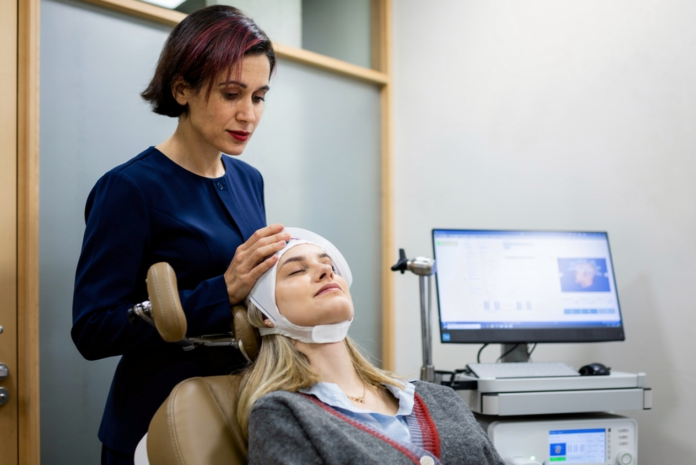
TMS is a type of “neuromodulation” (non-invasive brain stimulation) treatment for depression. It uses magnetic pulses to re-balance activity, and increase flexibility (plasticity), within and across brain networks (Downar et al, 2024). Patients come for one or more treatment sessions per clinic visit over a few weeks for a total of about thirty treatments. At each session, a treatment coil is positioned on their head (usually over an area called the left pre-frontal cortex). Each treatment is only around ten minutes of stimulation using the latest pulse sequences. The magnetic pulses cause brief current flow within targeted brain areas. A patient has TMS whilst they are awake and alert. It is different to “electroconvulsive therapy” (ECT) and does not involve an anaesthetic or impact memory.
The clinical effectiveness of TMS
When NICE recommended TMS for depression in 2015, it based this on four systematic reviews showing its clinical efficacy. The largest brought together findings from 32 randomised controlled trials (trials that compare active TMS to inactive/sham/placebo TMS) (Lepping et al, 2014).
A 2019 review brought together 63 randomised controlled trials in people with a current episode of depression (Mutz et al, 2019). A 2025 review focused on 16 trials in people with treatment-resistant depression, meaning depression that hasn’t responded to two or more antidepressants (Saelens et al, 2025). Both found real treatment worked better than sham for the two types of stimulation most used in clinics: standard high-frequency stimulation and intermittent theta burst stimulation (Table 1). In the 2025 review, theta burst stimulation ranked first out of 25 treatments for remission, ahead of electroconvulsive therapy.
Two more focused reviews reported risk ratios, which are easier to interpret (Vida et al, 2023; Kishi et al, 2024). They suggest real treatment roughly doubles the chance of response and remission compared with sham.
| Review | Standard high-frequency stimulation | Intermittent theta burst stimulation |
|---|---|---|
| Mutz et al, 2019 Adults with a current episode of depression (unipolar or bipolar) |
Response: OR 3.17 (2.29 to 4.37) Remission: OR 2.67 (1.79 to 4.00) |
Response: OR 3.20 (1.45 to 7.08) Remission: OR 3.30 (1.38 to 7.90) Not significant once high risk of bias trials were removed |
| Saelens et al, 2025 Treatment-resistant unipolar depression |
Response: OR 4.01 (2.36 to 6.81) | Response: OR 4.80 (2.21 to 10.39) Ranked first of 25 treatments for remission |
| Vida et al, 2023 Depression after two failed antidepressants |
Response: RR 2.25 (1.71 to 2.97) Remission: RR 2.78 (1.40 to 5.53) |
Not studied |
| Kishi et al, 2024 Adults with depression |
Not studied | Response: RR 2.00 (1.28 to 3.13) Remission: RR 2.16 (1.01 to 4.62) |
A 2018 trial that compared the two types of stimulation directly found theta burst was no less effective than standard stimulation (Blumberger et al, 2018), although some people may do better with one than the other. The big advantage of theta burst is speed: a session takes 3 to 10 minutes, compared with 20 to 40 minutes for standard stimulation.
A large UK multi-centre trial of people with moderate to severe difficult-to-treat depression (with an average duration of depression of 6 to 7 years) found that those who benefited could expect to stay well out to at least six months post-treatment (Morriss et al, 2024). (Some patients will stay well beyond this, whilst others might need a top-up course of TMS, or other treatments such as medications, to stay well). That trial delivered twenty treatment sessions per patient. Some patients responded quickly, but others showed a delayed response, suggesting longer treatment courses may be useful (Briley et al, 2024). Indeed, a retrospective case series found a dose-response relationship with number of treatment sessions, out to thirty sessions and beyond (Hutton et al, 2023).
Importantly, since people with difficult-to-treat depression often have multi-factorial difficulties, transcranial magnetic stimulation can be readily combined with other treatments, including medications and talking therapies. A large US trial compared three next steps for people whose antidepressant hadn’t worked: adding transcranial magnetic stimulation, adding an antipsychotic, or switching antidepressant (Papakostas et al, 2024). Adding transcranial magnetic stimulation improved depression scores more than switching (Table 2). In another trial, when given alongside cognitive behavioural therapy, transcranial magnetic stimulation was more effective than switching antidepressant (Dalhuisen et al, 2024).
| Next step after an antidepressant hasn’t worked | Responded | Recovered (remission) |
|---|---|---|
| Add transcranial magnetic stimulation | 52% | 34% |
| Add an antipsychotic (aripiprazole) | 38% | 25% |
| Switch antidepressant | 36% | 25% |
I responded late into treatment, but they extended the treatment from the 20 to the 30 sessions. And amazingly, I made a full recovery… I went from struggling to read just a few paragraphs to being in academic study.
Mark, Lived Experience Expert

The safety of TMS
TMS was invented at the University of Sheffield in the mid-1980s and so is not a new treatment. Its first uses were for neurological assessment. American psychiatrists saw the potential for treating depression and ran the first large multi-centre randomised controlled trial twenty years ago.
Because TMS uses magnetic fields, some people cannot have TMS and some precautions should be followed (Trapp et al, 2025). There are similar precautions to MRI brain scans, although the magnetic field with TMS is much more focal than for MRI. Therefore, particular concerns are conductive metal or electronics near the treatment coil. TMS makes a loud click when it delivers a magnetic pulse, so patients and clinicians should wear ear plugs during a treatment session.
The two most serious side effects are syncope (fainting) and seizure. However, these are rare. Syncope is most commonly early in a treatment course and in people who have previously experienced this for other reasons (e.g., during blood tests). In people without epilepsy, the risk of a seizure is around 1 in 30,000 per session (1 in 1,400 across a whole treatment course) (Taylor et al, 2021). TMS staff are trained to manage seizures and syncope and have protocols in place. In people with epilepsy, seizure risk has been estimated at 2 to 3% across a treatment course, which needs to be factored into any considerations of risks and benefits (Stultz et al, 2020).
More commonly, people have mild side effects during or shortly after treatment, mainly scalp pain or discomfort and headache. A 2022 review of 53 sham-controlled trials found these were the only side effects more common with real treatment than with sham (Wang et al, 2022). Table 3 shows how often each side effect happens and what helps.
| Side effect | How common | What helps |
|---|---|---|
| Scalp pain at the treatment site | 24% with real treatment, 5% with sham | Usually settles over sessions; small changes to coil position or intensity |
| Headache | 23% with real treatment, 16% with sham | Usual over the counter painkillers |
| Scalp discomfort | 11% with real treatment, 5% with sham | As for scalp pain |
| Loud click with each pulse | Every session | Ear plugs for patients and staff |
| Fainting | Rare; mostly early in a course, in people who have fainted before | Staff trained, with protocols in place |
| Seizure (people without epilepsy) | About 1 in 30,000 sessions, or 1 in 1,400 people over a course | Staff trained, with protocols in place |
| Seizure (people with epilepsy) | About 2 to 3% over a course | Risks and benefits weighed up before treatment |

Future directions for TMS
Not everyone benefits from TMS. There are a range of ways being explored to help more patients obtain more benefit more quickly (Peng et al, 2026). As already noted, greater benefit can often be achieved by delivering more treatment sessions. “Accelerated” approaches, which deliver multiple treatment sessions per day, can allow a treatment course to be delivered in a shorter timeframe (van Rooij et al, 2024).
Priming approaches may be able to boost response or potentially reduce the number of treatment sessions required. This includes TMS priming, in which a different (typically shorter) TMS pulse sequence is given at the start of each session to increase the responsivity of the brain to the main treatment (this was one of the most effective neuromodulation approaches in the 2019 review by Mutz et al).
Alternatively, another type of well-tolerated neuromodulation, transcranial direct current stimulation (tDCS), which uses weak electric currents (strong enough to light up a small LED), may be able to prime TMS (Shickle et al, 2026). Priming approaches modify processes underlying brain plasticity, such that the brain becomes more responsive to the effects of TMS (“meta-plasticity”). There is recent evidence that a medication that temporarily modulates brain plasticity (D-cycloserine) can help to compress a TMS treatment course into one or two days (Vaughn et al, 2025).
As well as reducing the number of treatment sessions that patients require, approaches to increase treatment flexibility are needed. One such approach could be a weekly treatment protocol, in which patients attend for several sessions once each week, perhaps supported by psychotherapeutic activities (or digital therapeutics) which have been studied in combination with TMS (Dalhuisen et al, 2024), to augment or prolong efficacy. It may be possible to deliver a weekly treatment in a mobile clinic that visits different GP practices or health hubs on different days, reaching people in their communities. We are currently exploring the potential of this approach.
It will be important to ensure that new developments increase, rather than worsen, access for underserved groups. Our recent survey found that awareness of neuromodulation treatments is low, and that there are socio-demographic differences in perceptions of safety and efficacy (Tan et al, 2026). Respondents identified several potential barriers to access, but also ways to address these that should be incorporated into treatment services and future trials.
I’m one of the lucky ones that has been offered it and being available to me in my region. So luck should not come into it.
Matt, Lived Experience Expert

Find out more about TMS
Depression is one of the most disabling conditions faced by people in the UK, and we need to be able to offer the full range of effective treatments. TMS is a safe and clinically and cost-effective treatment (Cox et al, 2026) and should be more widely available on the NHS.
A link to our website which includes the webinar and resources on the evidence and safety of TMS is at: https://mindtech.org.uk/research/research-themes/our-projects/tms-transcranial-magnetic-stimulation
Our website about a new project on approaches to enhance response to TMS and improve treatment accessibility (EnhanceTMS) is at: https://mindtech.org.uk/research/research-themes/our-projects/etms
The cost effectiveness of TMS will be covered in a future blog.
Primary care and mental health clinicians are invited to take our five-minute survey: we are looking to understand perceptions of TMS amongst clinicians who might refer patients for treatment in the future. This will guide our work developing new TMS treatment pathways. You can win a gift voucher and receive a certificate evidencing your engagement in this activity: https://app.onlinesurveys.jisc.ac.uk/s/nottingham/tms-survey-clinicians

Watch our TMS videos and webinar
Statement of interest
Paul Briley is a Consulting Neuroscience Specialist for The Science Behind, a division of Brainbox Ltd. He is an author of several studies cited in this blog (Briley et al, 2024; Morriss et al, 2024; Peng et al, 2026; Shickle et al, 2026; Tan et al, 2026) and is involved in the EnhanceTMS project.
Edited by
André Tomlin.
Evidence for TMS: a short bibliography
Abdelnaim MA, Langguth B, Deppe M. et al (2020) Anti-suicidal efficacy of repetitive transcranial magnetic stimulation in depressive patients: a retrospective analysis of a large sample. Frontiers in Psychiatry 2020 10 929. https://doi.org/10.3389/fpsyt.2019.00929
Al-Harbi KS (2012) Treatment-resistant depression: therapeutic trends, challenges, and future directions. Patient Preference and Adherence 2012 6 369-388. https://doi.org/10.2147/PPA.S29716
Blumberger DM, Vila-Rodriguez F, Thorpe KE. et al (2018) Effectiveness of theta burst versus high-frequency repetitive transcranial magnetic stimulation in patients with depression (THREE-D): a randomised non-inferiority trial. The Lancet 2018 391(10131) 1683-1692. https://doi.org/10.1016/S0140-6736(18)30295-2
Briley PM, Webster L, Lankappa S. et al (2024) Trajectories of improvement with repetitive transcranial magnetic stimulation for treatment-resistant major depression in the BRIGhTMIND trial. npj Mental Health Research 2024 3(1) 32. https://doi.org/10.1038/s44184-024-00077-8
Cox E, Ma J, Roadevin C. et al (2026) Is it time for mental health services to invest in neurostimulation? An economic evaluation of transcranial magnetic stimulation therapies for the treatment of moderate to severe treatment-resistant depression in the UK. BMJ Mental Health 2026 29(1) e302237. https://doi.org/10.1136/bmjment-2025-302237
Dalhuisen I, van Oostrom I, Spijker J. et al (2024) rTMS as a next step in antidepressant nonresponders: a randomized comparison with current antidepressant treatment approaches. American Journal of Psychiatry 2024 181(9) 806-814. https://doi.org/10.1176/appi.ajp.20230556
Downar J, Siddiqi SH, Mitra A. et al (2024) Mechanisms of action of TMS in the treatment of depression. Current Topics in Behavioral Neurosciences 2024 66 233-277. https://doi.org/10.1007/7854_2024_483
Hutton TM, Aaronson ST, Carpenter LL. et al (2023) Dosing transcranial magnetic stimulation in major depressive disorder: relations between number of treatment sessions and effectiveness in a large patient registry. Brain Stimulation 2023 16(5) 1510-1521. https://doi.org/10.1016/j.brs.2023.10.001
Kishi T, Ikuta T, Sakuma K. et al (2024) Repetitive transcranial magnetic stimulation for bipolar depression: a systematic review and pairwise and network meta-analysis. Molecular Psychiatry 2024 29(1) 39-42. https://doi.org/10.1038/s41380-023-02045-8
Kishi T, Ikuta T, Sakuma K. et al (2024) Theta burst stimulation for depression: a systematic review and network and pairwise meta-analysis. Molecular Psychiatry 2024 29(12) 3893-3899. https://doi.org/10.1038/s41380-024-02630-5
Lepping P, Schönfeldt-Lecuona C, Sambhi RS. et al (2014) A systematic review of the clinical relevance of repetitive transcranial magnetic stimulation. Acta Psychiatrica Scandinavica 2014 130(5) 326-341. https://doi.org/10.1111/acps.12276
Morriss R, Briley PM, Webster L. et al (2024) Connectivity-guided intermittent theta burst versus repetitive transcranial magnetic stimulation for treatment-resistant depression: a randomized controlled trial. Nature Medicine 2024 30(2) 403-413. https://doi.org/10.1038/s41591-023-02764-z
Mutz J, Vipulananthan V, Carter B. et al (2019) Comparative efficacy and acceptability of non-surgical brain stimulation for the acute treatment of major depressive disorder in adults: systematic review and network meta-analysis. BMJ 2019 364 l1079. https://doi.org/10.1136/bmj.l1079
NICE (2015) Repetitive transcranial magnetic stimulation for depression. HealthTech guidance [HTG396]. London: National Institute for Health and Care Excellence.
Papakostas GI, Trivedi MH, Shelton RC. et al (2024) Comparative effectiveness research trial for antidepressant incomplete and non-responders with treatment resistant depression (ASCERTAIN-TRD): a randomized clinical trial. Molecular Psychiatry 2024 29(8) 2287-2295. https://doi.org/10.1038/s41380-024-02468-x
Peng Y, Webster L, Lankappa S. et al (2026) Augmentation strategies for transcranial magnetic stimulation (TMS) in the treatment of unipolar depression: a scoping review. Journal of Affective Disorders Reports 2026 25 101058. https://doi.org/10.1016/j.jadr.2026.101058
Saelens J, Gramser A, Watzal V. et al (2025) Relative effectiveness of antidepressant treatments in treatment-resistant depression: a systematic review and network meta-analysis of randomized controlled trials. Neuropsychopharmacology 2025 50(6) 913-919. https://doi.org/10.1038/s41386-024-02044-5
Shickle J, Axford A, Tan SF. et al (2026) Combining transcranial electrical and magnetic stimulation: a scoping review of neurophysiological and clinical studies. Clinical Neurophysiology 2026 2112437. https://doi.org/10.1016/j.clinph.2026.2112437
Stultz DJ, Osburn S, Burns T. et al (2020) Transcranial magnetic stimulation (TMS) safety with respect to seizures: a literature review. Neuropsychiatric Disease and Treatment 2020 16 2989-3000. https://doi.org/10.2147/NDT.S276635
Tan SF, Shickle J, Webster L. et al (2026) Prospective acceptability and barriers to uptake for non-invasive brain stimulation for mental health treatment: a co-produced nationwide survey of people with lived experience of mental health conditions. Research Square 2026 (preprint). https://doi.org/10.21203/rs.3.rs-9814760/v1
Taylor JJ, Newberger NG, Stern AP. et al (2021) Seizure risk with repetitive TMS: survey results from over a half-million treatment sessions. Brain Stimulation 2021 14(4) 965-973. https://doi.org/10.1016/j.brs.2021.05.012
Trapp NT, Purgianto A, Taylor JJ. et al (2025) Consensus review and considerations on TMS to treat depression: a comprehensive update endorsed by the National Network of Depression Centers, the Clinical TMS Society, and the International Federation of Clinical Neurophysiology. Clinical Neurophysiology 2025 170 206-233. https://doi.org/10.1016/j.clinph.2024.12.015
van Rooij SJH, Arulpragasam AR, McDonald WM. et al (2024) Accelerated TMS: moving quickly into the future of depression treatment. Neuropsychopharmacology 2024 49(1) 128-137. https://doi.org/10.1038/s41386-023-01599-z
Vaughn DA, Marino B, Engelbertson A. et al (2025) Real-world effectiveness of a single-day regimen for transcranial magnetic stimulation using Optimized, Neuroplasticity-Enhanced techniques in Depression (ONE-D): an open-label case series. Transcranial Magnetic Stimulation 2025 5 100200. https://doi.org/10.1016/j.transm.2025.100200
Vida RG, Sághy E, Bella R. et al (2023) Efficacy of repetitive transcranial magnetic stimulation (rTMS) adjunctive therapy for major depressive disorder (MDD) after two antidepressant treatment failures: meta-analysis of randomized sham-controlled trials. BMC Psychiatry 2023 23(1) 545. https://doi.org/10.1186/s12888-023-05033-y
Vos T, Lim SS, Abbafati C. et al (2020) Global burden of 369 diseases and injuries in 204 countries and territories, 1990-2019: a systematic analysis for the Global Burden of Disease Study 2019. The Lancet 2020 396(10258) 1204-1222. https://doi.org/10.1016/S0140-6736(20)30925-9
Wang W-L, Wang S-Y, Hung H-Y. et al (2022) Safety of transcranial magnetic stimulation in unipolar depression: a systematic review and meta-analysis of randomized-controlled trials. Journal of Affective Disorders 2022 301 400-425. https://doi.org/10.1016/j.jad.2022.01.047