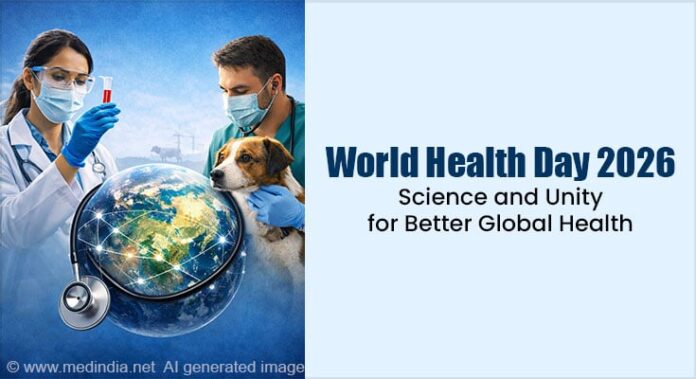
World Health Day 2026 promotes evidence-based health policies and the One Health approach to strengthen global public health systems.
- WHO theme emphasizes science-based decision-making in healthcare
- One Health approach integrates human, animal, and environmental health
- Global events aim to strengthen international health collaboration
World Health Day, observed every year on April 7, marks the founding of the World Health Organization (WHO) and draws attention to global health priorities (1✔ ✔Trusted Source
World Health Day 2026
Go to source
).
In 2026, the theme “Together for health. Stand with science” highlights the role of evidence-based healthcare, coordinated action, and integrated health systems.
The campaign emphasizes that many emerging infectious threats are linked to interactions between humans, animals, and the environment, supporting the relevance of the One Health approach.
This is a global public health campaign based on established scientific understanding rather than a single new study. Therefore, parameters such as sample size and study duration are not applicable.
Why Evidence-Based Public Health Matters in 2026
The campaign reinforces that scientific evidence is essential for effective health decision-making. WHO highlights that misinformation can influence public behavior and affect trust in healthcare systems.
Key focus areas include:
- Strengthening confidence in vaccines and preventive care
- Encouraging use of verified health information
- Supporting policies guided by scientific research
Evidence from public health practice shows that informed communities are more likely to adopt preventive measures and improve overall health outcomes.
One Health Approach Connecting Humans, Animals, and Environment
The One Health approach is a central theme of the campaign, recognizing the interconnected nature of health systems. It promotes collaboration across multiple disciplines to address shared risks.
Core aspects include:
- Monitoring diseases that can spread between animals and humans
- Addressing environmental risks such as climate change and pollution
- Strengthening food safety and ecosystem health
This approach supports early detection of potential health threats and coordinated responses across sectors.
Global Events Driving Science-Led Health Collaboration
As part of the 2026 campaign, WHO has outlined key international events:
- One Health Summit in Lyon, France (April 5 to 7)
- Global Forum of WHO Collaborating Centers (April 7 to 9)
These events aim to bring together experts, policymakers, and public health professionals to strengthen collaboration and share best practices.
The campaign also encourages:
- Investment in scientific research
- Cross-border cooperation in disease monitoring
- Integration of environmental and health policies
Such initiatives are intended to support coordinated responses to global health challenges.
Challenges in Implementing Global Health Campaigns
While the campaign is grounded in established public health principles, certain limitations should be considered:
- It does not present new experimental data but builds on existing evidence
- Implementation depends on national resources and policy priorities
- Outcomes may vary across regions due to differences in health system capacity
Despite these factors, the campaign provides a structured framework for strengthening health systems through science-based strategies.
What World Health Day 2026 Means for Global Health
World Health Day 2026 highlights the importance of science-led policies, global cooperation, and integrated health approaches. By promoting the One Health framework and encouraging trust in scientific evidence, the campaign aims to support sustainable improvements in global health systems.
Frequently Asked Questions
Q: What is the theme of World Health Day 2026?
A: The theme is “Together for health. Stand with science,” focusing on science-based healthcare and collaboration.
Q: What is the One Health approach?
A: It is a strategy that integrates human, animal, and environmental health to manage health risks more effectively.
Q: Why is World Health Day important?
A: It raises awareness about global health priorities and encourages coordinated public health action.
Q: How does misinformation affect public health?
A: It can influence health decisions, reduce trust in medical advice, and impact health outcomes.
Q: Who should follow the recommendations of this campaign?
A: Policymakers, healthcare professionals, and the public are encouraged to adopt science-based practices.
Reference:
- World Health Day 2026 – (https://www.who.int/campaigns/world-health-day/2026)
Source-Medindia