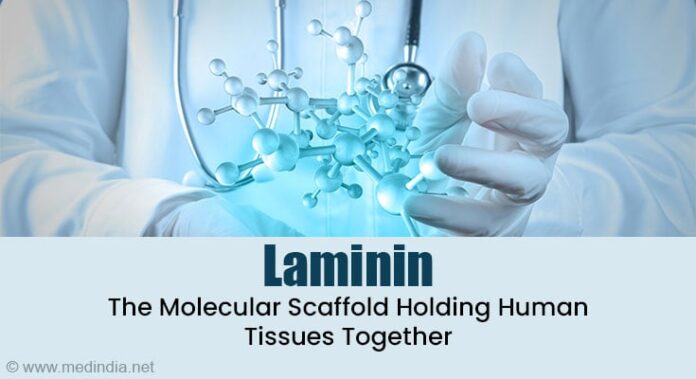
Laminin is a vital extracellular matrix protein that anchors cells, stabilizes tissues, and guides repair, according to major biological research reviews.
- Laminin builds the core scaffold of basement membranes
- It controls cell survival, migration, and tissue stability
- Genetic defects cause muscle weakness and fragile skin
Laminin belongs to a family of large extracellular matrix (ECM) glycoproteins that provide the architectural foundation of tissues (1✔ ✔Trusted Source
The role of laminins in cartilaginous tissues: from development to regeneration
Go to source
).
Two authoritative research reviews published in peer reviewed biomedical journals describe laminin as a dominant structural and signaling component of the basement membrane, the thin specialized sheet underlying skin, skeletal muscle, kidney filters, blood vessels, and peripheral nerves.
The basement membrane is not inert packing material. It functions as a mechanical support system and signaling platform that regulates how cells attach, migrate, proliferate, and survive. Laminin polymers form extensive sheet like networks that connect cells to surrounding matrix proteins such as collagen IV and nidogen, creating a resilient but dynamic scaffold essential for tissue integrity.
What Is Laminin Protein and How Is It Built
Detailed molecular analysis summarized in the cited reviews shows that laminins are heterotrimeric molecules assembled from three genetically distinct chains called alpha, beta, and gamma. Humans possess five alpha, three beta, and three gamma chains that combine into more than a dozen laminin isoforms.
Each isoform exhibits tissue specific distribution. Certain laminins dominate in skeletal muscle, others in kidney glomeruli, skin epidermis, or nervous tissue. Structurally, laminin adopts a cross shaped configuration that enables one domain to bind cell surface receptors while other arms polymerize with neighboring laminin molecules and matrix proteins. This architecture allows basement membranes to form continuous load bearing sheets.
How Laminin Maintains Tissue Integrity and Cell Survival
Experimental data compiled in the reviews demonstrate that laminin networks self assemble into highly ordered arrays and bind to integrins and dystroglycan on cell surfaces. These interactions physically link the extracellular matrix to the intracellular cytoskeleton and activate signaling pathways controlling polarity, migration, proliferation, and resistance to mechanical stress.
When laminin mediated adhesion is disrupted in laboratory models, cells detach, lose orientation, undergo programmed cell death, or fail to organize into proper tissue layers. During embryonic development, laminin guides migrating cells to their correct destinations. In adult tissues, it coordinates wound repair by directing epithelial and progenitor cells to repopulate damaged areas and restore barrier function (2✔ ✔Trusted Source
The laminin family
Go to source).
Which Human Diseases Are Linked to Laminin Defects
Both referenced reviews describe strong genetic and pathological evidence linking laminin abnormalities to multisystem disease. Mutations in laminin genes cause several forms of congenital muscular dystrophy, in which muscle fibers lose firm anchorage to basement membranes and progressively degenerate.
In skin, defective laminin interactions weaken adhesion between epidermal and dermal layers, producing blistering disorders such as epidermolysis bullosa. Altered laminin expression has also been associated with kidney filtration defects, peripheral neuropathies, and developmental abnormalities, underscoring how collapse of a single matrix scaffold can destabilize multiple organs.
Why Laminin Research Matters for Regenerative Medicine
The reviews further highlight how laminin biology is shaping tissue engineering strategies. Biomaterials coated with specific laminin isoforms are being explored to control stem cell differentiation and promote regeneration in nerve and muscle injury models. Such approaches rely on reproducing the same molecular cues that laminin provides in natural basement membranes.
Final Takeaway:
Extensive research synthesized in leading biomedical journals confirms that laminin is indispensable for human life. By forming the backbone of basement membranes, anchoring cells, and orchestrating essential signaling pathways, this protein quietly preserves organ structure and function while opening new avenues for regenerative therapies.
Frequently Asked Questions
Q: What is laminin protein in simple words
A: Laminin is a structural protein outside cells that acts like scaffolding to hold tissues together.
Q: Where in the body is laminin found
A: It is concentrated in basement membranes beneath skin, muscles, kidneys, blood vessels, and nerves.
Q: Why is laminin important for tissue health
A: It anchors cells, stabilizes organs, and regulates survival and repair signals.
Q: Which specialist should I consult for laminin related disorders
A: Patients may consult neurologists, genetic specialists, or internal medicine physicians depending on symptoms.
Q: Can laminin research lead to new treatments
A: Yes. Laminin based scaffolds are being studied for regenerative medicine and inherited muscle or skin diseases.
References:
- The role of laminins in cartilaginous tissues: from development to regeneration – (https://pmc.ncbi.nlm.nih.gov/articles/PMC7315463/)
- The laminin family
– (https://pmc.ncbi.nlm.nih.gov/articles/PMC3544786/)
Source-Medindia