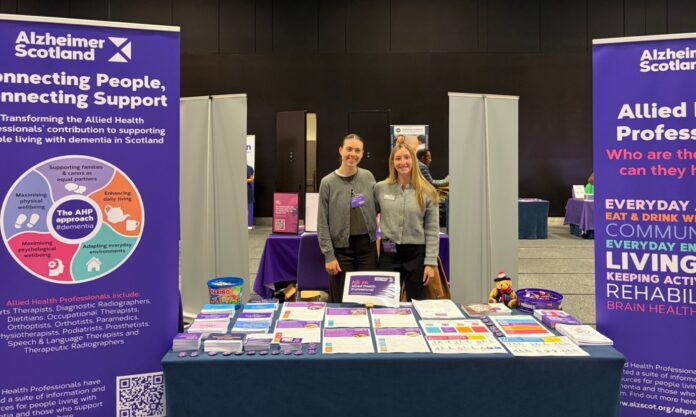
My name is Liana and I am a Physiotherapy student at Edinburgh Napier University. I spent 8 weeks on placement with Alzheimer Scotland and as part of this, I have had the opportunity to explore what physiotherapy can look like for someone living with dementia. One of the projects I have enjoyed working on was creating a resource called ‘How to Make your Physiotherapy Service Dementia Aware’, alongside my fellow Edinburgh Napier University physiotherapy student, Anna Richardson.
The idea behind the resource was simple – small changes CAN make a big difference. Physiotherapy can sometimes involve unfamiliar environments, new people, lots of information and instructions, and activities that might feel overwhelming. For someone living with dementia, these things can create additional barriers to accessing and engaging with physiotherapy. I wanted to create something practical and easy to use that could help physiotherapists think about how their service could be made more dementia aware. When creating the resource, I thought about physiotherapy as a whole experience, rather than focusing on the assessment or treatment itself. I wanted to consider what happens before someone even enters the department, as well as what happens during their appointment. To help shape the resource, I researched and read journal articles and guidance around creating dementia-aware and dementia-friendly healthcare services. This helped me understand that small changes to the way a service is designed and delivered can make a significant difference to the experience of someone living with dementia. I chose to focus on this area because being dementia-aware is not just about adapting the physiotherapy treatment itself – it is about making the whole journey through a service as accessible, comfortable, and supportive as possible. This encouraged me to think about areas such as communication, appointment times, the environment, and how exercise handouts are provided, alongside the assessment and treatment.
One of the first areas I focused on was getting to know the person. I highlighted the importance of considering the type of dementia that the person has and if a family member or carer will be attending alongside the patient (Griffiths et al., 2021). Most importantly, I wanted to encourage a person-centred approach. This is important in physiotherapy as it promoted dignity and respect, builds trust, encourages involvement, improves engagement, and focuses on what matters to the person (Hall et al., 2018). Everyone living with dementia is different, so it is important to think about what will help that person feel comfortable, safe, and supported.
I then looked at communication, which was one of the areas I found particularly interesting. I included simple suggestions such as using short, clear sentences, giving one instruction at a time, and allowing the person time to process information and respond (Alsawy et al., 2017). Demonstrations and gentle physical prompts may also be helpful (Alsawy et al., 2017). These are relatively small changes, but they can make communication feel much less overwhelming.
I also considered the wider environment. The section on treatment rooms encourages physiotherapists to create a warm and welcoming space, minimise unnecessary noise and distractions, and ensure that rooms are well lit (Alves et al., 2025; Wesson et al., 2013). It made me realise that being dementia aware is not always about doing something completely different. Sometimes it is simply about looking at an environment from another person’s perspective and considering how this might feel for them.
Another part of the resource focuses on accessible appointments. I suggested offering afternoon appointments where possible and providing text or telephone reminders (Griffiths et al., 2021). It is also important to give the patient a warm welcome and build a rapport early on (Ries, 2022)
I also included exercise handouts, which is particularly important in physiotherapy. I highlight the importance of keeping instructions short, simple, and clear, while using photographs, descriptions, or personalised videos to help demonstrate exercises (Quick et al., 2025).
What Will I Take Forward into Our Own Practice?
Creating this resource has encouraged me to think more deeply about how accessible physiotherapy really is. Before this placement, I probably would have focused more on adapting an assessment or exercise programme once I knew someone has dementia. I now understand that dementia-aware practice can start much earlier. It can involve how someone finds the department, how they are welcomed, how information is communicated, and whether the environment feels comfortable.
I also really enjoyed the process of creating something that can hopefully be useful beyond my placement. We had to think carefully about how to communicate information without making the resource overwhelming. This meant keeping the wording concise, using clear headings, and considering how the design could make the information easy to follow. It was a different skill from writing an academic assignment, but one that I think will be valuable as a future physiotherapist.
Most importantly, creating this resource has reinforced the importance of person-centred care for me. A diagnosis of dementia should never define the person or become a reason to lower expectations. Instead, we should think about what we can change within our practice to help someone participate as fully as possible.
As I begin my physiotherapy career, I want to carry this learning with me. I hope to become a physiotherapist who looks beyond a person’s condition and considers what I can do to make their experience feel easier, more comfortable, and more inclusive. Whether that is allowing a little more time, changing the way I give an instruction, reducing distractions, or adapting an exercise, these small adjustments can help someone feel more confident and included.
Creating this resource has shown me that making physiotherapy dementia aware does not necessarily require major changes. It starts with understanding, listening, and being willing to adapt. These are lessons that I will take forward into my practice, not only when working with people living with dementia, but with every person I have the opportunity to support.
What one thing has made accessing hospital or physiotherapy services
easier for you?
Contributor: Liana Mitchell, Edinburgh Napier University, Physiotherapy Student

Enjoyed this blog? Tell us more. We love feedback.
Please spend 1 minute completing this short anonymous feedback form to allow us to make our blog posts even better in 2026. Thank you
AHP Let’s Talk About Dementia Blog Feedback Form – Fill out form
References:
Alves, S. et al. (2025) Exploring Dementia-Friendly Environments in Long-Term Care Facilities: Perspectives from Multiple Stakeholders in Portugal, Journal of Aging and Environment, 39 (2), 193-211, https://doi.org/10.1080/26892618.2024.2302190.
Alsawy, S. et al. (2017) What is Good Communication for People Living with Dementia? A Mixed-Methods Systematic Review, International Psychogeriatrics, 29 (11), 1785-1800, https://doi.org/10.1017/S1041610217001429.
Griffiths, A. et al. (2021) Balancing the Needs of Individuals and Services in Cancer Treatment for People with Dementia: A Focused Ethnographic Study, International Journal of Nursing Studies, 121, https://doi.org/10.1016/j.ijnurstu.2021.104006.
Hall, A. et al. (2018) Are Physiotherapists Employing Person-Centred Care for People with Dementia? An Exploratory Qualitative Study Examining the Experiences of People with Dementia and their Carers, BMC Geriatrics, 2, https://doi.org/10.1186/s12877-018-0756-9.
Ries, J. (2022) A Framework for Rehabilitation for Older Adults Living with Dementia, Archives of Physiotherapy, 12 (9), https://doi.org/10.1186/s40945-022-0013405.
Quick, S. et al. (2025) What is Effective Physiotherapy for Dementia and How Do We Get There: A Qualitative Study, Physiotherapy Theory and Practice, 41 (7), 1447-1457, https://doi.org/10.1080/09593985.2024.2426181.
Wesson, J. et al. (2013) A Feasibility Study and Pilot Randomised Trial of a Tailored Prevention Program to Reduce Falls in Older People with Mild Dementia, BMC Geriatrics, 3, https://doi.org/10.1186/1471-2318-13-89.