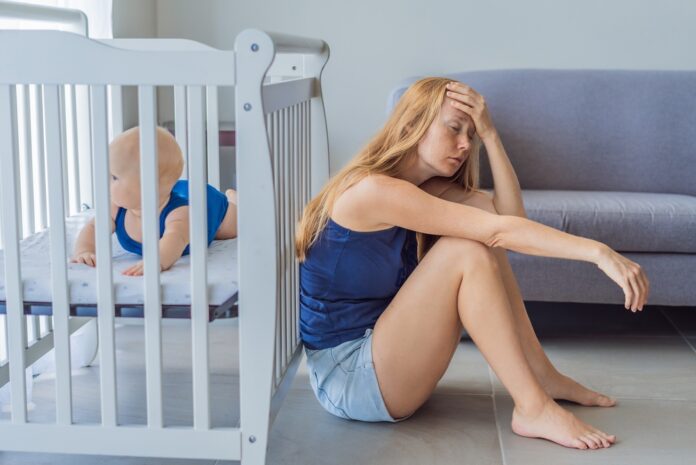
Stay awake, don’t rest your head, don’t lie down upon your bed.
The words Disney’s Mary Poppins sings in her lullaby might seem reminiscent of new parents’ experiences of disturbed sleep. Roughly half of pregnant individuals and two-thirds of those who have recently given birth suffer from poor sleep quality, with sleep disturbances being among the chief complaints (Yang Y. et al., 2020). Such poor sleep has long been established as a contributor to poor health, for example physically as a risk factor for cardiovascular disease (Itani O. et al., 2016) or mentally by being linked to depression (Riemann D. et al., 2019).
In light of the high prevalence of disturbed sleep in the months prior to, as well as after, birth and its strong connection to poor mental health, Cox and colleagues (2026) examined data from a previous study to assess the relationship between disturbed sleep and depressive, anxiety, and obsessive-compulsive symptoms, and coping skills. Their article was published in the journal Sleep under the title “Subjective sleep disruption, coping, and anxiety and related symptoms in the perinatal period: findings from a longitudinal study”.
Methods
Cox et al. (2026) made use of data from 231 adult women (mean age 33 years) recruited as part of a previous study (Abramowitz et al. 2025). The original study was designed to investigate obsessive-compulsive disorder-related processes and stratified recruitment based on participants’ baseline scores on the Obsessive Beliefs Questionnaire, selecting females with either high (>130) or low (< 96) scores. Participants with incomplete data were excluded from the relevant analyses.
In the current paper (Cox et al. 2026), data on insomnia symptoms (via the Insomnia Severity Index), subjective sleep duration, coping skills (via a subscale of the Perceived Stress Scale (PSS)), anxiety (via the Perinatal Anxiety Screening Scale), obsessive beliefs (via the Obsessional Beliefs Questionnaire), obsessive-compulsive symptoms (via the Yale-Brown Obsessive-Compulsive Scale), and depression (via the Edinburgh Postnatal Depression Scale) were analysed. This information was gathered at 20 weeks pregnant, 34 weeks pregnant, six weeks postnatal, and six months postnatal.
The authors analysed the data using two-level multilevel linear regression models, with the four timepoints (level 1) nested within participants (level 2) and random intercepts. This allowed them to examine both changes within individual participants over time and differences between participants. Sleep and coping were person-mean centred at level 1 and grand-mean centred at level 2. Age and parity included as covariates.
Results
Baseline correlations
At the first timepoint, approximately one quarter of the mothers reported clinically significant insomnia, anxiety symptoms, or moderate obsessive-compulsive symptoms. Seven percent of the participants also reported clinically significant depressive symptoms. Insomnia symptoms were negatively correlated with sleep duration (r = -0.56) and coping (r = -0.33), and positively correlated with anxiety (r = 0.50), obsessive beliefs (r = 0.44), obsessive-compulsive symptoms (r = 0.42), and depression (r = 0.41). Sleep duration correlations were weaker, but followed the same pattern as those for insomnia symptoms. Coping skills were negatively correlated with anxiety (r = -0.54), obsessive beliefs (r = -0.39), obsessive-compulsive symptoms (r = -0.35), and depression (r = -0.60). Anxiety, depression and obsessive symptoms were positively correlated, with moderate to large coefficients ranging from r = 0.37 between obsessive-compulsive and depressive symptoms to r = 0.76 between anxiety and obsessive beliefs.
Changes over time
Over the course of pregnancy and the first six months postpartum, insomnia symptoms were highest at 34 weeks pregnant and lowest at six weeks postnatal. Sleep duration decreased during pregnancy and increased again postpartum, but it remained lower at six months postpartum than at the first timepoint. Obsessive beliefs decreased between 20 and 34 weeks of pregnancy and remained stable thereafter.
Between-person associations
When comparing mothers’ average experiences across the study, the authors found that mothers who reported:
- Mothers with more insomnia symptoms or lower coping reported higher anxiety, obsessive beliefs, obsessive-compulsive symptoms and depressive symptoms.
- Mothers with shorter sleep reported higher anxiety, obsessive beliefs and obsessive-compulsive symptoms, but not higher depressive symptoms.
- Coping changed some of these links for anxiety and depression, but not for obsessive beliefs or obsessive-compulsive symptoms. In mothers with lower coping, shorter sleep was linked with higher anxiety and depression, and insomnia with higher depression. These links were not seen in mothers with higher coping.
Within-person associations
The authors additionally analysed changes within each participant over time and learned that shorter sleep duration predicted subsequent increases in perinatal anxiety (B = -0.63, p < .05) and obsessive beliefs (B = -2.17, p < .05). However, anxiety and related symptoms did not predict subsequent sleep disruption.
Results table
| Outcome | Above clinical cut-off at 20 weeks | Mothers with more insomnia symptoms scored higher | Mothers with shorter sleep scored higher | Mothers with lower coping scored higher | Less sleep than usual predicted a later rise | Did coping change the sleep link? |
|---|---|---|---|---|---|---|
| Anxiety | 28% | Yes (B = 1.19, p < .001) | Yes (B = −3.18, p < .001) | Yes (p < .001) | Yes (B = −0.63, p < .05) | Yes. Shorter sleep linked to anxiety only with lower coping; insomnia link weaker with higher coping |
| Obsessive beliefs | No cut-off (recruitment stratified on this measure) | Yes (B = 3.42, p < .001) | Yes (B = −11.57, p < .001) | Yes (p < .001) | Yes (B = −2.17, p < .05) | No |
| Obsessive-compulsive symptoms | 23% (moderate or above) | Yes (B = 0.69, p < .001) | Yes (B = −1.94, p < .001) | Yes (p < .001) | No (p = .83) | No |
| Depressive symptoms | 7% | Yes (B = 0.22, p < .001) | No (p = .19) | Yes (p < .001) | No (p = .68) | Yes. Both sleep links seen only with lower coping |
27% of mothers had clinically significant insomnia symptoms at 20 weeks. B values are unstandardised. For sleep duration, a negative B means each extra hour of sleep went with lower scores. Insomnia symptoms did not predict later change in any outcome within mothers, and no symptom predicted later sleep problems. Lower and higher coping were defined as 1 standard deviation below or above the sample mean.

Conclusions
The authors found that perinatal anxiety, obsessive-compulsive symptoms, and depression were closely intertwined and were each associated with disturbed sleep.
Furthermore, shortened sleep was identified as a predictor of following anxiety and obsessive beliefs. As stated by R. C. Cox and her colleagues, the results:
highlight sleep disruption as an important factor to consider in the emergence and maintenance of anxiety and related symptoms in the perinatal period.
Several of the associations were moderated by the mother’s coping skills, such that some associations between sleep disruption and mental health symptoms were not observed among mothers with high coping skills.

Strengths and limitations
The study holds several strengths. The authors used a comparatively large sample of 231 women and collected data at four reasonably chosen timepoints over a six-month period spanning pregnancy and the postpartum period. The variables were assessed with well-established and psychometrically sound measures. Given the nested nature of the data, choosing to analyse it with a multilevel model was appropriate. The authors also included lagged effects and considered possible bidirectionality.
Yet, some of the selected measures are limited. In particular, choosing to operationalise sleep disturbance primarily through insomnia symptoms only acknowledges disturbances that are considered pathological, when many struggles with sleep during pregnancy and while parenting a newborn are healthy and appropriate reactions. The authors acknowledge this. In light of this limitation and the finding that sleep quality is more strongly connected to mental health than sleep duration in other populations (Muzni K. et al., 2021), using a sleep quality measure like the Pittsburgh Sleep Quality Index that includes other sleep disturbances might have been more fitting. This could also be a reason why the association between sleep and mental health was unidirectional in the present study when it is more commonly found to be bidirectional (e. g. Fang H. et al., 2019). Measuring coping via the items of the PSS that refer to coping is similarly problematic.
It is difficult to judge the generalisability of the results. The paper gives only brief details of recruitment (two sites in the USA, through provider referrals, other studies and social media adverts), and the authors note that the sample was largely white, high income and highly educated. Several characteristics of the resulting sample are published, but only age and parity are included as control variables in the analyses. While this might be due to a desire to keep sufficient statistical power, it does not account for other potential influences such as living situation (i.e., noise or light pollution, or social support), for example, a potential partner responding to some disturbances rather than the mother to respond to all themselves.
Implications for practice
The majority of individuals who are either pregnant or recently have given birth experience poor sleep (Yang Y. et al., 2020). The findings by Cox et al. (2026) suggest that this widespread issue may be associated with poorer mental health, particularly anxiety and obsessive beliefs, but also depressive symptoms. The scarce information on the sample and the exclusion of women with moderate scores on the Obsessive Beliefs Questionnaire makes it difficult to assess the external validity (i.e., generalisability) of the results. Even though it may be worth studying this connection in a way that acknowledges more diverse disturbances and sleep quality, the present study still strongly suggests that sleep health should be an important topic in maternal health care. It may be a promising starting point for preventative interventions regarding peri- and postnatal anxiety as well as obsessive-compulsive symptoms and beliefs.
As discussed in the Mental Elf article “Bundle of joy, bundle of nerves: What do we really know about postpartum anxiety?” (Shipp L., 2025), postnatal anxiety affects roughly every tenth mother and can have negative effects on both the mother’s and the child’s health. Therefore, identifying a modifiable risk factor or warning sign is potentially valuable. Effective non-pharmacological treatments for perinatal insomnia already exist (Felder J. N. et al., 2026). This study suggests that it might be worth offering behavioural sleep interventions to expectant mothers more broadly.
Additionally, Cox and her colleagues’ findings identify coping as a moderator of the relationship between disturbed sleep and subsequent symptoms, such that good coping skills might act as a buffer. While future research should examine this with other, more specific operationalisations of coping skills, this is another modifiable factor for which effective interventions are already being developed (e.g., Kuipers Y. J., et al. 2024). This study underlines the need for such programs.
Listening to soothing music like a lullaby can be a great sleep aid, but if you choose Mary Poppins’ lullaby, please only follow her intention of initiating sleep and not her words, “Stay awake, don’t rest your head, don’t lie down upon your bed.”

Statement of interests
Hannah Bielefeld declares no conflicts of interest. She did not use AI in the preparation of this blog.
Editor
Edited by Éimear Foley. ChatGPT assisted with language refinement and formatting during the editorial phase.
Links
Primary paper
Rachel C. Cox, Caitlin P. Hoyniak, Jonathan Samuels, Jonathan S. Abramowitz, Gerald Nestadt, Eric A. Storch, Rachel Musci, Paul Nestadt, Lauren M. Osborne, Margaret Kimmel (2026). Subjective sleep disruption, coping, and anxiety and related symptoms in the perinatal period: findings from a longitudinal study. SLEEP, 49(7). https://doi.org/10.1093/sleep/zsag089
Other references
Abramowitz, J. S., Hellberg, S. N., Krasnow, J., Friedman, J. B., Myers, N. S., Nestadt, P. S., Ojalehto, H. J., Juel, E. K., Samuels, J., Kimmel, M. E., Osborne, L. M., Storch, E. A., Nestadt, G. & Musci, R. J. (2025). Prenatal obsessive beliefs predict postpartum obsessive-compulsive symptoms: a prospective study. Psychiatry Research, 351, 116620. https://doi.org/10.1016/j.psychres.2025.116620
Fang, H., Tu, S., Sheng, J., & Shao, A. (2019). Depression in sleep disturbance: A review on a bidirectional relationship, mechanisms and treatment. Journal of Cellular and Molecular Medicine, 23(4), 2324–2332. https://doi.org/10.1111/jcmm.14170
Felder, J. N., McClelland, B., Sorensen, C., Brown, M. & Mah, R. (2026). Behavioral Sleep Therapies During the Perinatal Period: A Scoping Review. Current Sleep Medicine Reports, 12(1), 5. https://doi.org/10.1007/s40675-026-00359-x
Itani, O., Jike, M., Watanabe, N. & Kaneita, Y. (2016). Short sleep duration and health outcomes: a systematic review, meta-analysis, and meta-regression. Sleep Medicine, 32, 246–256. https://doi.org/10.1016/j.sleep.2016.08.006
Kuipers, Y. J., Bleijenbergh, R., Rimaux, S. & Mestdagh, E. (2024). The effect of a web-based intervention on perinatal emotional wellbeing and coping: A nested case-control study. Mental Health & Prevention, 33, 200332. https://doi.org/10.1016/j.mhp.2024.200332
Muzni, K., Groeger, J. A., Dijk, D.‑J., & Lazar, A. S. (2021). Self-reported sleep quality is more closely associated with mental and physical health than chronotype and sleep duration in young adults: A multi-instrument analysis. Journal of Sleep Research, 30(1). https://doi.org/10.1111/jsr.13152
Riemann, D., Krone, L. B., Wulff, K. & Nissen, C. (2019). Sleep, insomnia, and depression. Neuropsychopharmacology, 45(1), 74–89. https://doi.org/10.1038/s41386-019-0411-y
Yang, Y., Li, W., Ma, T., Zhang, L., Hall, B. J., Ungvari, G. S. & Xiang, Y. (2020). Prevalence of Poor Sleep Quality in Perinatal and Postnatal Women: A Comprehensive Meta-Analysis of Observational Studies. Frontiers in Psychiatry, 11, 161. https://doi.org/10.3389/fpsyt.2020.00161