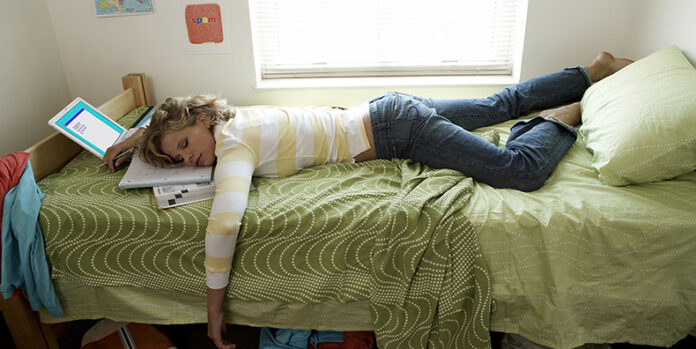
For college students, sticking to a sleep schedule is a challenge — and even more so when you add bipolar disorder to the mix.
As a college student, it’s challenging to balance routines, like getting enough sleep, against dealing with the unpredictable nature of college life, especially for those of us with bipolar disorder.
- What if you have a paper due the next day that you must finish before you sleep?
- What if your roommate has the TV on when you’re trying to unwind?
- What if you get a text or want to scroll on your phone for a bit before bed?
- What if watching your favorite show before bed calms you down enough to fall asleep?
Especially if you live on campus and in a dorm with others, your routines will be thrown off — particularly for sleep routines.
While you need to get adequate and quality sleep — and follow a routine in general — when you have bipolar disorder, it is also essential to recognize that it is not likely for college students to do so, bipolar or not.
Here are some practical yet feasible tips I’ve learned — and currently utilize — to better manage my sleep while living in my school’s housing.
Reduce Your Blue Light Exposure
The research is undeniably true: Blue light before bed impacts your ability to fall asleep and stay asleep. I’ve also seen this firsthand myself. Here are a few helpful strategies to protect your body’s natural sleep cycle:
- If possible, avoid screen time (computers, phones, tablets, and even TV) in the hour leading up to bed.
- If you have both reading homework and computer-based tasks, aim to complete your screen-heavy work earlier in the day. Save any textbook reading or note reviewing for later in the evening when you can step away from your computer.
- If you absolutely must look at a screen, adjust the settings on your devices to reduce blue light exposure.
Although the research is variable, I have found blue-blocking glasses very helpful.
Have a Nighttime Routine — That You Can Stick To
One of the things I did wrong when I first started to have a nighttime routine was trying to do everything right. I would begin my routine precisely an hour before bed and obsess over ensuring I was following all the best advice, step by step.
I often read about what others would do to wind down: shower, have a cup of tea, journal, meditate — the list seems endless. And while these suggestions are all great, I quickly realized that trying to implement them all was actually making my nighttime routine more stressful.
The Centers for Disease Control and Prevention offers some evidence-based recommendations for improving sleep hygiene. These include:
- Do not use electronics for at least a half-hour before bed.
- Exercise regularly, but not too close to bedtime.
- Avoid eating heavy meals before going to sleep.
- Make sure the temperature of your room is cool and that it’s quiet.
- Go to bed at the same time every day and get up at the same time every day.
These are excellent tips, but as a college student, I found some of them to be challenging to apply consistently. At first, I was so focused on “doing it right” that I lost sight of the ultimate goal: getting good, regular sleep. And when I was too exhausted or depressed, I’d skip the routine altogether because it felt too much.
Plus, what if I had just gone out with friends? Would I then need to wait an extra hour to follow the perfect presleep routine?
RELATED: How Daily Routine Can Help Bipolar Symptoms
Eventually, I learned that adjusting the process and finding what fits my lifestyle are okay. Instead of following every step perfectly, I started small and experimented with what worked for me. After some trial and error, I found a simple routine that felt more manageable and effective. Now, as my prebedtime ritual, I focus on just a few key steps:
- Wash my face
- Brush my teeth
- Put on moisturizer
- Slip on my blue light-blocking glasses
- Relax for a bit before I go to bed
These small, calming activities signal to my body that it’s time to unwind and prepare for sleep. Everyone’s routine will look different, and that’s okay! The key is to look at evidence-based strategies and tailor them to what makes the most impact for you. Start small, make it doable, and focus on consistency. Over time, your body will respond to these cues, and you’ll find it easier to fall into a restful, relaxing sleep.
Speak to Disability Services at Your School for an Accommodation
The thing that undeniably helped me the most with sleeping properly while in school was contacting disability services.
I made the mistake of initially contacting them after I had already had an awful first semester due to my bipolar symptoms. Contacting them before I started my classes would have assisted me in reaching my full potential for that first semester. Instead, I spent the rest of my time at college “fixing” my first semester grades.
Disability services helped me with a variety of things. Regarding sleep, they allowed me to register early for my classes. With this, I have been able to choose classes that start at a time that works well for me. This way, I can be sure to get enough sleep beforehand.
RELATED: Sleep Solutions for Managing Bipolar Disorder
Everyone requires a different amount of sleep; some people may need at least eight hours, while others do better on more or less.
If my ideal time to sleep is midnight, an 8 a.m. class will either majorly disrupt my ability to rest or have me starting my day without being prepared. Instead, I aim for my first classes of the day to start between 10 a.m. and 12 p.m.
It might be tempting to schedule all of your classes for 2 p.m. or later so you can go to sleep around 2 or 3 a.m., but I’ve found that this makes things less effective. I then oversleep, which we all know can lead to a depressive episode instead of a hypomanic one.
After making use of this particular accommodation, my sleep anxiety has very much decreased. Now, I don’t have to worry about going to bed at a specific time, such as 10 p.m., to get my desired sleep.
Listen to the Advice Out There — But Do What Works Best for You
All in all, I’ve found that the best advice is listening to my own advice — adopting what others have said and adapting it to my particular situation.
When it comes to any kind of routine, including a sleep routine, you need to leave yourself a little wiggle room.
And it helps if you always keep the focus on the end goal: getting quality sleep.
When you think about it, it’s similar to bipolar treatment: It’s not “one size fits all.” What matters most is taking all the ideas you hear and research you find — and then using this and that to create the best routine for you.
Editorial Sources and Fact-Checking