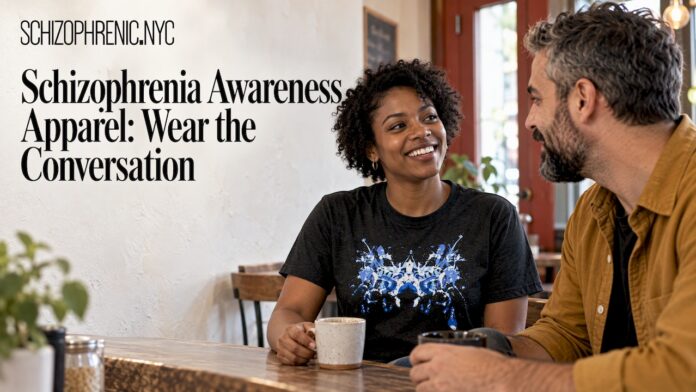
Schizophrenia awareness apparel is clothing that carries a message about the condition, so that a stranger on the subway, a coworker or a relative sees the word and the conversation begins. The best pieces do two things at once: they look like something you would wear anyway, and they treat the diagnosis with respect. Schizophrenic.NYC was built on that idea. Michelle Hammer, a schizophrenia activist, designs bold graphic shirts, hoodies, tank tops and accessories so people living with the condition, and the people who love them, can wear their support openly.
This guide explains why apparel works as advocacy, what separates a thoughtful design from a careless one, how to wear a shirt in public and at work, and how to pair it with other awareness efforts.
TL;DR
- Awareness apparel works because it is a small, repeatable conversation starter: the wearer does not have to explain anything until someone asks.
- Good designs use respectful, people-first language and avoid jokes at the expense of people with the condition.
- Research on anti-stigma images suggests the picture you choose should match the outcome you want, whether that is empathy or understanding.
- Schizophrenic.NYC offers T-shirts, tank tops, hoodies, pillboxes, jewelry, prints and more, all designed with lived experience behind them.
- Pair what you wear with action: learn, talk, and join a stigma-reduction campaign.
Table of Contents
Why wear schizophrenia awareness apparel at all?
Schizophrenia is a serious mental illness that affects how a person thinks, feels and behaves, as the National Institute of Mental Health describes it. The World Health Organization reports that about 1 in 300 people worldwide, roughly 27 million, live with it. That makes it far more common than most people assume, and yet the same WHO fact sheet notes that stigma, discrimination and violations of human rights are common for people with the condition.
Stigma rarely shows up as one dramatic event. It shows up as a lowered voice, a joke, a headline that links illness to violence, a friend who stops calling. Because it lives in everyday moments, everyday objects can push back against it. A shirt is one of the few things you wear in front of other people for hours at a time. It does not lecture. It simply makes the word “schizophrenia” visible in a context where it is rarely spoken kindly.
There is a long tradition behind this. People have used clothing to carry causes for generations, and the thinking behind it is explored in an article on fashion activism and social change. What makes mental health different is that many people cannot see the cause on someone’s face. A shirt gives the cause a voice.
If you want the longer case, our own pages walk through why wear schizophrenia awareness apparel and what schizophrenia awareness apparel is.
Who wears it, and what they get from it
The people who wear awareness apparel are not one group, and each gets something different from it.
People with a diagnosis. For some, wearing the word is a way of refusing shame. It says: this is part of my life, and I am not hiding it. For others, it is a quieter signal to people who understand. Either way, the choice is theirs, and that matters. Nobody should feel they must disclose to be part of the cause.
Family and friends. Allies often do not know how to show support without speaking for someone. Wearing a shirt lets them stand beside the people they love without putting anyone’s story on display.
Clinicians, educators and advocates. A therapist, teacher or peer-support worker can wear a design to a conference, a classroom or a community event and signal that the room is safe for honest talk.
Art and fashion fans. Plenty of customers simply like bold graphic design and want it to mean something. That is a perfectly good reason, and it widens the audience beyond people already touched by the condition.

What makes a design respectful and effective
Not every shirt that mentions mental illness helps. Some novelty designs lean on tired jokes about “hearing voices” or “being crazy,” which feeds the stereotype instead of challenging it. A few questions sort the good from the careless.
Does the language put the person first?
The NJAMHA 2023 State of Workforce Mental Health Report, based on a survey of more than 2,500 US employees, recommends people-first language, such as “a person with a substance use disorder” rather than a label. It also warns that casual phrases like “she’s being crazy today” can contribute to stigma. The same principle applies to a slogan on your chest. A line that describes a person and their experience carries more weight than a line that turns a diagnosis into a punchline.
Does the image match what you want people to feel?
A University of Nebraska Omaha experiment with 92 participants, published by the university’s psychology faculty, compared photographs with cartoons in anti-stigma messages. Photographs produced greater empathic closeness and reduced the wish for social distance, especially for less common illnesses like schizophrenia. Cartoons, meanwhile, increased comprehension. The authors conclude that the picture should be chosen to match the outcome and the illness.

For apparel, that translates into a practical rule. If you want a stranger to feel closer to a person with schizophrenia, lean toward human, concrete imagery. If you want to explain something quickly, such as what the condition is or what the three symptom groups are, a clear graphic or short phrase can do the teaching.
Does it show nuance rather than fear?
A study of 80 graphic design students in Türkiye, reported in the Turkish Journal of Clinical Psychiatry, found that a 60-minute session led by a psychiatrist reduced stigma scores. It also shifted the students’ awareness posters toward nuanced metaphors and storytelling driven by empathy. Color and typography barely changed. In other words, what improved the work was understanding, not a new font. Designs made by people who know the subject tend to read as honest for the same reason.
Who made it?
This is the question we care about most. A design shaped by someone who has lived with schizophrenia carries details that an outsider tends to miss: the humor people actually use, the symbols that mean something, the things nobody should joke about. That is why we say plainly that Schizophrenic.NYC designs come from a schizophrenia activist with lived experience.
A quick checklist before you buy any awareness shirt
- Read the words out loud. Would you say them to a person with the diagnosis, face to face?
- Look for people-first phrasing. Statements about experience and support land better than labels.
- Check the tone. Bold and funny can work when the humor invites people in. It fails when the diagnosis is the target.
- Think about the audience. A design for a rally can be louder than one for a classroom.
- Ask who profits and who designed it. Support designers and advocates who are part of the community.
How lived experience shapes what we make
The designs at Schizophrenic.NYC are by Michelle Hammer, who lives with schizophrenia and has spent her career as an advocate. The shop pairs bold graphic artwork with clothing and accessories made to start conversations and reduce stigma. The line includes mental health T-shirts, awareness tank tops, and hoodies and sweatshirts, plus pillboxes, tote bags, mugs, stickers, buttons, necklaces, rings and earrings.
Some favorites show the range. The Psych Meds Keep It Real tee speaks directly about medication, a topic many people avoid. The Black Blue Ink tee is a graphic piece for people who want art first and a conversation second. The Blue Rorschach hoodie turns a famous psychology image into a cozy layer.
If you want something beyond clothing, the pillboxes put a daily routine in a design you are happy to carry, and the artwork, prints and buttons let you bring the message into a room or onto a bag. There are also canvas prints for walls.
Wearing your shirt in public and at work
Wearing awareness apparel is your choice, and you can decide the setting every time. A few things help.
Decide what you are comfortable sharing. A shirt invites questions. Before you wear it somewhere new, think about what you would say if someone asks, and what you would not. “It’s a cause I care about” is a complete answer.
Pick the right piece for the room. A tee or hoodie suits a weekend, a walk or a campus. A pin, a button or a pillbox carries the message more quietly in a workplace where you want a lower profile.
Bring people-first language to the conversation. The NJAMHA report recommends putting mental health on meeting agendas and supporting employee resource groups to foster dialogue. If your shirt sparks a question at work, that can be a natural moment to mention those ideas.
Expect mixed reactions. Most people are curious and kind. Some are awkward. A calm, short reply works in both cases. If a workplace comment crosses into harassment, you may want to talk with your HR team, a union representative or an employment lawyer about your rights.
Look after yourself first. If you live with schizophrenia and feel unsure about disclosing in a particular setting, talk it through with your care team or a trusted peer. There is no rush, and the cause does not need you to take a risk you are not ready for.
What the evidence says about conversation and stigma
Public understanding of schizophrenia is often shaped by fear. Hammer made a point of this in a MM+M report on a New York installation that simulated hallucinations and racing thoughts to show the positive, negative and cognitive symptom groups. In it she says that no symptom makes someone a violent person. That single sentence is the sort of correction a shirt can carry into everyday life.
The WHO fact sheet adds a reason for hope: a range of effective care options exists, and at least one in three people with schizophrenia will be able to fully recover. Awareness matters because stigma can stand between a person and that care. When people feel safe talking about a diagnosis, they are more likely to seek help, stay in treatment and hold on to their relationships.
One caution keeps us honest. A shirt does not replace treatment, and it does not diagnose anything. It opens a door. What happens next depends on listening.
Beyond the shirt: efforts that go well with awareness apparel
Apparel is strongest when it joins a bigger movement. The National Alliance on Mental Illness (NAMI) runs a StigmaFree campaign that asks individuals, businesses, colleges and communities to learn about mental illness, see the person and not the illness, and take action. According to NAMI’s 2015 annual report, more than 10,000 people took the pledge that year, and its “Hope Starts with You” public service announcements, including one on schizophrenia, reached more than 185 million people nationwide.
Here are a few ways to combine the two:
- Wear it to an event. Walks, support groups, campus talks and community fairs are good places for a shirt to meet people who want to talk.
- Take the StigmaFree pledge. It turns a visible gesture into a commitment.
- Share a story, not a slogan. If someone asks about your shirt, one sentence about why it matters to you can land harder than any statistic.
- Invite a speaker. Michelle is available for public speaking, and you can find that option on our main site.
- Give a gift with meaning. A pillbox or tote can say “I see you” to a friend or relative in a way a greeting card cannot.
Our perspective
We started this brand because we wanted people with schizophrenia to see themselves on clothes that looked good, said something true, and did not apologize.
When I design a piece, I think about two people. The first is someone who is newly diagnosed and wondering whether they will ever feel normal again. The second is the stranger who has only ever heard the word in a scary headline. A good design speaks to both. It tells the first person they are not alone, and it gives the second a reason to be curious instead of afraid.
That is why we put the artwork first. Bold graphics get noticed. Noticing leads to questions, and questions lead to the kind of real talk that reduces stigma. A tee, a tank top, a hoodie or a pillbox is a small thing, but it is something you can wear every week, and a conversation repeated every week adds up.
Wearing your story, or standing with someone who tells theirs, is a hopeful act. It says that confidence can get you anywhere, and that nobody should have to walk there quietly.
Michelle
Find your piece
If you are ready to wear the message, start with the mental health T-shirts for an everyday option, the hoodies and sweatshirts for cooler days, or the tank tops for warmer ones. Our pillboxes, mugs, stickers, totes and jewelry are there when you want something smaller. Every item is designed to open a conversation, and you choose how far it goes.
FAQ
What is schizophrenia awareness apparel?
It is clothing and accessories that carry a message of support, understanding or education about schizophrenia. The goal is to make the condition visible in a respectful way and to start conversations that reduce stigma. Our overview page goes into more detail.
Do I have to have schizophrenia to wear an awareness shirt?
No. Family members, friends, clinicians, educators and allies wear awareness apparel to show support. The key is to wear it respectfully and to let people with lived experience lead the conversation about their own stories.
How do I answer when someone asks about my shirt?
Keep it short and honest. You can say it supports people with schizophrenia and that you want to cut down on stigma. You decide how much personal detail to share, and “I care about this cause” is always enough. People-first language, such as “a person with schizophrenia,” keeps the tone respectful.
Is it appropriate to wear awareness apparel at work or school?
Often yes, especially in settings that welcome conversations about mental health. If you prefer a lower profile, a button, a pillbox or a small piece of jewelry carries the message more quietly. If you ever face unfair treatment because of it, an HR representative or an employment lawyer can explain your options.
What else can I do besides wearing a shirt?
Learn about the condition from reliable sources, use people-first language, take part in a campaign such as NAMI’s StigmaFree pledge, and listen to people who live with schizophrenia. Apparel is a starting point, and action is what carries it forward.