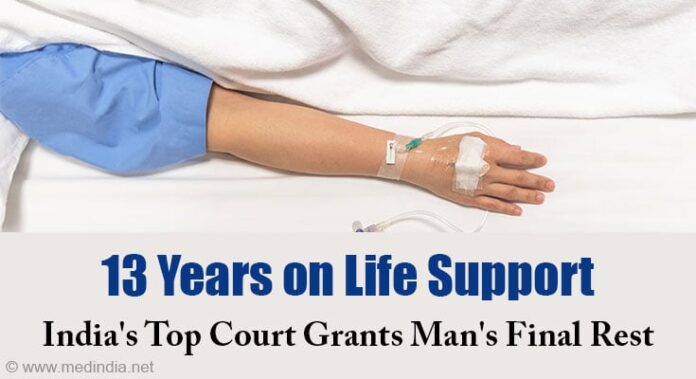
In a landmark move, the Supreme Court has allowed a family to withdraw life support for their son who has been in a coma for 13 years, upholding his right to die with dignity.
- Supreme Court allows passive euthanasia for 32-year-old Harish Rana in a vegetative state since 2013
- Court orders tailored withdrawal of life support including nutrition tubes to ensure dignity in death
- Judgment clarifies application of 2018 and 2023 guidelines on withdrawing feeding tube support
A landmark ruling has allowed passive euthanasia for a 32-year-old man who has remained in a vegetative state for 13 years (1✔ ✔Trusted Source
Supreme Court Allows 1st Passive Euthanasia For Man In Vegetative State For 13 Years
Go to source
).
In a historic judgment, the Supreme Court permitted the withdrawal of life support for Harish Rana, a 32-year-old resident of Ghaziabad who has been living in a vegetative condition for more than a decade.
A bench consisting of Justice JB Pardiwala and Justice KV Viswanathan approved the removal of life-sustaining support for Rana, who has remained in a coma since suffering severe head injuries after falling from a building in Chandigarh in 2013. Since the accident, he has been kept alive through medical tubes that provide breathing assistance and nutrition.
Supreme Court Allows Withdrawal of Life Support
The case marks the first known instance in India where passive euthanasia has been ordered by a court after the practice was legalized in 2018 and revised in 2023. The decision reinforced the recognition of a fundamental right to die with dignity.
According to observations from the bench quoted by LiveLaw, Harish Rana, now 32 years old, had once been a promising young student.
After falling from the fourth floor of his paying guest accommodation, he suffered a devastating brain injury that left him in a Persistent Vegetative State (PVS) with complete quadriplegia.
Complete quadriplegia is a severe form of paralysis in which loss of motor and sensory function affects all four limbs and the torso, usually due to a complete spinal cord injury in the cervical region. Medical records presented before the court indicated that his condition has shown no improvement over the past 13 years.
Medical Reports Confirm No Scope for Recovery
The court also highlighted that the ongoing treatment provided to Rana mainly involved Clinically Administered Nutrition delivered through surgically inserted PEG feeding tubes. The judges noted that this treatment could only extend his biological existence without offering any possibility of therapeutic recovery.
These findings played a crucial role in the court’s decision, as the medical evidence demonstrated that continuing such treatment would not lead to any meaningful improvement in his health condition.
Background of the Harish Rana Case
Harish Rana was a Bachelor of Technology student in Chandigarh when he sustained a severe traumatic brain injury in August 2013 after falling from the fourth floor of his paying guest residence.
Since that accident, he has remained bedridden and entirely dependent on others for daily activities. His condition has required continuous medical care and support for basic bodily functions.
Legal Journey From High Court to Supreme Court
In 2024, Rana’s father approached the Delhi High Court seeking permission for passive euthanasia for his son. However, the plea was rejected because the patient was not classified as terminally ill.
Later that year, the father moved the Supreme Court with the same request. The apex court initially declined to consider the petition but directed the Uttar Pradesh government to cover the expenses of Rana’s medical treatment.
Medical Boards Examine the Patient
In 2025, Rana’s father filed a miscellaneous application before the Supreme Court again, stating that his son’s condition had no possibility of improvement.
Following this submission, the court ordered the formation of two medical panels. A Primary Medical Board led by the District Hospital in Noida was tasked with examining Rana’s condition, while a Secondary Medical Board was constituted at the All India Institute of Medical Sciences to conduct an additional assessment.
After reviewing the reports submitted by the medical boards, Justice Pardiwala described the findings as deeply distressing, stating that the patient could not continue living in such circumstances. Before issuing the final order, the court also met with Rana’s parents.
The Supreme Court directed the All India Institute of Medical Sciences to provide palliative care to ensure that the withdrawal of Clinically Administered Nutrition is carried out properly.
Guidelines for Withdrawing Life Support
To ensure that the process respects the dignity of death, the apex court instructed that life-sustaining support must be withdrawn according to a carefully planned procedure.
The ruling also clarified the application of passive euthanasia in situations where a patient’s survival depends on feeding tubes.
Changes Following the 2018 Passive Euthanasia Ruling
In 2018, a five-judge Constitution Bench of the Supreme Court recognized and permitted passive euthanasia while also allowing individuals to create living wills or advance directives.
Later in 2023, the court modified the guidelines and stated that withdrawal of life support would be allowed only after approval from both a Primary Medical Board and a Secondary Medical Board.
Through the Harish Rana judgment, the Supreme Court further clarified how passive euthanasia should be implemented in cases involving feeding tubes that sustain life.
The court also waived the usual reconsideration period of 30 days and ruled that medical treatment, including Clinically Administered Nutrition, could be withheld or withdrawn.
Understanding Passive Euthanasia in India
Passive euthanasia refers to allowing a terminally ill or irreversibly comatose patient to die naturally by intentionally withholding or withdrawing life-sustaining treatments such as ventilators, feeding tubes, or medications. The practice has been legal in India since 2018 but remains subject to strict legal guidelines.
Active euthanasia, on the other hand, involves administering a lethal injection to cause death. This practice remains illegal in India and is treated as a criminal offense.
Aruna Shanbaug Case and Earlier Legal Developments
The discussion surrounding passive euthanasia in India first gained prominence during the Aruna Shanbaug case in 2011. Shanbaug, a nurse at Mumbai’s KEM Hospital, had remained in a vegetative state for 42 years following an assault in 1973.
Although the Supreme Court rejected euthanasia in her case because the hospital staff caring for her did not support withdrawing treatment, the judgment laid the groundwork for permitting passive euthanasia in rare circumstances under strict conditions. Shanbaug continued receiving care and passed away naturally in 2015.
In conclusion, the Supreme Court’s decision in the Harish Rana case represents a major development in India’s end-of-life legal framework.
By permitting withdrawal of life support after extensive medical review, the judgment reinforces the principle of dignity in death while clarifying the application of passive euthanasia under existing legal guidelines.
Frequently Asked Questions
Q: What exactly did the Supreme Court allow in this case?
A: The Supreme Court allowed doctors to stop providing artificial nutrition and other life-sustaining treatments.
Q: Why did the court waive the 30-day waiting period?
A: The court waived the waiting period because the medical boards had already confirmed that the patient’s condition was irreversible and there was no hope for improvement.
Q: What is the difference between passive and active euthanasia?
A: Passive euthanasia means letting someone die by stopping medical treatment, like turning off a ventilator. Active euthanasia means deliberately causing death, like giving a lethal injection, which is illegal in India.
Q: Is this the first time passive euthanasia has been allowed in India?
A: This is the first time a court has ordered passive euthanasia since it became legal in 2018.
Q: What was the patient’s condition that led to this decision?
A: The patient, Harish Rana, suffered a severe brain injury from a fall 13 years ago. He was in a persistent vegetative state with no awareness and complete paralysis.
Reference:
- Supreme Court Allows 1st Passive Euthanasia For Man In Vegetative State For 13 Years – (https://www.healthandme.com/health-news/supreme-court-allows-1st-passive-euthanasia-for-man-in-vegetative-state-for-13-years-article-153808962)
Source-Medindia