Hi, my name is Alice and I work as an Occupational Therapist and Sensory Integration Practitioner with people across the lifespan, specialising in mental health and neurodivergent needs. Alongside my main role, I also work on the Staff Bank providing input to the Older People’s Mental Health Wards.
For me rehabilitation in dementia it is about supporting people to continue living lives that are meaningful, maintaining their sense of identity, and staying connected to the people and activities that matter to them. It might be a moment of doing an activity they enjoy, a shared smile, a conversation sparked by a familiar song, or someone feeling calm enough to join others for part of the day.
Growing up, my mum had a picture up with the quote, ‘A laugh is the shortest distance between two people.’ That message has stayed with me, particularly in sensory work. It reminds me that rehabilitation is often rooted in relationships, shared experiences, and creating opportunities for connection. While laughter is not always possible, meaningful connection can be. These ideas around rehabilitation are reflected in the work of Tina Champagne (2018), who describes sensory modulation approaches as helping people to “prepare, enhance and/or maintain the ability to engage actively in meaningful life roles and activities.” Rather than focusing on difficulties or losses, sensory approaches build on strengths and support participation, wellbeing, and connection.

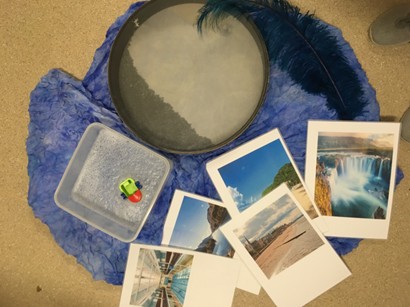
 I have recently been fortunate to be involved in a project on the dementia assessment wards, where we established sensory-based occupational therapy groups for patients with complex needs who were finding it difficult to participate in existing ward activities. Guided by the principles outlined in Sensory Modulation in Dementia Care (2018), we developed a sensory group programme. Each week was themed around a different colour, providing a sense of consistency and familiarity while also creating visual impact and curiosity.
The groups were designed to be simple and accessible. We used familiar objects (balloons, colourful scarves, wooden tools), visuals, movement and touch to create opportunities for sensory engagement. Rather than directing activities, we aimed to create a space where patients could take the lead and engage in ways that felt meaningful to them.

The groups took place in communal ward spaces, with at least one facilitator moving around the ward inviting people and supporting participation. The aim was not simply to provide stimulation, but to create opportunities for movement, connection, choice, enjoyment and to reduce distress. Novel experiences often sparked engagement. One patient transformed a coloured scarf into a fashion accessory, inviting others to do the same. A balloon became the focus of shared attention, with patients instinctively batting it between one another. What began as simple explorative activities quickly broke down barriers and created opportunities for communication, laughter, and social interaction.
Perhaps the greatest lesson was that less is often more. It can be tempting to overcomplicate interventions, but some of the most meaningful outcomes came from the simplest activities. The sensory activities provided an opportunity; it was the connection between people that brought them to life.
Contributor. Alice Farnham, Specialist Occupational Therapist, Reference:
Champagne, T (2018), Sensory Modulation in Dementia Care: Assessment and Activities for Sensory-Enriched Care. JKP: LondonNHS Lothian
Enjoyed this blog? Tell us more. We love feedback.
Please spend 1 minute completing this short anonymous feedback form to allow us to make our blog posts even better in 2026. Thank you
AHP Let’s Talk About Dementia Blog Feedback Form – Fill out form