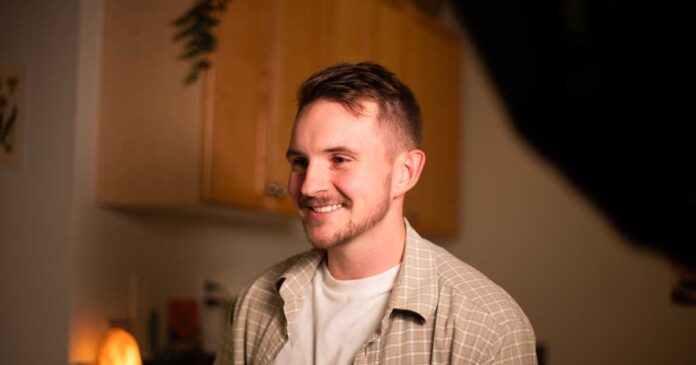
About Aodhan:
To anyone reading this,
I hope your day is going great and know that you are one of a kind.
My name is Aodhan, and I’m an actor and filmmaker from Perth, Australia. I was 12 when I was diagnosed with OCD and anxiety. I was prescribed antidepressant medication to help combat the growing impulses that affected many areas of my life. It was an isolating and difficult period in my life. I didn’t want to talk about it with my family or the therapists trying to help me because I thought it was weak and abnormal to do so.
But there’s fight in everyone, and I didn’t want OCD or anxiety to control my life. I realized that this wouldn’t be an overnight fix. It was going to take small steps forward to break the responses I had to intrusive thoughts and negative ideas I had about myself.
My experience with all of this led me to write my first short film, FEAR. I wanted to present fear as a physical manifestation in the film—a figure who builds strength from the silence of our male protagonist, Michael.
I created this project with the aim of breaking the silence and stigma associated with men’s mental health and male vulnerability.
WHAT WAS THE MAJOR TURNING POINT IN YOUR RECOVERY FROM OCD AND ANXIETY?
I saw a psychiatrist and multiple therapists during my teenage years at my parents’ insistence, but I never really made an effort or was present during the sessions because I thought it was stupid and weak to talk to someone about my feelings.
It wasn’t until my early twenties that I returned to therapy of my own accord, feeling isolated, uncertain, and anxious about my career and relationships. I was one year into living in Canada, on the other side of the world from my home in Perth, Western Australia, and I was struggling in silence. My anxiety increased the longer I kept quiet, leading me to believe that I wouldn’t be able to find love and that my career as an actor and filmmaker was going nowhere.
I remember attending that session and making a genuine effort to discuss everything that was going on in my life, which was difficult to do. What came out of that session was the realisation that I was extremely self-critical and had commitment issues when it came to dating. I felt a sense of freedom afterwards and put the tools and perspective I had learnt during the session to the test. It was difficult to put them into practice, but this shift in mindset regarding my career, dating, and mental health helped alleviate many of the negative thoughts I had about myself and others. I even met a girl a few weeks later and committed to a relationship with her, which turned out to be one of the best decisions I’ve made. Around the same time, I booked a principal role in a movie filmed on Vancouver Island.
I still sometimes push my OCD and anxiety aside and keep everything bottled up because I feel I don’t have time to deal with it or talk about it. However, each time I make the decision to see a mental health professional or open up to someone, I learn more about my mental health triggers and gain clarity on how to address the challenges I’m facing.
WHAT ARE SOME THINGS THAT REALLY HELPED?
- Limiting social media: Social media is a great tool for connection and staying informed, but sometimes it can provide false ideals of who you should be and become a distraction. Staying off social media for the first two hours of my day helps ground me for the day ahead and clears my mind.
- Setting intentions for the day: Setting simple intentions, such as to read, to move my body or to simply take the day as it comes.
- Practicing meditation: Finding a few minutes in the morning or throughout the day to clear your mind and relieve any tension physically and mentally.
- Embracing vulnerability: Don’t see therapy or opening up to people you trust as a weakness. Take it in small steps and utilize sources available in person and online to free yourself from the silence.
- Being out in nature: Going out for a walk or a run, or even just walking to a café to get out of the house.
- Trying new things: Approaching new experiences from an open and non-judgemental mindset.
- Implementing a morning and night routine – Having one routine that sets me up for the day and another that helps me winds me down at night.
WHAT ADVICE WOULD YOU GIVE TO OTHER GUYS FIGHTING OCD AND ANXIETY?
Take the journey to recovery in small steps. There are going to be ‘good days’ and ‘bad days’, but that’s part of your growth in the journey. Don’t be ashamed to ask for or seek help. It’s not a weakness. It’s one of the bravest things you can do.
Recognize it’s starts with you to cultivate a different approach to life and remember you have time.
Aodhan Guy
Vancouver, Canada
@fearshortfilm26