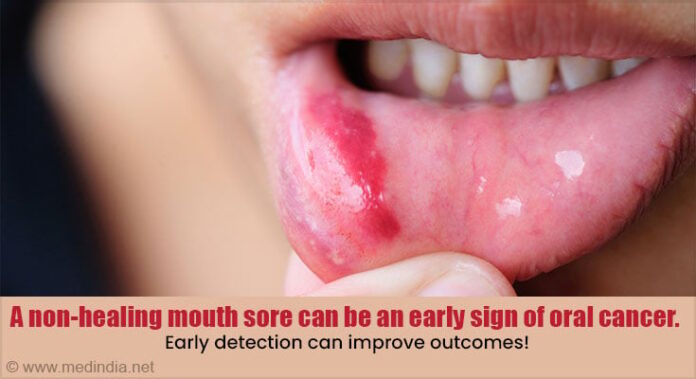
Persistent mouth sores can be an early sign of oral cancer, making timely screening and diagnosis important.
- Around 60,000 oral cancer cases occur annually in India, with five deaths every hour
- Non-healing mouth sores lasting more than two weeks may indicate oral cancer or precancerous lesions
- Early detection improves treatment success and survival outcomes
A non-healing mouth sore that does not improve within two weeks may be more than a routine ulcer.
Evidence from recent observational clinical studies on oral lesions suggests that some non-healing sores can reflect early oral cancer or precancerous changes (1✔ ✔Trusted Source
Red flags of oral cancer: Unravelling the early symptoms – A literature review
Go to source
).
India reports approximately 60,000 new oral cancer cases each year, with nearly five deaths every hour, making early recognition of such symptoms clinically important.
What Is Oral Cancer and Its Early Warning Signs
Oral cancer develops in the tissues of the mouth, including the lips, tongue, gums, inner cheeks, and the roof or floor of the mouth. It begins as small, abnormal changes in the lining of these areas. In early stages, oral cancer may appear as a harmless-looking patch or sore. Because it is often painless initially, it can go unnoticed.
Early warning signs include a non-healing mouth sore, white or red patches, a lump inside the mouth, difficulty chewing or swallowing, numbness, loose teeth, or persistent ear pain.
When Non-Healing Mouth Sores Signal Oral Cancer Risk
Most mouth ulcers are harmless and heal within 7–14 days. They are commonly caused by minor injury, stress, or nutritional deficiencies such as low vitamin B12 or iron.
However, non-healing mouth sores that last longer than two to three weeks, increase in size, or bleed easily may indicate oral cancer or precancerous conditions like leukoplakia and lichen planus. Early lesions are often painless, which can delay diagnosis.
What Research Shows About Non-Healing Oral Lesions
Recent observational research on oral potentially malignant disorders (OPMDs) shows that a subset of non-healing oral lesions can develop epithelial dysplasia, a recognized precancerous change (1✔ ✔Trusted Source
Red flags of oral cancer: Unravelling the early symptoms – A literature review
Go to source
).
Molecular studies published in 2025 have also identified early genetic and cellular alterations in oral tissues that may precede cancer development (2✔ ✔Trusted Source
Recognising oral cancer: The role of medical professionals
Go to source). These findings indicate an association, not certainty, meaning not all non-healing sores become cancerous.
Common Mouth Ulcer vs Non-Healing Sore: Key Differences
| Feature | Common Mouth Ulcer | Non-Healing / Concerning Sore |
|---|---|---|
| Healing time | 7–14 days | More than 2–3 weeks |
| Pain | Usually painful | May be painless early |
| Appearance | Round, shallow | Red/white patches or irregular |
| Bleeding | Rare | May bleed easily |
This comparison helps identify when a sore needs medical evaluation.
Why Early Evaluation of Non-Healing Sores Matters
Detecting oral cancer early improves treatment outcomes. However, most available evidence comes from observational data, meaning it does not prove that every non-healing ulcer will lead to cancer.
Delays in diagnosis, symptom overlap, and differences in patient populations are important limitations in current research.
Any non-healing mouth sore lasting more than two weeks should not be ignored. Early evaluation by a dentist or doctor can help detect serious conditions at a stage when treatment is more effective. In high-risk individuals, this simple step can be life-saving.
How to Care for Mouth Sores and When to Seek Help
Simple care steps can help manage common mouth ulcers and support healing. However, these should not delay medical evaluation if the sore does not improve.
- Maintain good oral hygiene by brushing gently and using a soft toothbrush.
- Avoid spicy, acidic, or very hot foods that may irritate the sore.
- Staying hydrated and ensuring adequate intake of vitamin B12 and iron can also support healing.
Over-the-counter topical gels or antiseptic mouth rinses may provide temporary relief, but they do not treat underlying causes. Avoid tobacco and alcohol, as they can delay healing and increase irritation.
Seek medical or dental advice if a mouth sore:
- lasts more than two weeks
- increases in size or changes in appearance
- bleeds easily or causes persistent pain
causes difficulty swallowing or speaking Early evaluation helps rule out serious conditions and ensures timely treatment when needed.
Frequently Asked Questions
Q: What is a non-healing mouth sore?
A: A sore that does not improve or disappear within two weeks.
Q: Are non-healing mouth sores always cancer?
A: No, but they may be precancerous and should be evaluated.
Q: What are early signs of oral cancer?
A: Non-healing sores, red or white patches, and difficulty swallowing.
Q: Who is at higher risk?
A: Tobacco users, alcohol consumers, and those with poor oral hygiene.
Q: When should I see a doctor?
A: If a mouth sore lasts more than two weeks or shows changes in size, color, or bleeding.
References:
- Red flags of oral cancer: Unravelling the early symptoms – A literature review – (https://www.sciencedirect.com/science/article/pii/S2772906025000524)
- Recognising oral cancer: The role of medical professionals – (https://www.nature.com/articles/s41406-025-1521-0)
Source-Medindia