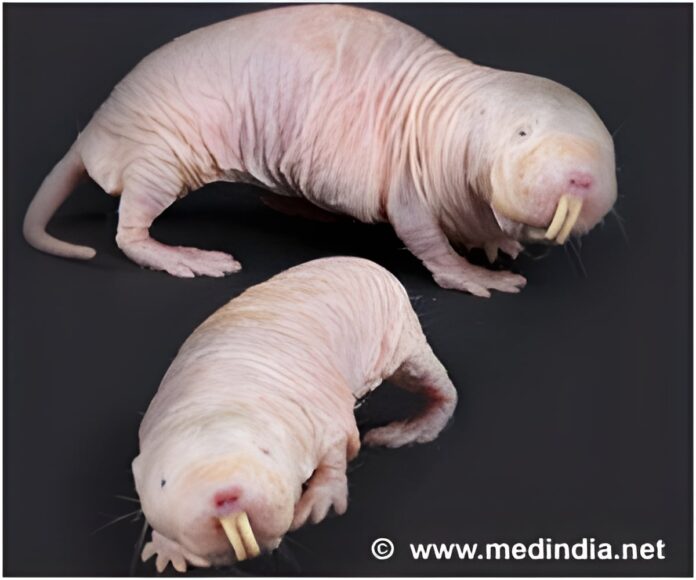
Naked mole rat gene linked to cancer resistance and healthy aging extended mouse lifespan, offering new clues for improving human healthspan.
A gene from naked mole rats helped mice live longer and remain healthier by reducing inflammation and improving resistance to cancer. (1✔ ✔Trusted Source
Increased hyaluronan by naked mole-rat Has2 improves healthspan in mice
Go to source
).
Naked mole rats are widely recognized for their exceptional lifespans and strong protection against disease, making them one of the most intriguing animals in aging science.
These tiny, wrinkled rodents can survive for decades, rarely develop cancer, and appear naturally protected against many illnesses commonly linked with aging.
Researchers at the University of Rochester demonstrated that one of these biological advantages could be transferred into another mammal.
By introducing a gene connected to the naked mole rat’s unusually high levels of high molecular weight hyaluronic acid (HMW-HA), the team improved overall health and slightly extended lifespan in mice.
Healthier Aging in Genetically Altered Mice
The findings, published in Nature, indicated that some longevity mechanisms that evolved in long-living animals may potentially work beyond their original species. The genetically altered mice experienced healthier aging and showed an approximately 4.4 percent increase in median lifespan compared with normal mice.
“Our study provides a proof of principle that unique longevity mechanisms that evolved in long lived mammalian species can be exported to improve the lifespans of other mammals,” explained Vera Gorbunova, the Doris Johns Cherry Professor of biology and medicine at Rochester.
High Molecular Weight Hyaluronic Acid Benefits
Gorbunova, together with Andrei Seluanov, a professor of biology, and their team, concentrated on a gene involved in producing HMW-HA. This substance exists in large amounts in naked mole rats and has been associated with their remarkable resistance to cancer, inflammation, and age-related deterioration.
Naked mole rats are similar in size to mice, yet their lifespan is extraordinary for rodents. They can survive up to 41 years, almost ten times longer than rodents of comparable size.
Their long lifespan is not the only reason scientists are fascinated by them. As naked mole rats grow older, they seem to avoid several disorders that commonly affect other mammals, including neurodegeneration, cardiovascular disease, arthritis, and cancer. For many years, Gorbunova, Seluanov, and other scientists have explored the reasons behind this resilience.
One major factor is HMW-HA. Naked mole rats possess nearly ten times more of this substance than mice and humans. Earlier investigations showed that removing HMW-HA from naked mole rat cells made those cells more likely to develop tumors.
Gene Transfer Into Mice
That discovery led to an important question. If HMW-HA protects naked mole rats from cancer and age-related damage, could the same biological mechanism function in another species?
To explore this possibility, the Rochester researchers engineered mice to carry the naked mole rat version of the hyaluronan synthase 2 gene. This gene is responsible for producing the protein that generates HMW-HA.
All mammals possess a form of hyaluronan synthase 2, but the naked mole rat version appears especially active. It seems to stimulate stronger gene expression, resulting in increased production of the protective molecule.
The genetically modified mice developed higher levels of hyaluronan in several tissues. They also showed greater resistance to spontaneous tumors and chemically induced skin cancer.
Healthier Aging in Modified Mice
The advantages extended beyond cancer protection. Mice carrying the naked mole rat gene remained healthier overall, survived longer than ordinary mice, experienced lower inflammation in several tissues during aging, and preserved better gut health.
Since chronic inflammation is considered one of the major biological hallmarks of aging, the reduction in inflammation was especially significant. Researchers believe HMW-HA may partly function by directly affecting the immune system, although further work is required to fully understand how it delivers such widespread benefits.
Longevity Mechanisms Across Species
The rise in median lifespan was approximately 4.4 percent, which may appear modest. However, the larger importance of the finding lies in the successful transfer of a longevity mechanism from one mammal to another.
The discovery therefore goes beyond a mouse experiment focused on a single gene. It supports the possibility that naturally long-living species may contain biological adaptations that can be examined, modified, and potentially used to improve health in other animals.
Future Human Health Applications
“It took us 10 years from the discovery of HMW-HA in the naked mole rat to showing that HMW-HA improves health in mice,” Gorbunova stated. “Our next goal is to transfer this benefit to humans.”
The scientists believe there are two major approaches for achieving this objective. One strategy would involve slowing the breakdown of HMW-HA within the body, while the other would focus on increasing its production.
“We already have identified molecules that slow down hyaluronan degradation and are testing them in pre-clinical trials,” Seluanov explained. “We hope that our findings will provide the first, but not the last, example of how longevity adaptations from a long-lived species can be adapted to benefit human longevity and health.”
Since the 2023 Nature publication, naked mole rats have continued to reveal additional clues about their unusual aging patterns. A 2025 study in Science identified another possible longevity mechanism involving cGAS, a protein primarily known for its role in immune defense.
Genome Stability and DNA Repair
In humans and mice, cGAS can interfere with certain forms of DNA repair, but the naked mole rat version appears to assist cells in repairing DNA damage more effectively. That investigation found that specific modifications in the naked mole rat protein improved genome stability and delayed aging signs in experimental models.
This newer evidence does not replace the HMW-HA discovery. Instead, it reinforces a broader understanding that naked mole rats likely achieve their unusually long and healthy lives through multiple overlapping defense systems, including cancer resistance, inflammation regulation, DNA repair, and tissue protection.
For human aging science, these findings are highly important. A single molecule is unlikely to serve as a simple cure for aging, but every new discovery provides scientists with another possible strategy for targeting the biological processes responsible for age-related diseases.
The 2023 gene transfer experiment remains a powerful proof of concept. A survival mechanism that evolved in one of nature’s most unusual mammals helped mice resist disease, age more gradually, and live longer. The next major challenge is determining whether these same biological mechanisms can be safely adapted to improve human healthspan.
Reference:
- Increased hyaluronan by naked mole-rat Has2 improves healthspan in mice(https://www.nature.com/articles/s41586-023-06463-0)
Source-Medindia