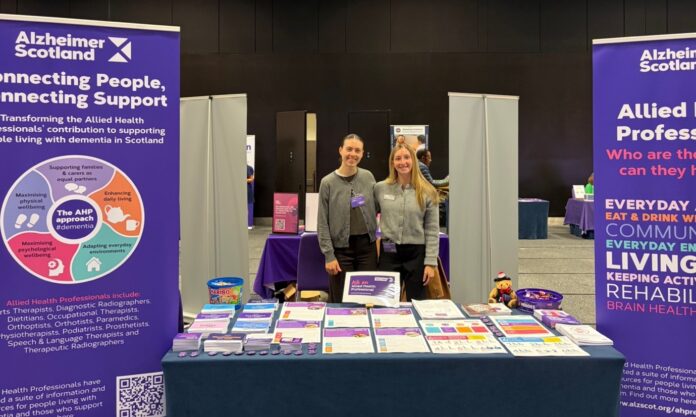
Hello! I’m Anna – a final year physiotherapy student from Edinburgh Napier University. As part of my degree, I must undertake four eight-week placements across a range of clinical and community settings to be eligible for registration with the Health and Care Professions Council. These placements are so valuable for developing our skills in real-world, practical environments. My fellow Napier student, Liana, and I were both allocated a placement with Alzheimer Scotland, which was delivered as a long‑arm placement.
What is a Long-Arm Placement?
A long-arm placement involves supervision from a physiotherapist at a distance, alongside in-person support from a health or social care professional. During my placement with Alzheimer Scotland, I was supervised remotely by Claire Craig, an experienced physiotherapist specialising in mental health and dementia, while my day-to-day learning was overseen by Elaine Hunter, the National AHP consultant and a qualified occupational therapist. This structure differs from many traditional placements where your physiotherapy supervisor is based onsite and directly involved in your daily caseload. Despite the contrasting structure, long-arm placements are designed to provide high-quality learning opportunities and fully align with national regulatory standards.
Starting a Different Type of Placement
Before I started, I felt a little apprehensive about how a long-arm placement might work. As I’d never undertaken one before, I wasn’t sure how I would receive feedback or how we would be assessed. However, once we had our initial meetings with Elaine and Claire, I was quickly reassured. Together, they set us a variety of learning objectives, frequently checked in on our progress and were always available to answer our questions.
We also had online meetings with Claire every Monday and Thursday, each lasting around 90 minutes. These meetings proved to be one of the most beneficial aspects of the long-arm structure. While you do receive regular feedback in hospital-based placements, it would be unusual to have the time to sit down for 90 minutes with your supervisor to discuss your learnings, development and practice. In these meetings, we covered a range of topics, including risk enablement, rare types of dementia, communication styles and strength and balance exercises for people living with dementia. Claire consistently challenged us to consider how we would make our physiotherapy practice dementia friendly in every setting. These conversations deepened my understanding of person-centred, accessible care and will stand to me as I continue my journey as a student physiotherapist.
Physiotherapy Role: Outside of the Clinical Environment
My experience with Alzheimer Scotland has shown that physiotherapy is a broader profession than I previously considered, extending beyond clinical environments to include public health promotion, policy and disease prevention. Many of my learning objectives for this placement centred around these areas. Liana and I took over the AHP dementia Instagram page and created the Move Your Way theme, where we shared quotes from members of Active Voice about what movement means to them. Our goal for this takeover was to highlight how movement can be fun, meaningful and personalised to each individual, whilst also providing evidence-based information about the benefits of physical activity. We also created a resource for physiotherapists entitled ‘So your Next Patient has Dementia…’ and updated another entitled ‘How to Make your Physiotherapy Service Dementia Aware’. The aim of these resources was to support our physiotherapy colleagues to deliver the highest quality of care to people living with dementia. Through a significant amount of research and discussion with members of Active Voice – a national, member led campaigning and awareness raising group made up of people with lived experience, we made sure that these documents were backed up by the evidence.
Some of our other tasks included providing strength assessments and health education to attendees of the Alzheimer Scotland Conference, supporting public health promotion at the Big Brain Tour, leading exercise classes for people living with dementia, and joining the Day Opportunities group on their weekly activities.
My Takeaways from the Learning Experience
I have learned so much from this learning experience. I have developed a much greater understanding of dementia and a clearer sense of how to communicate effectively, adapt assessments and create comfortable, accessible environments. These lessons will undoubtedly enable me to be a more inclusive, confident and person-centred physiotherapist.
Going forward, I want all of my physiotherapy colleagues to remember that everybody has the right to rehabilitation, and that our role must go beyond assessment and treatment. We have a responsibility to listen to those with lived experience and to advocate for positive change. As members of Active Voice often said, we must always see the person before the diagnosis. As a strongly stigmatised disease, it is up to all of us to challenge the assumptions that surround dementia.
I’m so grateful for everything I have learned whilst on placement with Alzheimer Scotland, and I’m excited to be able to carry these lessons into my future practice as a (soon-to-be) qualified physiotherapist.
“In your experience, what helps make rehabilitation truly inclusive and accessible for people living with dementia?”
Contributor: Anna Richardson, Edinburgh Napier University, Physiotherapy Student
Hear more about long-arm placements by listening to a conversation between Claire Craig, Programme Lead Mike Leavitt, and physiotherapy student Megan: Long Arm Supervision in Action: Turning Adversity into Opportunity
Enjoyed this blog? Tell us more. We love feedback.
Please spend 1 minute completing this short anonymous feedback form to allow us to make our blog posts even better in 2026. Thank you
AHP Let’s Talk About Dementia Blog Feedback Form – Fill out form