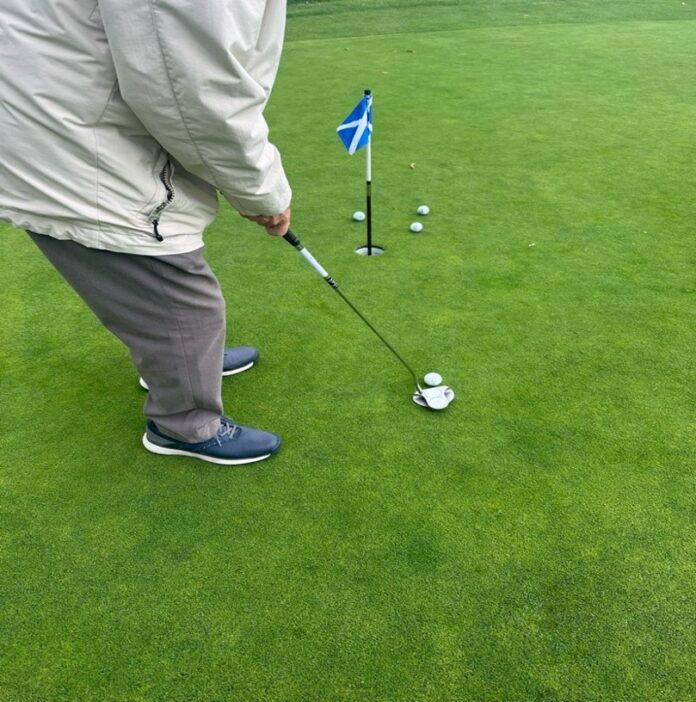
As Occupational Therapy students, we were introduced to Golf in Society through our practice placement. Going into our first session, we honestly did not know quite what to expect. Neither of us had ever played golf before, so alongside our excitement, there was definitely a little nervousness about whether our golfing skills would be up to scratch!
However, it did not take long for those nerves to disappear. From our very first session, we were made to feel part of the Golf in Society team. What began as something we were unsure about quickly became one of the highlights of our placement, and we soon found ourselves looking forward to our two-hour sessions each week just as much as the golfers did.
A typical session
Each session was split into two parts. For the first hour, we took part in golfing activities, either on the putting green or the larger practice green. Where we played depended on the golfer we were spending time with that day, including their mobility and energy levels. The second hour was usually spent indoors, where everyone came together for a drink and some shortbread biscuits before getting involved in different games. We played both regular dominoes and ‘golf’ dominoes, followed by a round of golf bingo Although the activities were familiar from week to week, no two sessions were quite the same. We noticed that some days were better than others for individual golfers, and that their abilities, energy and confidence could vary. This was one of the things that stood out to us most throughout our time at Golf in Society: every day can look different for a person living with dementia.

More than just golf
What became clear to us very quickly was that Golf in Society is about much more than learning or playing golf. It is about meaningful occupation, connection and being part of a community.
We saw this in the relationships that had developed between the golfers and volunteers. The volunteers were incredibly welcoming and clearly valued their time at Golf in Society just as much as the golfers did. They would support golfers with their aim, positioning and technique, while also taking the time to chat, laugh and enjoy the activity alongside them.
During the indoor activities, golfers would sometimes team up with a volunteer or one of us students when they needed a little extra support seeing the dominoes or bingo images. These moments were particularly special because the focus was not simply on completing the activity, but on doing it together. And, of course, winning our team game was always an added bonus!

Celebrating the little wins
Some of our favourite moments were when a golfer got a hole in one on the putting green or hit an especially good shot on the practice ground. We would get excited, cheer and celebrate, while the golfer would often simply smile and act as though it was no big deal!
These moments reminded us how important it is to recognise and celebrate achievement, no matter how small it may seem. Golf provided opportunities for success, enjoyment and social interaction, while allowing each person to participate at their own level.
Why we think it is so Occupational Therapy
As Occupational Therapy students, we kept coming back to one thought: Golf in Society is so OT!
Occupational Therapy is about supporting people to engage in meaningful occupations that are important to them. Golf in Society gave us the opportunity to see this happen in real life. Whether someone had played golf for years or had never picked up a golf club before, the focus was not simply on sporting ability. It was about having fun, being active, socialising, trying something new and being part of a community.
We also developed an even greater appreciation for carers. Golf in Society provides a regular two-hour period where carers can have some time to themselves while knowing that their loved one is taking part in an enjoyable and meaningful activity. Although two hours may not seem like a long time, we saw how valuable this regular opportunity can be.

A community we will miss
Golf in Society became something that we genuinely looked forward to every week. There was always plenty of laughter, conversation and encouragement, and we were made to feel welcome from day one.
Most importantly, we saw a community where people living with dementia could come together, participate in meaningful activity and simply enjoy themselves. The relationships between golfers, volunteers, students and carers created a warm and supportive environment that we were so grateful to be part of.
And if there is one thing we would tell anyone considering joining, it is this: you absolutely do not need to be a golfer! Neither of us had any previous experience, and we quickly realised that Golf in Society is much more about having fun and being part of something than being good at golf. It is a chance to learn, laugh, meet people and become part of a community.
We would recommend Golf in Society to anyone who might benefit from being involved, and we hope to see this wonderful programme continue to grow within communities. We certainly hope that one day we will be able to return!
Contributors: Eimear Grall & Kirsten Doyce, Occupational Therapy Students, Edinburgh Napier University.
Placement Supported by: Vivienne Thomson & Claire Wilkie, Clinical Specialist Occupational Therapists, AHP Older Adult Mental Health Team, NHS Forth Valley & Golf in Society.
Enjoyed this blog? Tell us more. We love feedback.
Please spend 1 minute completing this short anonymous feedback form to allow us to make our blog posts even better in 2026. Thank you
AHP Let’s Talk About Dementia Blog Feedback Form – Fill out form