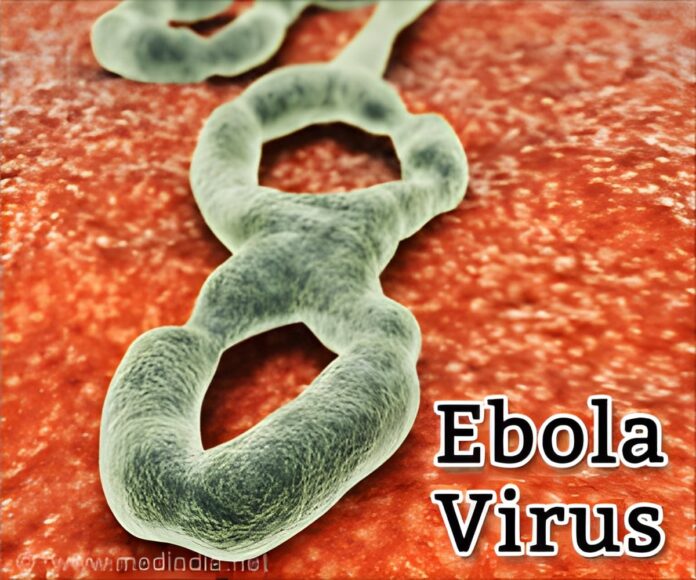
The first human trial of a Bundibugyo Ebola vaccine is now underway. Moderna’s mRNA vaccine aims to protect against a strain with no approved vaccine.
- Moderna begins the first human trial of a Bundibugyo Ebola vaccine
- The vaccine targets an Ebola strain with no licensed vaccine
- Phase 1 study will evaluate safety and immune response in healthy adults
The search for the first vaccine against the Bundibugyo strain of Ebola has reached a major milestone with Moderna launching the world’s first human clinical trial of its investigational mRNA vaccine, mRNA-1469. (1✔ ✔Trusted Source
Moderna’s Bundibugyo ebolavirus vaccine candidate enters first human trial, backed by CEPI
Go to source
).
The study comes at a critical time as the Democratic Republic of the Congo (DRC) continues to battle the largest Bundibugyo Ebola outbreak ever recorded.
According to the World Health Organization (WHO), the outbreak had resulted in 3,748 confirmed cases, 1,657 deaths, and 708 recoveries across 49 health zones in five provinces as of August 1, 2026.
While licensed vaccines are available against the Zaire strain of Ebola, there are currently no approved vaccines or proven preventive therapies specifically for Bundibugyo ebolavirus (BDBV).
Why Is Moderna’s Vaccine Trial a Landmark for Ebola Research?
The first participant has received mRNA-1469 in a Phase 1 clinical trial, making it the first human study of an mRNA vaccine specifically developed against Bundibugyo ebolavirus.
The vaccine has been developed using Moderna’s messenger RNA (mRNA) platform, the same technology previously used in its COVID-19 vaccine, but redesigned to target the Bundibugyo Ebola virus.
mRNA-1469 is one of four Bundibugyo Ebola vaccine candidates currently being advanced simultaneously using different vaccine technologies to improve the chances of identifying an effective vaccine as quickly as possible.
How Will the Phase 1 Study Be Conducted?
The ongoing study is a randomized, observer-blind, placebo-controlled, dose-escalation Phase 1 clinical trial designed to evaluate multiple dose levels of mRNA-1469 (2✔ ✔Trusted Source
A Study to Investigate the Safety, Reactogenicity, and Immunogenicity of mRNA-1469 Vaccine to Prevent Ebola-Bundibugyo Virus Disease in Healthy Adult Participants
Go to source
).
Researchers will first determine whether the vaccine is safe before assessing whether it produces immune responses strong enough to support larger efficacy trials.
|
Study Component |
Details |
|
Vaccine candidate |
mRNA-1469 |
|
Developer |
Moderna |
|
Target virus |
Bundibugyo ebolavirus (BDBV) |
|
Trial phase |
Phase 1 |
|
Study design |
Randomized, observer-blind, placebo-controlled, dose-escalation |
|
Participants |
Approximately 84 healthy adults (18–65 years) |
|
Trial locations |
Three research sites in Canada |
|
Primary goals |
Assess safety, reactogenicity, and immunogenicity |
|
Primary completion |
Expected September 2027 |
According to the trial protocol, investigators will monitor local and systemic adverse reactions, medically attended adverse events, serious adverse events, and Bundibugyo-specific antibody responses over the course of the study.
Why Does the World Need a Bundibugyo-Specific Ebola Vaccine?
Although vaccines are already available against the Zaire ebolavirus, they do not specifically target the Bundibugyo species responsible for the current outbreak.
No licensed vaccine currently exists for Bundibugyo ebolavirus, making the ongoing outbreak particularly challenging from a public health perspective.
A scientific review explains that four Ebola virus species—including Zaire, Sudan, Bundibugyo, and Taï Forest ebolaviruses—can cause severe disease in humans (3✔ ✔Trusted Source
Current state of Ebola virus vaccines: A snapshot
Go to source).
However, most advanced vaccines have been developed primarily against the Zaire strain, leaving an important gap in protection against other medically important Ebola species.
WHO also noted that research protocols developed before the current outbreak enabled vaccine studies to begin much earlier than during previous Ebola emergencies, helping accelerate the global research response.
Who Is Funding Moderna’s Ebola Vaccine Development?
According to CEPI, the organization has committed up to US$50 million to support the preclinical development and Phase 1 clinical evaluation of mRNA-1469 (4✔ ✔Trusted Source
CEPI fast-tracks three Bundibugyo ebolavirus vaccine candidates
Go to source
).The funding also supports manufacturing additional clinical trial doses while the Phase 1 study is still underway, allowing larger Phase 2 and Phase 3 studies to begin quickly if early results are promising.
As part of its partnership with CEPI, Moderna has also committed to making at least 500,000 vaccine doses available at access pricing for low- and middle-income countries if the vaccine is eventually licensed.
What Do Early Studies Show About mRNA Ebola Vaccines?
Although Moderna’s mRNA-1469 is the first mRNA vaccine being tested in people against Bundibugyo Ebola, earlier laboratory research has shown encouraging results.
According to a recent study (5✔ ✔Trusted Source
An mRNA vaccine encoding the Ebola virus glycoprotein induces high neutralizing antibody titers and provides strong protection against lethal infections in mouse models
Go to source):
- The experimental mRNA Ebola vaccine produced higher neutralizing antibody levels than an rVSV-based Ebola vaccine in mouse models.
- It provided complete protection against lethal Ebola infection in two different animal models.
- The vaccine triggered strong immune responses by targeting key Ebola virus proteins involved in infection.
The findings suggest that mRNA technology could become a promising platform for future Ebola vaccines.
However, the results are based on animal studies, and further human clinical trials are needed to confirm its safety, effectiveness, and long-term protection against different Ebola virus species.
How Is Moderna’s Vaccine Different From Existing Ebola Vaccines?
Most approved Ebola vaccines protect against the Zaire strain, but Moderna’s mRNA-1469 is specifically designed to target the Bundibugyo strain responsible for the current outbreak (6✔ ✔Trusted Source
New Ebola vaccine trial launches as outbreak spreads in DR Congo
Go to source
).
This highlights an important gap in Ebola vaccine protection, as vaccines against one Ebola species may not protect against another.
|
Vaccine |
Targets |
Current Status |
|
Ervebo (rVSV-ZEBOV) |
Zaire ebolavirus |
Licensed; used during Ebola outbreaks |
|
Zabdeno/Mvabea |
Primarily Zaire ebolavirus |
Licensed two-dose vaccine |
|
mRNA-1469 (Moderna) |
Bundibugyo ebolavirus |
Phase 1 human trial |
|
Oxford–Serum Institute vaccine |
Bundibugyo ebolavirus |
Phase 1 human trial |
According to the review, future Ebola vaccines should ideally protect against multiple Ebola species—including Bundibugyo, Sudan, Taï Forest, and Zaire—to improve preparedness for future outbreaks.
How Are Scientists and the UN Responding to the Ebola Outbreak?
Vaccine research is being supported by new treatment studies and international response efforts.
- A new clinical trial is testing an oral medicine to prevent Ebola in people exposed to the virus.
- Three research centres are already running in Ituri Province, with more expected to open.
- WHO said early planning helped vaccine and treatment trials begin faster than in previous Ebola outbreaks.
- WHO, UNICEF, UNHCR, WFP, MONUSCO, and OCHA are supporting outbreak control through testing, infection prevention, patient care, and public awareness.
- A mobile laboratory at the DRC–Uganda border provides Ebola test results in about one hour, helping speed up diagnosis.
- UNICEF supports affected children, UNHCR strengthens screening and hygiene, MONUSCO protects healthcare facilities, and OCHA is providing emergency funding to strengthen the response.
Frequently Asked Questions
Q: What is the Bundibugyo strain of Ebola?
A: Bundibugyo ebolavirus is one of the Ebola virus species that can cause severe disease in humans and currently has no approved vaccine.
Q: Why is Moderna’s vaccine trial important?
A: It is the first human clinical trial of an mRNA vaccine developed specifically for the Bundibugyo strain of Ebola.
Q: What is the goal of the Phase 1 study?
A: The trial will assess the vaccine’s safety, side effects, and ability to trigger an immune response.
Q: Who can participate in the trial?
A: Around 84 healthy adults aged 18–65 years are expected to participate at three research sites in Canada.
Q: Are there already Ebola vaccines available?
A: Yes, but currently licensed vaccines mainly target the Zaire strain of Ebola, not the Bundibugyo strain.
Q: Is Moderna’s vaccine available to the public?
A: No. It is still an investigational vaccine undergoing early-stage clinical testing.
References:
- content – ()
Source-Medindia