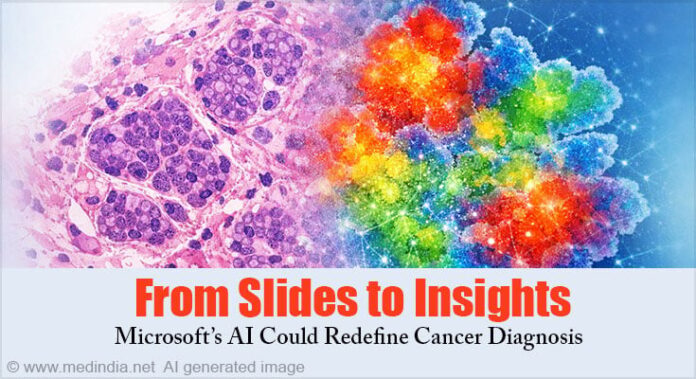
Microsoft’s GigaTIME AI may speed up cancer diagnosis and expand access to care using advanced tumor analysis.
- GigaTIME converts routine pathology slides into detailed protein maps of tumors
- AI model may reduce cost and time required for cancer diagnosis
- Technology could improve access to precision cancer care globally
Tech giant Microsoft has unveiled a new artificial intelligence model called GigaTIME, which could significantly improve how cancer is diagnosed and studied (1✔ ✔Trusted Source
Multimodal AI generates virtual population for tumor microenvironment modelling
Go to source
).
According to CEO Satya Nadella, the model can transform routine pathology slides into advanced molecular-level data.
“We’ve trained a multimodal AI model to turn routine pathology slides into spatial proteomics, reducing time and cost while expanding access to cancer care,” Nadella said.
What Makes GigaTIME Different
GigaTIME uses a multimodal AI system to convert standard hematoxylin and eosin (H&E) slides, commonly used in cancer diagnosis, into virtual multiplex immunofluorescence (mIF) images. These advanced images show:
- Protein activity inside tumor cells
- Spatial distribution of cancer markers
- Tumor microenvironment behavior
This allows doctors to gain insights that would otherwise require expensive and time-consuming lab tests.
How the AI Model GigaTIME Works
The model was developed in collaboration with Providence and the University of Washington.
- Trained on 40 million cells
- Uses 21 protein channels
- Applied to 14,256 patients across 51 hospitals
The system generated:
- 300,000+ virtual tumor images
- Data across 24 cancer types and 306 subtypes
It also identified over 1,200 clinically relevant associations linked to biomarkers, disease progression, and survival.
Key Advantages of GigaTIME
|
Feature |
Benefit |
|
Converts routine slides |
No need for advanced lab tests |
|
High-resolution protein mapping |
Better tumor understanding |
|
Faster analysis |
Quicker diagnosis |
|
Lower cost |
Improved accessibility |
|
Large-scale data analysis |
Supports precision oncology |
Experts Highlight Breakthrough Potential
Experts believe this technology could significantly advance cancer research and treatment.
Carlo Bifulco, Chief Medical Officer at Providence Genomics, said: “GigaTIME is about unlocking insights that were previously out of reach.” He added: “It has the potential to accelerate discoveries that will shape the future of precision oncology and improve patient outcomes.”
Why GigaTIME, the AI Model Matters for Global Cancer Care
Cancer diagnosis requires expensive and specialized testing, which may not be available in many parts of the world. By using widely available pathology slides, GigaTIME could:
- Reduce dependence on costly tests
- Improve diagnostic accuracy
- Expand access to advanced cancer care
This is especially important for low-resource settings, where access to advanced diagnostics is limited.
A Step Toward Precision Oncology
The ability to analyze tumor biology at a deeper level may help doctors:
- choose more effective treatments
- predict disease progression
- personalize cancer therapy
Researchers say the model is now publicly available, which could accelerate global research and innovation.
Frequently Asked Questions
Q: What is GigaTIME?
A: GigaTIME is an AI model developed by Microsoft to analyze cancer using routine pathology slides.
Q: How does GigaTIME help in cancer diagnosis?
A: It converts standard slides into detailed protein maps, helping doctors understand tumors better.
Q: What is spatial proteomics?
A: It is the study of proteins and their location within cells, providing insights into disease behavior.
Q: Why is spatial proteomics technology important?
A: It may reduce costs, speed up diagnosis, and improve access to cancer care globally.
Q: Is GigaTIME available for use?
A: The model has been made publicly available to support research and clinical advancements.
Reference:
- Multimodal AI generates virtual population for tumor microenvironment modeling – (https://www.cell.com/cell/fulltext/S0092-8674%2825%2901312-1)
Source-Medindia