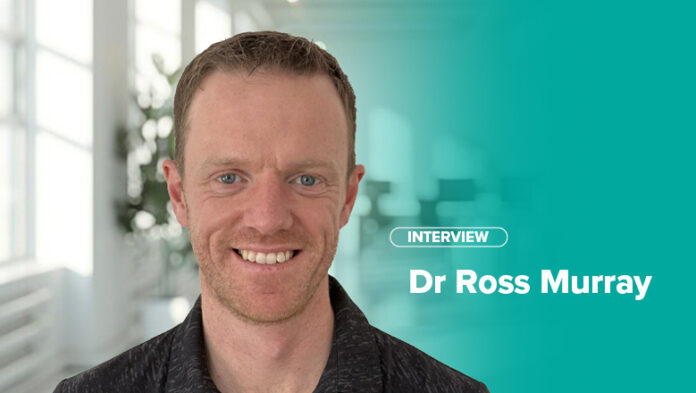
Dr Ross Murray is one of our brand new EMDRIA-MQ Foundation EMDR Fellows.
Ross’s research combines psychological, physiological, behavioural, and performance data to better understand how people respond to emotionally demanding and high-pressure situations.
We asked Ross about his research, what motivates him and what becoming an MQ Fellow means.
Hi Ross, tell us about your career so far.
I completed my BA in Psychology at Wilfrid Laurier University before moving to the University of Stirling, where I completed both my MSc and PhD in Sport Psychology. My doctoral research looked at how being part of a group, and the way we interpret success and failure, can shape how we think, feel, and behave.
I then joined the University of Toronto as a postdoctoral researcher, where my work expanded to examine emotion, mental health, and physical activity, often within sport and other high-pressure environments. This has increasingly led me toward understanding how people regulate emotions in real-world settings and how we can translate psychological science into practical approaches that support mental health and wellbeing. This progression has directly shaped the research I am now pursuing through the MQ Fellowship.
How long have you been at the University of Toronto and what do you like about it?
I’ve been at the University of Toronto for six years. One of the things I value most is the interdisciplinary nature of the Faculty of Kinesiology and Physical Education. There is a real breadth of expertise across psychology, physiology, physical activity, sport, and health, which creates lots of opportunities to think about research questions from different perspectives and collaborate across disciplines.
I am particularly interested in how people experience and regulate emotions in high-pressure or challenging environments,
What is your area of study?
My research sits at the intersection of sport psychology, emotion, mental health, and physical activity. I am particularly interested in how people experience and regulate emotions in high-pressure or challenging environments, and how psychological and social factors can influence mental health, performance, and wellbeing. Much of my work has focused on sport, which provides a useful real-world setting for studying these processes as they unfold.
What motivated you to study this area? Do you have a personal connection to the subject?
My background in sport initially sparked my interest in how people perform under pressure, because sport makes emotional responses especially visible. People are constantly managing pressure, uncertainty, success, failure, and expectations.
Over time, that interest has broadened beyond performance to mental health and wellbeing. I have experienced how important physical activity can be for supporting my own mental health and regulating emotions, which has made me increasingly interested in understanding how physical activity might support others, particularly in challenging or high-pressure situations.
That personal experience, alongside my research and applied work in sport, has motivated me to better understand these processes and ultimately develop practical ways of supporting people when emotions become difficult to regulate.
When did you first encounter EMDR therapy and why does it interest you?
I first came across EMDR in a clinical psychology course during my undergraduate degree. I remember being really interested by the idea that something as seemingly simple as guided eye movements could play a role in how we process difficult emotional experiences.
As my own research has moved more toward emotion regulation and mental health, I’ve become interested in EMDR again from a research perspective. A lot of my work looks at how people respond emotionally under pressure, so I’m particularly interested in better understanding the processes through which EMDR may influence emotional regulation and whether those insights can help us develop more effective ways of supporting people experiencing emotional distress.
I’m hoping to better understand how we can use the body to regulate the mind and our emotions.
What are you hoping to discover or achieve as a result of your research?
I’m hoping to better understand how we can use the body to regulate the mind and our emotions. EMDR is interesting because it already brings those things together, and I want to see whether we can build on that by using exercise and physiological regulation to help people manage difficult emotions.
With this project, we’re testing whether exercise before EMDR can help people feel more ready for therapy, engage with it more effectively, and ultimately get more out of treatment. More broadly, I hope the findings can help us think differently about how we can use movement and the body as part of mental health care. Ultimately, I’d love to see this work lead to relatively simple changes that make therapy more manageable and effective for people living with PTSD.
What does receiving an MQ Fellowship mean to you?
Receiving an MQ Fellowship is a huge opportunity for me to take the next step in my research and start building a more independent programme of work around emotion regulation, physical activity, and mental health.
It also means a lot to have support for a project that brings together areas I’ve been interested in for a long time. The fellowship gives me the chance to test an idea that is a little different, work more closely with clinical researchers and practitioners, and hopefully produce research that can have a meaningful impact on how we support people experiencing PTSD.
Would you encourage other scientists to apply for an MQ Fellowship?
Absolutely. I found the application process very positive. The reviewers were very supportive but also challenged me to shape and refine my idea at each stage, which ultimately made the project much stronger.
Is there anything else you would like to say?
I’m grateful to MQ for the opportunity and excited to get started. I’m particularly looking forward to working across different areas of research and seeing where this project can lead, both scientifically and in terms of how we support people living with PTSD.
The post Meet MQ Fellow: Dr Ross Murray first appeared on MQ Mental Health Research.