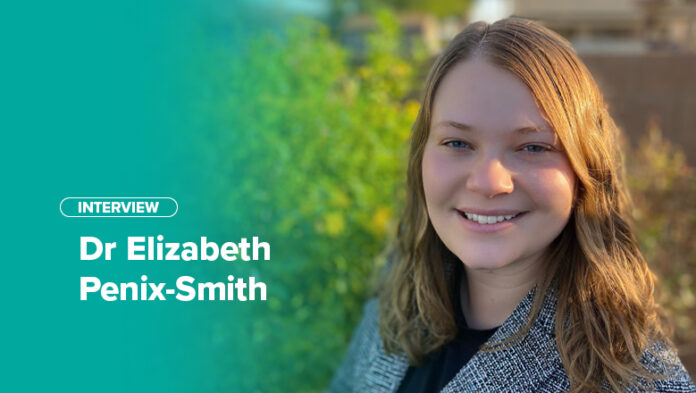
Elizabeth’s research focuses on improving mental health care for military populations through clinician training and tools, discerning who benefits from mental health treatments like EMDR, and using advanced statistical tools such as machine learning and meta-analyses to better understand which treatments work best for whom.
We asked Elizabeth about her research, what motivates her and what becoming an MQ Fellow means to her.
Hi Elizabeth, tell us about your career so far.
I completed my PhD in clinical psychology at Idaho State University, where my research focused on better understanding how clients view their experiences in psychotherapy, identifying who is most likely to benefit from and complete treatment, and identifying strategies clinicians can use to help their clients engage in treatment. I completed my pre-doctoral clinical internship at the Phoenix Veterans Affairs (VA) Health Care System, where I later joined as a staff psychologist after graduating with my doctorate. My clinical work and research interests have been closely intertwined, including providing care to Service Members and Veterans, improving trauma-focused treatments for PTSD, and navigating suicide risk. I later transitioned into a research psychologist role at the Walter Reed Army Institute of Research (WRAIR) as a National Research Council fellow.
How long have you been at Walter Reed (WRAIR) and what do you like about it?
I have been in my current research psychologist role at WRAIR for about two years, but my history with WRAIR began when I was an undergraduate student in 2014. I served as a summer intern and taught STEM classes to middle and high school students. I returned the following summer to complete my undergraduate thesis with researchers at WRAIR’s Center for Military Psychiatry and Neuroscience, and came back yet again the following year to work as a full-time research assistant after graduating with my bachelor’s degree. I sometimes joke that I am a “WRAIR boomerang” as a result. But, I think that the “boomerang” phenomenon ultimately reflects how much I care about and gravitate towards WRAIR’s mission of meeting the mental health needs of Service Members.
It is a privilege to be at WRAIR, where we are in a unique position to work hand-in-hand with Service Members, leaders, clinicians, and policymakers to develop research and tools that improve care and make a difference in Service Members’ lives on a broader scale.
On top of that, I have been incredibly fortunate to foster long-term relationships with my mentors and coworkers at WRAIR, who have played a pivotal role in my professional development. I admire them very much, learn from them all the time, and am very grateful to have the opportunity to work with them over the years!
What is your area of study?
My psychotherapy research work with Service Members and Veterans focuses on trauma treatment, suicide prevention, and developing clinician tools. I also enjoy using statistical tools to help support the psychotherapy process. For example, we have been researching how to use artificial intelligence to better understand who is most likely to benefit from Eye Movement Desensitisation and Reprocessing (EMDR) therapy.
Yes, I would say I have a personal connection to the subject on two fronts. Growing up, I was close with my grandfather who was a Dutch Sailor before he immigrated to the United States. Through him, I developed an early appreciation for military communities and the experiences that Service Members and Veterans carry with them. I have always been drawn to better understanding those experiences and supporting the healing process as Service Members and Veterans receive mental health care. Second, I am also a clinician and have had the privilege of providing many of the trauma treatments I research myself. I admire the resiliency and strength of the military and veteran communities, and I strongly believe that every Service Member and Veteran matters and deserves the highest quality care possible. In the end, I hope that my research helps support both clients and therapists as they navigate the healing process together.
When did you first encounter EMDR therapy and why does it interest you?
When I was working at the Phoenix VA, I joined a team of clinicians who were using EMDR with Veterans and they had a lot of important questions about how well EMDR was working in everyday clinical practice. They had the clinical expertise, but they were looking for support from a psychotherapy researcher to help conduct and analyze that research. I have been working with that VA team ever since, and over time our work has expanded into broader VA and Department of War (DoW) collaborations to better understand EMDR outcomes. For me, EMDR research is also an exciting space to work in because there are still a lot of practical questions that EMDR researchers can work towards answering, such as who is most likely to benefit from EMDR, why some clients stop treatment early, and how well EMDR works when it is provided in real-world settings. Also, my personal experience with EMDR clinicians is that they are very passionate about the work that they do. Their passion is contagious and continues to fuel my own interest in better understanding EMDR effectiveness!
What are you hoping to discover or achieve as a result of your research?
At the end of the day, I hope that we achieve two things. First, I hope we are able to provide research-backed guidance about which PTSD treatment – including EMDR – works best for individual Service Members and Veterans. Answering that question could address the current trial-and-error nature of finding a treatment that works best and help clients start a treatment that meets their needs sooner. Second, even though we know EMDR is effective and well received by many clients, it is largely under-researched in military and Veteran communities. I hope our efforts help address this gap, which can help support national EMDR training initiatives, establish future research priorities, and increase the accessibility of EMDR across VA and DoW systems.
For me, EMDR research is also an exciting space to work in because there are still a lot of practical questions that EMDR researchers can work towards answering,
What does receiving an MQ Fellowship mean to you?
Receiving an MQ Fellowship is very meaningful to me, both because of what the fellowship makes possible for my EMDR research work and also because of how closely MQ’s values align with my own as a scientist and clinician. This MQ Fellowship will give me the time, resources, mentorship, and collaborative support needed to investigate questions that could influence how PTSD treatment is delivered in VA and DoW settings. I also strongly believe that the best mental health services research comes from close collaborations between researchers, clinicians, individuals with lived experiences, and leaders. As such, I really value MQ’s commitment to making those voices integral to the research process and to ensuring that the research we do ultimately reaches the communities we serve. I’m grateful to become part of a broader, international community that shares the same passion and commitment to improving mental health services through research.
Would you encourage other scientists to apply for an MQ Fellowship?
Yes! I would absolutely encourage other scientists to apply. I was drawn to the MQ fellowship because of their investment in early-career researchers, their commitment to meaningfully improving mental health care, and their emphasis on better understanding EMDR. Even at this early stage, I have been impressed by MQ’s commitment to supporting early-career researchers, developing collaborations and professional networks, and keeping the needs of people with lived experience at the center of research.
Is there anything else you would like to say?
I’m incredibly grateful to MQ and the EMDRIA Foundation for supporting this work. I’m excited about this opportunity to contribute to the broader EMDR community and efforts to better support Service Members and Veterans.
Disclaimer: The views, opinions, and findings contained in this interview are those of the speaker and do not necessarily reflect the views of the Department of War and should not be construed as an official DoW/Army position, policy or decision.
The post Meet MQ Fellow Dr Elizabeth Penix-Smith first appeared on MQ Mental Health Research.