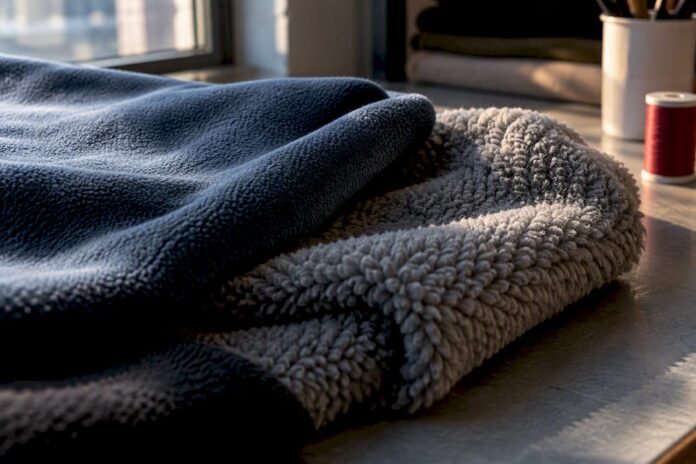
Fleece ranges from ultra-light microfleece to plush, high-pile sherpa, and the whole category comes down to two things: weight and pile. Match a fabric’s weight (measured in gsm or labeled by a series like Polartec’s Micro, 100, 200, or 300) and its pile height to what you’re actually doing, whether that’s layering on a hike or curling up at home, and you’ll almost never pick wrong.
TL;DR:
- Fleece’s warmth depends more on its pile height and loft than its weight, with high-pile sherpa providing the most insulation but less breathability.
- Microfleece is ideal for lightweight layering and travel, while midweight polar fleece balances warmth and versatile everyday use.
- Polyester fleece, including recycled options, resists moisture and retains loft, but it sheds microfibers during washing regardless of origin.
- Active users should choose low-pile fleece, such as microfleece or 100-series, to prevent overheating, while high-pile fleece suits stationary warmth and lounging.
- Finishing treatments like anti-pill coatings or water resistance extend fleece durability and functionality but can impact breathability.
Table of Contents
What is fleece, and what are the main types?
Fleece is a knit fabric, usually polyester, that gets brushed on one or both sides to raise fibers into a soft pile. That brushing step is what separates fleece from a flat knit: it traps air in the raised fibers, and trapped air is what keeps you warm. Once you understand that one mechanism, every fleece variety on a store tag starts to make sense.
Here’s a quick reference for the names you’ll see most often:
- Microfleece: the lightest, thinnest fleece, brushed low and tight, built for layering without bulk.
- Polar fleece (midweight): the classic, all-purpose fleece most people picture, balanced between warmth and breathability.
- Sherpa (high-pile fleece): thick, deep pile that mimics shearling wool, built for maximum stationary warmth.
- Slub fleece: fleece knit with irregular, thick-and-thin yarns, giving it a textured, heathered look with midweight warmth.
- French terry: a looped-back knit with a smooth face, closer to a sweatshirt fabric than true fleece, valued for breathability.
- Sweatshirt fleece (brushed fleece): often a cotton or cotton-polyester blend, brushed on the inside face, common in hoodies and joggers.
- Terry cloth (terrycloth): an uncut, looped fabric prized for absorbency, most familiar from towels and robes.
The industry’s clearest reference point for naming and weight is Polartec’s fleece series, which organizes fleece into Micro, 100, 200, and 300 classes. Each step up adds warmth without piling on unnecessary bulk, and outdoor brands still use that same shorthand even when they’re not using Polartec fabric directly. It’s a naming convention worth knowing, the same way “raglan sleeve” or “crew neck” tells you something specific about construction before you even touch the garment.
None of these types are strictly better than another. Microfleece won’t keep you warm on a cold porch in January, and sherpa will make you sweat through a fast walk. The type only matters in relation to what you’re asking the fabric to do.
How fleece weight and loft determine warmth
Two separate properties decide how a fleece performs: its weight and its loft. They sound similar, but they’re not measuring the same thing, and mixing them up is the most common mistake people make when shopping for fleece.
Weight is measured in grams per square meter, or gsm, using standardized testing methods like ASTM D3776, which lays out approved options for weighing a fabric sample consistently. It’s an objective number, not a marketing guess. In Polartec’s naming system, Micro sits at the lightest end, 100-series fleece is light-to-midweight, 200-series is the classic everyday weight, and 300-series is the heaviest, warmest tier before you’re into sherpa-style pile.
Loft is different. It refers to the height and density of the pile itself, not simply how thick or heavy the fabric feels. Loft is the single biggest driver of insulation in fleece, more than raw weight, because it determines how much still air the fabric can hold against your skin, according to Polartec’s documentation of its own series. A fabric can be heavier without necessarily being loftier, and a lofty fabric can trap more heat than a denser, heavier one.
Put weight and loft together and you get practical outcomes:
- Low weight and low pile: packs small, breathes well, dries fast, but offers modest warmth.
- High weight and low pile: sturdier and warmer, still reasonably breathable for movement.
- High weight and high pile: maximum warmth, but bulkier and slower to dry.
That’s why a technical low-pile jacket and a plush sherpa throw can carry similar weight numbers on paper yet feel completely different against your skin.
What are the main types of fleece, and what are they best for?
Once you know the mechanics, it helps to see how they play out in the fabrics you’ll actually find on a hanger or a blanket shelf.
- Microfleece is the thinnest and lightest option, typically low-pile and quick-drying, which makes it a favorite for travel layers, base layers, and anything you need to stuff into a bag without adding weight.
- Polar fleece (midweight), often the 200-series equivalent, is the most versatile fabric in the category. It balances warmth and breathability well enough to work as a stand-alone jacket in mild cold or a mid-layer in serious cold, which is why so many everyday fleece jackets land here.
- Sherpa (high-pile fleece) trades breathability for warmth. Its deep, dense pile is excellent for stationary comfort, lounging, blankets, jacket linings, but that same loft holds in heat and moisture, so it’s a poor choice for anything active, a distinction Elevenate’s comparison of sherpa and fleece lays out clearly: high-pile traps more heat and suits downtime, while low-pile breathes better during movement.
- Slub fleece uses irregular yarn thickness to create a textured, almost heathered surface. Performance-wise it sits close to midweight polar fleece, but people choose it for the look and hand-feel as much as the warmth.
- French terry looks nothing like brushed fleece up close. It has a smooth knit face and a looped, uncut reverse side, and that loop structure absorbs moisture and breathes better than a brushed pile does, according to a comparison from White Cotton. It’s the better pick for transitional weather or activewear where you don’t need heavy insulation, just comfort and airflow.
- Terry cloth (terrycloth) takes the looped construction of French terry and leaves the loops uncut and dense, maximizing absorbency rather than warmth. It’s why bath towels and robes are terry, not fleece, even though the two fabrics share a family resemblance.
- Sweatshirt fleece, sometimes called brushed fleece, is usually a cotton or cotton-polyester blend brushed on the inside. It’s the fabric behind most hoodies and joggers, chosen for softness and casual comfort rather than technical performance.
None of these are competing for the same job. A microfleece base layer and a sherpa-lined jacket might sit next to each other on a rack, but they’re solving opposite problems: one is about moving without overheating, the other is about staying still without getting cold.
How fiber content and blends change the way fleece performs
The fiber behind a fleece matters as much as its weight or pile. Most fleece is polyester, and for good reason: it’s lightweight, it dries quickly, and it holds its loft wash after wash better than natural fibers do.
Cotton and cotton blends change the equation. Cotton-blend fleece, the kind you’ll find in most sweatshirts, feels soft and breathes well, but it absorbs moisture rather than wicking it away, so it stays wet longer and loses some warmth once damp. It’s also more prone to shrinking if you wash it hot or dry it on high heat.
Recycled polyester fleece, made from processed PET plastic, has become common across the market. Performance-wise, it can hold up alongside virgin polyester in warmth and durability, according to a fleece fabric guide from ZJMANew, so choosing recycled doesn’t necessarily mean giving up performance.
Here’s how the choice typically breaks down:
- Polyester (virgin or recycled): dries fast, resists moisture, holds loft over time.
- Cotton blends: softer hand-feel, better breathability at rest, but slower to dry and prone to shrinkage.
- French terry (usually cotton or cotton blend): the better pick when you want breathability and a lighter, more casual feel than brushed fleece offers.
If you sweat easily or live somewhere humid, polyester fleece will serve you better. If softness and everyday comfort matter more than moisture management, a cotton-blend sweatshirt fleece or French terry will feel better against your skin.
Which fleece works best for your activity or climate
The core tradeoff in every fleece decision is warmth against breathability, and layering rules follow from it: thin, low-pile fabrics go closest to your skin during activity, while thick, high-pile fabrics go on top when you’re not moving much.
A few activity-based picks make this concrete:
- Active layering (hiking, running in cold weather): microfleece or low-pile 100-series fleece, worn under a shell.
- Everyday jacket: midweight 200-series polar fleece, warm enough for daily errands without overheating indoors.
- Heavy stationary insulation: 300-series or sherpa, for standing around outside or lounging at home.
- Loungewear and blankets: sherpa or sweatshirt fleece, chosen for comfort over performance.
- Travel layers: microfleece, since it packs down small and dries quickly if you need to wash it on the road.
Pilling, weight, and drying time all affect how a fleece holds up over months of wear. Lower-quality fleece pills faster because the fibers are shorter and less tightly knit, and heavier, high-pile fabrics generally take longer to dry after washing, which matters if you’re relying on one jacket during a multi-day trip.
Climate plays a role too. In humid environments, breathable, low-pile fleece or French terry will feel far more comfortable than a dense sherpa, which traps moisture against your skin. In dry, cold climates, that same trapped heat becomes an advantage.
Pro Tip: If you’re only buying one fleece, choose a 200-series midweight. It’s the one weight that works as a stand-alone jacket in mild cold and a mid-layer in serious cold.
How to wash and dry fleece without ruining it
Fleece is low-maintenance, but a few habits make the difference between a jacket that looks new after two years and one that’s pilled and flat after two months.
- Wash in cold or lukewarm water on a gentle cycle, using a small amount of regular detergent.
- Skip fabric softener entirely. It coats the fibers and flattens the pile, which is the opposite of what you want.
- Turn the garment inside out before washing to reduce friction against zippers and other fabrics that cause pilling.
- Tumble dry on low heat or air dry. High heat can melt or warp synthetic fibers and shrink cotton blends.
- Remove pills with a fabric shaver or a soft-bristle brush once they appear, rather than letting them build up.
- Wash cotton-blend sweatshirt fleece and French terry separately from zippers or rough fabrics, since the looser weave is more prone to snagging.
Cotton blends need slightly more caution than pure polyester fleece, since they shrink more readily and hold moisture longer. When in doubt, the cooler and gentler option is always the safer one.
What to know about recycled fleece and sustainability
Recycled polyester fleece starts as PET plastic, typically from bottles, which gets broken down, respun into fiber, and knit into fabric the same way virgin polyester is. The appeal is straightforward: it diverts plastic waste from landfills and, according to a fabric guide comparing fleece types, can match virgin polyester’s warmth and durability in many cases.
That parity doesn’t erase every tradeoff. A few things worth knowing before you buy:
- Performance parity: recycled fleece can hold loft and warmth comparably to virgin polyester, so choosing recycled rarely means sacrificing quality.
- Microfiber shedding: like all polyester fleece, recycled versions shed tiny plastic fibers during washing, a limitation of the fiber type itself rather than something recycling fixes.
- End-of-life: synthetic fleece, recycled or not, doesn’t biodegrade, so donating or repurposing worn-out garments matters more than the recycled label alone.
- Labels to check: look for specific recycled content percentages and third-party certifications rather than vague “eco-friendly” language on a tag.
Recycled content is a genuine improvement over virgin plastic production, but it’s one piece of a fabric’s environmental footprint, not the whole picture.
A quick checklist for choosing the right fleece
You don’t need to memorize every fabric name to buy well. Work through this order, and the right fleece becomes obvious fast:
- Decide your primary use: active layering, everyday wear, or stationary warmth.
- Pick a weight or series (Micro/100 for light layering, 200 for everyday, 300 or sherpa for heavy warmth).
- Choose pile height: low-pile for movement, high-pile for sitting still or maximum cold.
- Choose fiber: polyester for moisture management, cotton blend for softness and casual comfort.
- Confirm care instructions and sustainability claims before buying.
A few scenarios to make it concrete:
| Scenario | Recommended fleece and weight |
|---|---|
| Winter hiking mid-layer | Microfleece or 100-series, low-pile |
| Daily commuter jacket | 200-series polar fleece, midweight |
| Couch blanket or lounge hoodie | Sherpa or 300-series, high-pile |
| Casual weekend sweatshirt | Cotton-blend sweatshirt fleece |
| Mild-weather activewear top | French terry |
Watch for a few red flags when shopping: no weight listed anywhere on the tag or product page, vague fiber descriptions like “fleece blend” with no percentages, and care instructions that only say “wash cold” with no guidance on heat or softeners. Those gaps usually mean the maker hasn’t thought carefully about the fabric either.
How finishing treatments change what fleece can do
The base fleece knit is only part of the story. Finishing treatments applied afterward change how the fabric behaves, sometimes more than the fiber choice does.
Brushing is the finish that creates fleece in the first place, raising fibers into pile on one or both sides. Beyond that baseline step, anti-pill finishes bond fibers more securely at the surface, which slows down the fuzzing and pilling that comes from friction over time. It’s a meaningful upgrade for anything that gets worn often or rubs against straps and bags.
Water-resistant or waterproof coatings are sometimes bonded to the outer face of a fleece to block wind and light moisture, turning a pure insulating layer into something closer to a soft-shell jacket. That coating comes at a cost: it reduces the fabric’s natural breathability, since it’s blocking the same air movement that made fleece comfortable in the first place.
None of these finishes change the base fabric’s weight class or fiber, but they shift how it performs in the field. A 200-series fleece with an anti-pill finish will look better after a year of wear than the same weight without it, and a fleece with a wind-resistant coating will handle a breezy trail better than a plain brushed version, at the cost of some breathability indoors.
Does the knit structure affect how fleece feels?
Fleece starts as a knit, not a woven fabric, and that single fact explains a lot about how it behaves. Knit construction is what gives fleece its stretch and drape, while a woven fabric like canvas or denim holds its shape rigidly with almost no give.
The specific knit used underneath the brushed pile also matters. A tighter, denser knit base holds pile more securely and resists pilling longer, while a looser knit lets fibers shed and mat faster under friction. This is part of why two fleece jackets with the same gsm weight can feel and wear completely differently: the visible pile might look identical, but the knit holding it together is not.
French terry and terry cloth make this even clearer, since their looped structure is fundamentally different from a brushed knit. The loops themselves create the texture and absorbency, rather than a raised, cut pile, which is why a comparison of French terry and fleece treats them as related but distinct fabrics rather than interchangeable ones.
Knit structure won’t be printed on most tags, but it’s part of why two fabrics with the same fiber and similar weight can still feel noticeably different in your hands.
What happens to fleece in the wash, environmentally
Recycled content addresses where the plastic in a fleece comes from, but it doesn’t address what happens after you buy it. Every wash of a polyester fleece garment releases tiny plastic fibers, known as microfibers, into wastewater, regardless of whether the polyester started out virgin or recycled.
This shedding is a property of the fiber type itself, not a flaw specific to lower-quality fleece, though looser knits and higher-pile fabrics like sherpa tend to shed more per wash simply because there’s more surface fiber to lose. There’s no fully solved fix built into most garments today, though washing less frequently, using a full load, and choosing cold water cycles all reduce the mechanical friction that knocks fibers loose in the first place.
It’s worth holding two facts at once here: recycled polyester fleece is a real improvement over using virgin plastic, and it still sheds microfibers the same way virgin polyester does. Neither fact cancels the other out. If shedding is a serious concern for you, a laundry filter bag designed to catch microfibers during the wash cycle is currently the most direct tool available to reduce what reaches the water supply.
Why fabric choice matters for advocacy wear
Clothes that carry a message get worn again and again, not just once. When a piece is meant to spark a conversation about mental health, it has to hold up through repeated wear and washing, or the message fades along with the fabric.
That’s the lens we bring to picking fleece and other materials for the pieces we make. Durability, washability, and comfort aren’t afterthoughts when a hoodie or sweatshirt is doing the work of starting conversations about schizophrenia and mental illness, sometimes daily. If you’re curious what that looks like in practice, our hoodies and sweatshirts page and our guide to choosing pullover versus zip styles are good places to start.
— Michelle
Where to find fleece built for everyday advocacy
Understanding fleece weight and pile helps you shop smarter anywhere, and it’s exactly what we think about when choosing fabrics for our own advocacy apparel. If you’re looking for a hoodie or sweatshirt that holds up to daily wear while carrying a message worth repeating, our hoodies and sweatshirts reflect that thinking, and the full range of pieces lives on Schizophrenic.
Sources
FAQ
What is the highest quality fleece?
There’s no single “highest quality” fleece since it depends on the job, but fabrics built to a named weight series, like Polartec’s Micro, 100, 200, and 300 classes, tend to be the most reliable because their weight and construction are documented rather than vague. Look for consistent weight labeling, a tight knit base, and, where warmth matters most, a denser, higher pile.
Which type of fleece is the warmest?
Sherpa, or high-pile fleece, is the warmest type because its deep, dense pile traps the most still air against your body, according to Elevenate’s explanation of how pile height drives insulation. That warmth comes with reduced breathability, so it performs best for stationary use rather than active movement.
Are there different grades of fleece?
Yes, fleece is typically graded by weight, from lightweight microfleece up through heavier 300-series and sherpa-level fabrics, following the naming conventions Polartec popularized across the industry. Pile height and knit density also affect how a given weight class performs, so two fabrics in the same weight tier can still feel different.
How can you tell if fleece is good quality?
Good quality fleece feels dense and springs back when you press the pile down, rather than staying flattened, and it should list a specific weight or series rather than a vague description. Checking the fiber content and care label also helps, since fabrics with clear, specific information tend to come from manufacturers who tested the material properly.
Recommended
Comments