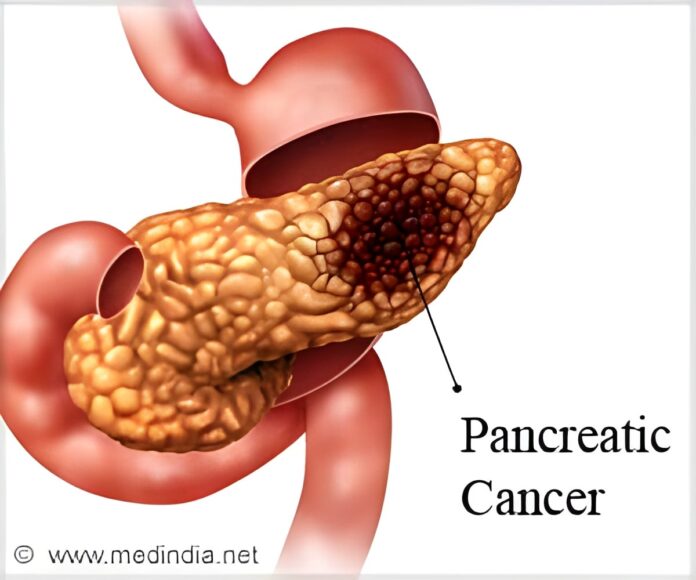
Pancreatic cancer patients often face dangerous blood clots. Depleting liver-made clotting protein (fibrinogen) may shrink pancreatic tumors.
Depleting a clotting protein from the liver may help slow pancreatic cancer, according to a new study conducted by a team of researchers at the Indiana University Melvin and Bren Simon Comprehensive Cancer Center.
The findings of the study are published in the journal Gastroenterology (1✔ ✔Trusted Source
Depletion of Fibrinogen Suppresses Growth of Primary Tumors and Metastasis of Pancreatic Ductal Adenocarcinoma
Go to source
).
Fibrinogen: The Tumor Fuel Behind Pancreatic Cancer
The research led by Melissa L. Fishel, Ph.D, shows that reducing fibrinogen in mouse models shrinks primary pancreatic ductal adenocarcinoma (PDAC) tumors and reduces their ability to metastasize to the liver. Fibrinogen is cleaved to fibrin following injury and is a primary structural component of blood clots. Fibrinogen is deposited on pancreatic tumors and contributes to their growth and environment in which the tumor grows.
Blood Clots Threaten Pancreatic Cancer Patients
“It’s well known that pancreatic cancer patients have some of the highest rates of blood clots or deep-vein thrombosis, or DVTs,” said Fishel, an associate professor of pediatrics and the Myles Brand Scholar in Cancer Research at the IU School of Medicine. “We wanted to understand whether the proteins involved in blood coagulation and clotting are driving the disease or are a byproduct of the disease.” Fishel is also a researcher at the Herman B Wells Center for Pediatric Research and co-leader of the Cancer Biology and Microenvironment research program at the cancer center.
Role of Fibroblasts and Fibrin in Pancreatic Cancer Growth
Pancreatic cancer is known to have a dense, fibrotic microenvironment rich in cancer-associated fibroblasts and a matrix of proteins including fibrin. These fibroblasts are recruited and build a matrix that supports tumor cells. In healthy pancreas tissue, researchers found very little evidence of fibrin deposition, but on pancreatic tumor samples, fibrin was abundantly deposited.
Using two different methods to deplete fibrinogen in mouse models, the researchers demonstrated that tumors grew smaller and produced far fewer liver metastases.
“When fibrin was not there, we saw a dramatic reduction in primary tumor size as well as liver lesions,” Fishel said. “When pancreatic cancer spreads to the liver the patient prognosis is grim, so we were very excited by the possibility of reducing that tumor burden and metastasis.”
The study used multiple tumor cell models, including two derived from IU patient samples and developed by the cancer center’s Pancreatic Cancer Working Group.
To determine whether fibrin in the bloodstream contributed to cancer spreading, researchers also used tumor models that resulted in sites of metastasis in the liver or lung, similar to what is observed in human patients. They found no difference in metastatic growth with or without fibrinogen, suggesting the protein impacts the tumor cells in the pancreas to alter tumor behavior and aggressiveness.
“Something about not having fibrin in the primary pancreatic tumor site really changes those tumor cells, so they are either less likely to leave the pancreas or are somehow unable to make a liver lesion,” Fishel said.
Managing Fibrinogen to Fight Pancreatic Cancer
Since the body needs fibrinogen to prevent excessive bleeding, Fishel said the goal is not to eliminate the protein entirely in patients.
“Since levels of fibrinogen are elevated in pancreatic cancer, the idea would be to return it to baseline — not to zero,” Fishel said. “We believe that could be clinically manageable.”
Next steps for this research include combining fibrinogen-targeted approaches with chemotherapy or emerging pancreatic cancer therapies, since reducing fibrinogen led to delayed disease progression — not a cure — in the mouse models.
“Now we want to understand what fibrin is turning on or off in the tumor so we can combine treatments to make them more effective,” Fishel said.
Reference:
- Depletion of Fibrinogen Suppresses Growth of Primary Tumors and Metastasis of Pancreatic Ductal Adenocarcinoma – (https://www.gastrojournal.org/article/S0016-5085(25)06025-1/fulltext)
Source-Eurekalert