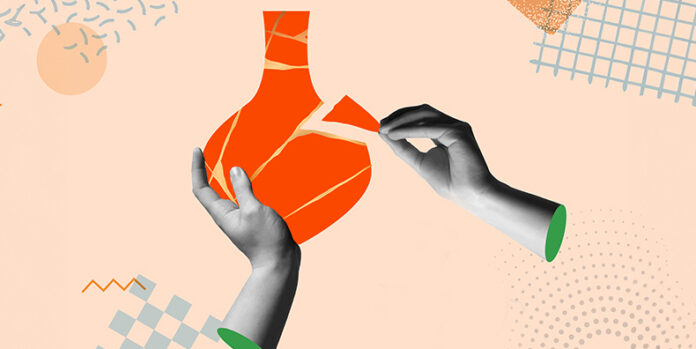
Kintsugi, the art of mending with gold, helped me reframe success and see beauty and purpose in life’s broken pieces.
I still remember the moment, more than two decades ago, when I picked up a mental health magazine in my psychiatrist’s sterile office: white walls, a battered couch, and a coffee table scattered with old, mismatched magazines.
One cover caught my eye — a person smiling. Bold. Bright. Unapologetic. It was an issue of bp Magazine.
At the time, I had just been diagnosed with bipolar disorder. That smile on the cover felt impossibly far from the darkness I was navigating. I remember the hesitation, the fear that someone might see me reading it and know my secret.
The shame of the diagnosis was heavy, and I did everything I could to hide it — even from myself.
Defining Myself by Achievement
For much of my life, I led with achievement. Top marks. Academic awards and scholarships. A promising career and multiple pivots into leadership roles — these were my armor.
I believed that success, if pursued hard enough, would make me worthy.
It wasn’t until I began working with a therapist who introduced the idea that perfectionism could be a coping mechanism that I started to question everything.
At first, I resisted. Fiercely. To me, perfectionism meant strength, discipline, and work ethic. It was proof that I was okay.
But the more I explored, the more I realized that my ambition had become a mask.
Letting Go to Move Forward
That realization didn’t erase my drive — it redefined it.
Recently, I made the difficult decision to pause a peer support group I had been facilitating for women living with bipolar disorder. The Courage Circle had been a home to me for three years — a place of shared experience, raw truth, and unspoken understanding.
Letting it go was hard. But I knew I needed to make space to write the next chapter of my life, both literally and figuratively.
I received a book deal to write my memoir, Dear Younger Me. In the past, I would’ve pushed through, doing everything perfectly — even at the expense of my health.
I wouldn’t have let anything go. I would’ve just kept adding on.
But this time, I chose differently. My younger self would be proud that I’m choosing rest over relentless achievement and creating space to connect with her through my writing journey.
Breaking and Mending With Gold
While making space to rest and reflect, I stumbled upon a kintsugi workshop in a serendipitous moment. I didn’t realize until after I signed up that it was being held at a palliative care center.
Kintsugi is a Japanese art form that involves mending broken pottery with gold. Instead of hiding the cracks, it highlights them, transforming something broken into something even more beautiful.
At the workshop, we were asked to hold our bowl with love and reflect: What does breaking this bowl symbolize for you? What are you ready to let go of?
For me, it was the grief, pain, and perfectionism I no longer wanted to carry — the parts of me shaped by trauma and unrealistic expectations.
When I smashed the bowl with a hammer, I didn’t expect to cry. But I did.
And not just for myself. Every time someone else broke their bowl, I felt it. I didn’t need to know their stories — I could feel them. We were all breaking something sacred.
Repairing One Piece at a Time
My bowl shattered badly, but only on one side. The other half remained intact.
It wasn’t until someone pointed it out that I saw the symbolism for bipolar disorder.
One side of life may appear whole and “normal,” while the other carries visible fractures. Yet both are beautiful.
And the side with the golden seams, the side that had been broken, was the most stunning.
At first, looking at the pieces, I thought: There’s no way I can put this back together. It felt like my life had felt at times — too complex, too fractured, too far gone.
But the facilitator reminded us: One piece at a time. That’s how we mend.
And we did.

A New Purpose, a New Definition
That bowl — now repaired and radiant with gold — can’t hold water. But it has a new purpose.
It will travel with me to future keynotes and presentations as a symbol of transformation.
Just like me.
I used to think my purpose was to be successful in the traditional sense — to climb, to achieve, to lead.
But bipolar was my hammer. It shattered me.
And piece by piece, I’ve put myself back together.
Now, my purpose isn’t just to hold. It’s to shine — scars and all. Like my kintsugi bowl, I am whole. I am beautifully unbroken.
A Message to Those Still Struggling
If you’re reading this now, maybe in a waiting room like I was years ago, know this:
You are not broken. You are becoming.
Every crack, every hard day, every diagnosis is not the end of your story. It’s an opening.
You are beautifully unbroken.
Healing hasn’t made me less ambitious — it’s made me more aligned.
I no longer strive to be perfect. I strive to be whole.
And that, I’ve come to see, is the greatest success of all.