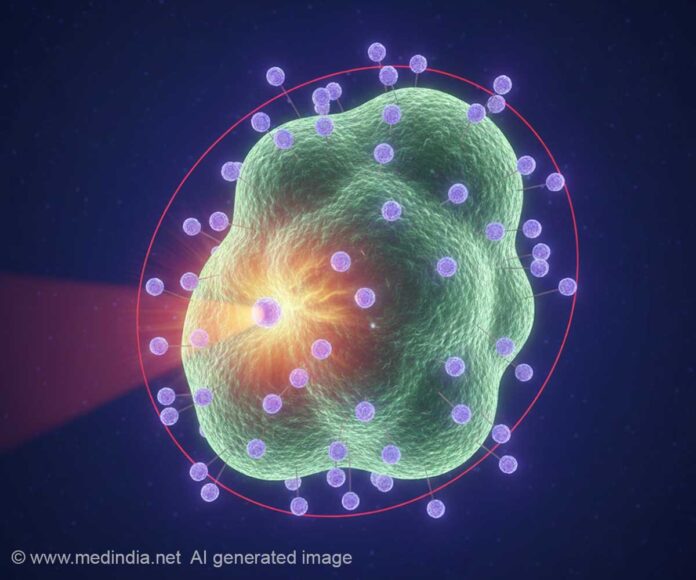
Hydroxyapatite nanoparticles enable high-precision cancer care through targeted imaging and light-activated heat therapy.
Hydroxyapatite nanoparticles are biocompatible and biodegradable materials that use light-based nanotechnology to transform tumor detection.
The breakthrough discovery was made by researchers at New York University Abu Dhabi, and the paper was published in the journal Cell Reports.(1✔ ✔Trusted Source
Tumor-targeted hydroxyapatite nanoparticles for near-infrared II light-mediated dual-mode diagnostic imaging and photothermal cancer therapy
Go to source
)
The light-driven mechanism ensures that hydroxyapatite nanoparticles effectively enter cancer cells without affecting surrounding healthy cells, which enhances the precision of the treatment.
While the activated light allows hydroxyapatite particles to produce fluorescent signals, aiding doctors with advanced cancer diagnosis/imaging, the same light activation gives rise to heat which is necessary to destroy tumor tissue (tumor ablation). This process is known as photothermal therapy.
The research underscores that hydroxyapatite nanoparticles provide a non-invasive and safer alternative for deep-tissue cancer care through multi-modal imaging, including MRI (Magnetic Resonance Imaging), X-ray, and NIR (Near-Infra Red Imaging), thereby minimizing the need for aggressive chemotherapy, surgery, or radiation in traditional methods.(2✔ ✔Trusted Source
Near-Infrared Fluorescent Hydroxyapatite Nanoparticles for Targeted Photothermal Cancer Therapy
Go to source)
Near-Infra Red Activated Nanoparticles Safely Destroy Deep-Tissue Tumors
The study advances photothermal therapy, a treatment approach that uses light to generate heat inside tumors and destroy cancer cells. The NYU Abu Dhabi team designed tiny, biocompatible and biodegradable nanoparticles that carry a dye activated by near-infrared light.
When exposed to this light, the particles heat up damaging tumor tissue while minimizing harm to healthy cells. Near-infrared light was chosen specifically as it penetrates the body to greater depth than visible light, thereby enabling treatment of tumors that are not close to the surface.
A key challenge in photothermal therapy is keeping the light-responsive material stable in the body and efficiently delivering it to tumors. Many existing photothermal agents degrade quickly, clear from the bloodstream, or fail to enter cancer cells efficiently.
Hydroxyapatite Nanoparticles Provide Superior Stability for Therapeutic Dyes
To address this, the researchers developed nanoparticles made from hydroxyapatite, a mineral found in bones and teeth. The particles are coated with lipids and polymers, which help them circulate longer in the bloodstream and avoid immune detection, allowing more of the therapeutic material to reach the tumors.
The particles also take advantage of the mildly acidic environment found in tumors. A peptide (a small protein) on their surface becomes active under these conditions, helping the nanoparticles efficiently enter cancer cells while largely avoiding healthy tissue.
The researchers found that the nanoparticles are highly stable, effectively protect the dye cargo from degradation and accumulate efficiently in tumors.
Upon activation by near-infrared light, generate localized heat that destroys tumor tissue and produce fluorescent and thermal signals that allow tumors to be visualized and treatment effects to be monitored in real time.
Scientists Indicate Hydroxyapatite Nanotechnology as the Future of Precision Oncology
“This work brings together targeted treatment and imaging in a single, biocompatible and biodegradable system,” said Mazin Magzoub, senior author of the study and associate professor of biology at NYU Abu Dhabi.
“By addressing key challenges in delivering therapeutic agents to tumors, our approach has the potential to improve cancer treatment precision.
The findings highlight the promise of this nanoparticle as an integrated system for cancer diagnosis and therapy, and an important step toward safer, more effective light-based cancer treatments.
Reference:
- Tumor-targeted hydroxyapatite nanoparticles for near-infrared II light-mediated dual-mode diagnostic imaging and photothermal cancer therapy- (https://www.cell.com/cell-reports-physical-science/fulltext/S2666-3864(25)00663-0?_returnURL=https%3A%2F%2Flinkinghub.elsevier.com%2Fretrieve%2Fpii%2FS2666386425006630%3Fshowall%3Dtrue)
- Near-Infrared Fluorescent Hydroxyapatite Nanoparticles for Targeted Photothermal Cancer Therapy – (https://www.mdpi.com/1999-4923/15/5/1374)
Source-Eurekalert