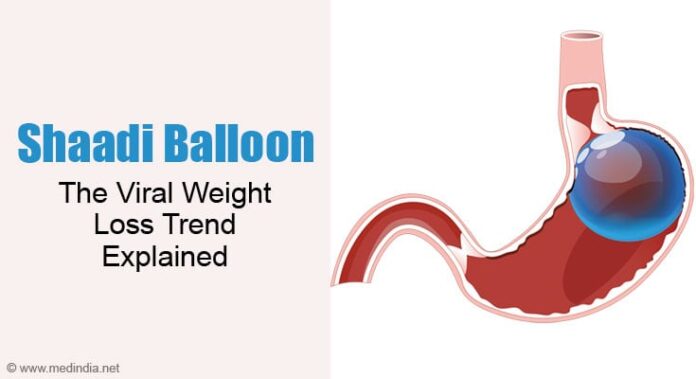
The Shaadi Balloon promises quick, non-surgical weight loss, but behind the trend lies a clinically supervised obesity treatment that requires careful use and lifestyle change.
- The Shaadi Balloon works by occupying space in the stomach, reducing hunger and portion size
- Patients lose 10–15% of body weight within 6 months, according to clinical data
- The balloon is temporary and requires strict diet and lifestyle changes for lasting results
The “Shaadi Balloon” (often referring to a swallowable gastric balloon, such as the Allurion Balloon) has quickly become a viral shortcut for weight loss, especially among people preparing for weddings or milestone events.
It is promoted as a quick, non-surgical way to become “wedding-ready,” involving a capsule that is swallowed and expands into a balloon inside the stomach.
However, medically, this is not a cosmetic hack—it is a structured obesity treatment known as intragastric balloon therapy, used under clinical supervision.
Large-scale clinical studies show that while the procedure can aid weight loss, it requires strict eligibility criteria, a commitment to lifestyle changes, and careful monitoring. The viral trend simplifies a process that is far more complex in reality (1✔ ✔Trusted Source
Inserting a gastric balloon
Go to source).
What Exactly Happens Inside the Body When You Take the “Shaadi Balloon”?
At its core, the Shaadi Balloon works on a very simple biological principle—reducing the available space inside the stomach. Once the balloon is inside and inflated, it occupies a significant portion of the stomach, leaving less room for food. This creates a sensation called early satiety, meaning you feel full after eating much smaller portions.
The balloon is made of silicone and is designed to make individuals feel full sooner, thereby naturally reducing food intake. By decreasing stomach volume, the balloon works through three key effects:
- It limits how much food the stomach can hold
- It triggers early satiety, helping you feel full faster
- It prolongs fullness, reducing hunger between meals
In practical terms, this means the body is gently “trained” to accept smaller portions. Over time, this can lead to reduced calorie intake and gradual weight loss. However, this effect is temporary and works best when paired with long-term dietary and behavioral changes.
How Is the Procedure Actually Done—Is It Really “No Surgery, No Effort”?
The simplicity advertised online hides a medically structured procedure.
In traditional gastric balloon therapy, the process begins with a careful examination of the stomach using an endoscope, flexible tube with a camera. This allows doctors to check for issues such as ulcers or inflammation before proceeding.
Once cleared, the balloon is placed and inflated inside the stomach. The overall procedure typically follows these steps:
- A thin endoscope is passed through the mouth to examine the stomach
- The deflated balloon is guided into the stomach
- The balloon is filled with saline (400–700 ml) or air (up to 750 ml)
- It expands to roughly the size of a grapefruit and seals in place
The procedure itself usually takes about 15 to 20 minutes and is performed under sedation to keep the patient comfortable. After placement, the balloon remains inside the stomach.
The newer “Shaadi Balloon” versions, such as swallowable systems, remove the need for endoscopy during insertion. Instead, the patient swallows a capsule attached to a thin tube, which inflates once it reaches the stomach. Despite this innovation, medical supervision is still essential.
Recovery is relatively quick, but it follows a structured progression:
- Most patients go home the same day or the next day
- Normal daily activities can usually resume within 1–2 days
- Diet begins with liquids, then moves to soft foods
- Regular meals are gradually reintroduced over a few weeks
Importantly, the balloon is temporary. It typically remains in the stomach for about 6 months, though newer models may last up to 12 months before removal.
Who Should Actually Consider It—And Why It’s Not Just for Wedding Weight Loss?
The “Shaadi Balloon” is marketed as a quick fix for anyone wanting to slim down before an event, but medically, it is intended for a very specific group of individuals.
The balloon is generally recommended for adults with a Body Mass Index (BMI) between 30 and 40, which falls within the obesity range. It may also be considered for those who have not achieved weight loss through diet, exercise, or medications.
The balloon is often used as a bridge therapy—helping patients lose weight before undergoing surgery or reducing risks for other medical procedures.
This means the procedure is not designed for:
- Mild weight loss goals
- Cosmetic slimming
- Short-term event preparation alone
Instead, it is part of a broader medical strategy to manage obesity and related health risks such as diabetes, heart disease, and metabolic disorders.
How Much Weight Can You Really Lose—What Do Studies Show?
Clinical evidence paints a realistic picture—an effective, but not dramatic, overnight transformation.
According to research, patients typically lose about 10–15% of their total body weight within six months (2✔ ✔Trusted Source
Gastric Balloon for Weight Loss
Go to source).
A large 12-month study published in Obesity Surgery involving 1,149 patients found (3✔ ✔Trusted Source
Safety and Efficacy of 12-Month Intra-gastric Balloon-Series of over 1100 Patients
Go to source):
- Median weight loss of 11.36 kg
- Around 11.11% total body weight loss
- Up to 15.38% weight loss at the time of removal
- Over 56% of patients lost at least 10% of their body weight
Another 6-month clinical study reported weight reduction from 104.5 kg to 88 kg, along with significant decreases in both body fat and BMI (4✔ ✔Trusted Source
Six-Month Outcomes of Endoscopic Intragastric Balloon Therapy: A Prospective Single-Center Study
Go to source
).
Interestingly, weight loss tends to be:
- Rapid in the first 3 months
- Slower but steady afterward
The research also shows that patients who attend regular follow-ups achieve better outcomes, highlighting the importance of ongoing medical support.
What Are the Risks, Side Effects, and Hidden Downsides?
While often promoted as “safe and simple,” gastric balloons do come with risks.
In the initial days after placement, many patients experience:
- Nausea
- Vomiting
- Stomach cramps
These symptoms usually settle within a few days.
However, more serious complications—though rare—can occur. Healthdirect lists risks such as:
- Balloon deflation leading to bowel blockage
- Ulcers in the stomach lining
- Acid reflux
- Overinflation of the balloon
- In rare cases, perforation of the stomach or esophagus
Large clinical data show:
- Around 5.22% overall complication rate
- About 4.35% early removal due to intolerance
- Severe complications are rare (0.17%)
Another large study involving over 2,400 patients reported a complication rate below 1%, reinforcing that, while generally safe, the procedure is not risk-free (5✔ ✔Trusted Source
Advancing Bariatric Strategies: Different Gastric Balloons in 2454 Patients
Go to source
).Is the “Shaadi Balloon” a Lasting Solution or Just a Temporary Trend?
This is the most important reality check.
The balloon is not permanent. Once removed, the stomach returns to its original size. Without sustained lifestyle changes, weight regain is common—a concern highlighted across multiple studies.
The long-term success depends entirely on maintaining improved eating habits and regular exercise. Research also shows that patients who actively engage in follow-up care and lifestyle programs achieve significantly better, more sustained results.
In essence, the balloon serves as a kick-start not a cure. It helps initiate weight loss, but long-term outcomes depend on behavior, not the device itself.
The Bottom Line: Is the Shaadi Balloon Worth It?
The “Shaadi Balloon” may look like a quick, effortless path to weight loss, but medically, it is a carefully controlled obesity treatment backed by years of research. It offers a non-surgical, reversible option for people struggling with obesity, delivering moderate but meaningful weight loss.
However, it is not:
- A shortcut for instant transformation
- A substitute for diet and exercise
- A risk-free cosmetic procedure
The trend oversimplifies what is, in fact, a clinical intervention that requires commitment, monitoring, and lifestyle change. For the right candidate, it can be effective—but for casual, event-driven weight loss, it may not be the appropriate solution.
Frequently Asked Questions
Q: What is the Shaadi Balloon?
A: It is a swallowable gastric balloon used for weight loss by reducing stomach capacity.
Q: How much weight can you lose with it?
A: Most patients lose around 10–15% of their body weight within 6 months.
Q: Is the procedure safe?
A: It is generally safe but may cause side effects like nausea, with rare serious complications.
Q: Is it permanent?
A: No, the balloon is temporary and removed after 6-12 months.
Q: Can weight return after removal?
A: Yes, without lifestyle changes, weight regain is common.
References:
- Inserting a gastric balloon – (https://www.healthdirect.gov.au/surgery/inserting-a-gastric-balloon )
- Gastric Balloon for Weight Loss – (https://www.hopkinsmedicine.org/health/treatment-tests-and-therapies/gastric-balloon-for-weight-loss)
- Safety and Efficacy of 12-Month Intra-gastric Balloon—Series of over 1100 Patients- (https://pmc.ncbi.nlm.nih.gov/articles/PMC10781818/)
- Six-Month Outcomes of Endoscopic Intragastric Balloon Therapy: A Prospective Single-Center Study – (https://pmc.ncbi.nlm.nih.gov/articles/PMC12616975/ )
- Advancing Bariatric Strategies: Different Gastric Balloons in 2454 Patients – (https://journals.sagepub.com/doi/10.1177/10926429251411136)
Source-Medindia