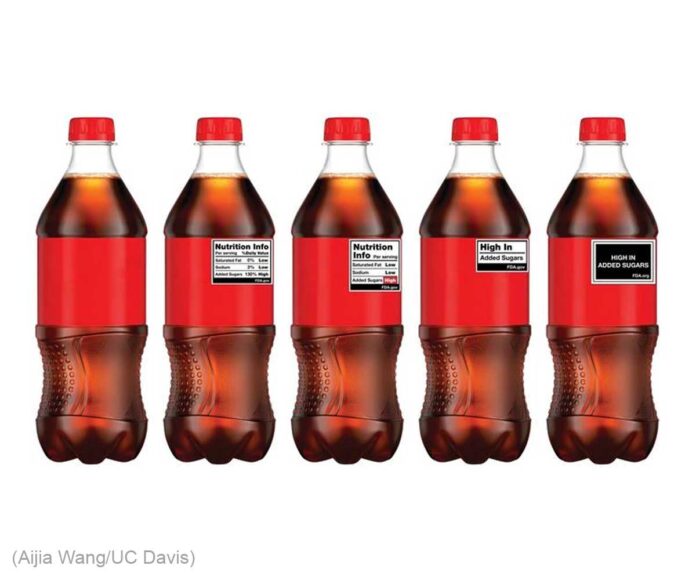
‘High-in’ vs. Nutrition info box: Do nutrition labels need a redesign? Clearer front-of-package labels can drive healthier food choices and prevent misleading health perceptions.
Health starts with a label — because a clear nutrition label today leads to a healthier tomorrow.
Packaged foods are convenient for families and individuals; however, they often contain high levels of saturated fat, sodium, and added sugars. When consumed in excess, these nutrients can increase the risk of chronic diseases.
Front-of-Pack Labels: Know Before You Eat
To help people build healthier diets, the U.S. Food and Drug Administration (FDA) proposed a new front-of-package nutrition label in January 2025 that would inform consumers about the presence of these nutrients.
While the FDA works to finalize the label, a research team led by the University of California, Davis, suggested a design that highlights products that are high in added sugar, sodium or saturated fat. They suggest in a new study an easy-to-understand label that make the healthfulness of foods more apparent.
The findings of the study are published in the journal, The Lancet Public Health (1✔ ✔Trusted Source
Efficacy of front-of-package nutrient labels designed for mandatory implementation in the USA: an online randomized controlled trial
Go to source).
The FDA’s effort to provide shoppers with an at-a-glance guide is an important step, said Jennifer Falbe, UC Davis associate professor of nutrition and human development and corresponding author of the study.
Rethinking Nutrition Labels for Healthier Decisions
The federal proposal would require a small “nutrition info” box on the front of most packaged food. Saturated fat, sodium and added sugars would each be listed with a rating of “low,” “medium” or “high.” This would be based on the % Daily Value, as defined by the FDA, which for these nutrients are a daily limit, in one serving. The labels would also list the numeric % Daily Value.
However, to make nutrient content easier to understand, researchers suggest that front-of-package labels should only flag products that are high in added sugar, sodium or saturated fat with labels that says “high in” a specific nutrient.
For example, a candy product might have one simple “high in added sugars” label. A pot pie might have “high in sodium” and “high in saturated fat” labels, researchers said.
The FDA label for the same candy and pot pie would list all those nutrients and the low, medium or high levels with the exact % Daily Value of each.
Putting Labels to the Test
Researchers conducted an online randomized controlled trial with more than 13,000 adults across the United States to compare the FDA’s proposed black-and-white nutrition info box to alternative designs to assess the effects of the labels on consumer understanding and behavior.
Falbe said “high in” label designs outperformed the FDA’s proposed label in helping participants quickly identify healthier choices. Using multiple “high in” labels, such as “high in added sugar,” “high in sodium,” or “high in saturated fat” also surpassed the FDA’s label in helping participants choose healthier foods for themselves in virtual shopping settings.
Also, compared to “high in” labels, the FDA’s proposed “nutrition info” labels caused participants to misperceive items such as processed meat and candy as healthier. “That’s probably because the FDA label listed two ‘lows’ and one ‘high’ for these products,” said Falbe. “The two ‘low’s’ may have created a false health halo, another reason the FDA should go with a ‘high in’ label.”
“This label will be seen every day by millions of Americans for decades, so the FDA should pick the best label,” Falbe said.
A Smarter Front-of-Pack for Smarter Food Choices
The new proposed label would be on display on the front of packages in addition to the nutrition facts panel already seen on the back or side of most food and beverage products.
“A lot of people overconsume added sugars, sodium and saturated fat, so to be able to quickly see that ‘high-in’ label makes it very easy to say, ‘maybe I should avoid that today,’” said Brittany Lemmon, a Ph.D. candidate in epidemiology and lead author of the study.
Reference:
- Efficacy of front-of-package nutrient labels designed for mandatory implementation in the USA: an online randomized controlled trial – (https://www.thelancet.com/journals/lancet/article/PIIS2468-2667(26)00027-7/fulltext)
Source-Eurekalert