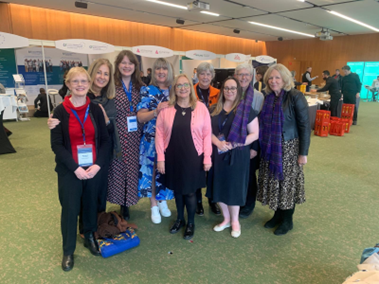
Hello! Emma and Aoife here. We are Occupational Therapy Students from Queen Margaret University who were on a 10-week placement with Alzheimer Scotland. During this placement, we have been working with Active Voice Members from the Scottish Dementia Working Group (SDWG). Emma and I had the pleasure of hosting a conversation with Margaret, a SDWG member, to enable us to write a blog scribing her journey. I hope you enjoy this blog helping us all to know who Margaret is.
In conversation with Margaret
Margaret shared with us that she is living with a rare type of frontotemporal dementia at the age of 51. Margaret discussed that she has been living with dementia for 10 years. She explained that this was a hard thing to hear, as there was no cure, especially as her type of dementia is caused by a mutant gene (C9orf72) which causes YOD or motor neuron disease. Her consultant was honest but supportive, and he encouraged her to connect with Alzheimer Scotland. Margaret felt the diagnosis was frightening, but she explained it also pushed her to stay positive and focus on what she could still do and achieve.
Work and Identity
Margaret’s work as a directorate administrator was a huge part of Margaret’s identity. Her story has been featured in the text book, Occupational Therapy and Dementia: Promoting Inclusion, Rights and Opportunities for People Living with Dementia (Maclean et al 2023) . She shared her many years of experience with us, working with allied health professionals and pharmacy teams, and her love for IT. Margaret always been curious about the innovations in IT. Before Margaret’s diagnosis, she described how her working environment did not make reasonable adjustments. unfortunately, she was told that “if she had a different health condition, she probably could have kept working”. Margaret shared that it’s good and important to be positive with a diagnosis of dementia, no matter the type, and your abilities. Margaret has been actively involved in making an inclusive workspace, in 2017 she attended the ‘Working with Dementia’ conference to share her story.
Working with Dementia Network: https://workingwithdementia.org/
Finding My Voice Through Scottish Dementia Working Group
Joining the Scottish Dementia Working Group has given Margaret purpose, connection, and a platform to raise awareness of her rare type of dementia. Margaret also explained how they try to make systems better for others living with dementia. Margaret finds this working group a joy to be part of and values the chance to engage with the public, including professionals and students.
“Just to always see the person and not whatever kind of dementia they have… because we are still people.”
Representing Scotland Across Europe: European Working Group of People with Dementia
Margaret represented Scotland in the European Working Group of People with Dementia. She commits to raising awareness, improving services, and challenging assumptions about dementia. She speaks proudly about contributing to research and national networks, emphasising that “we can still walk and talk.” Her European role built on this drive to ensure that lived experience informs change far beyond Scotland.
Friendship, Laughter, and Recognition
Margaret shared with us that some of her most meaningful moments have come through connection. Margaret discussed how she “always had good craic” with her experiences being in the frontotemporal dementia groups. At the European Working Group of People with Dementia (EWGPWD) annual conference in Helsinki, Margaret was presented with a plaque to mark her time as a member and Vice Chair. She shared that this was incredibly special, made even more so by the wonderful company of colleagues and friends from Alzheimer Scotland.
Living Beyond Prognosis
Now aged 61, and approaching her 62nd birthday, Margaret has been advised by her Neuro Consultant that she has exceeded her original prognosis, after being diagnosed with frontotemporal dementia at age 51 in 2016. Margaret had been informed that she had a gene mutation that typically causes YOD and in some people MND. Margaret informed us that her case is rare. This milestone holds deep personal meaning, underlining her resilience, while offering a powerful reminder that life with dementia has been meaningful and purposeful for Margaret, especially with her passion to engage with SDWG and EWGPWD.
Why Research Is Key, Raising Awareness of Different Dementias
Margaret tells us that she believes strongly in research being vital to shaping the future for people living with dementia. For her, research is key for advancements. This belief is closely connected to her commitment to raising awareness of rare and young onset dementias. Through media involvement, education, and public engagement, Margaret continues to challenge misconceptions, ensuring that lived experience informs research, policy, and the way society understands dementia.
This also aligns with Margaret’s longstanding interest in innovation and how systems work. Curious by nature, she is drawn to new ideas, research, and improved ways of ensuring inclusivity and delivering support. This interest continues to shape her involvement in education, service development, and research informed by lived experience. Margaret voiced that when she meets with students, she hopes that they takeaway “Just to always see the person and not whatever kind of Dementia they have.”
“I have always enjoyed, IT and just innovation of anything. So, yeah. I’ve always been curious about how things work”
Closing Reflection: Looking Forward
Looking ahead, Margaret remains motivated by a strong sense of purpose and hope. Margaret shared with us that she remains thankful for every day. Her commitment to advocacy, research, and connection continues to drive her forward, grounded in the belief that people living with dementia can shape change, challenge assumptions, and live meaningful, active lives.
Thank you for taking the time to read this blog post.
Contributors. Emma Galloway and Aoife Gordon, Queen Margaret University, Occupational Therapy Student.

Thank you for taking the time to read this blog post.
If you want to learn more about SDWG or join, please visit this link here
You can find the Alzheimer Scotland 24 hour Freephone Dementia Helpline, for information, signposting and emotional support to people with dementia, their families, friends and professionals here
Allied Health Professionals have created a suite of information resources for people with dementia, their families and carers that you can find here
Enjoyed this blog? Tell us more. We love feedback.
Please spend 1 minute completing this short anonymous feedback form to allow us to make our blog posts even better in 2026. Thank you
AHP Let’s Talk About Dementia Blog Feedback Form – Fill out form