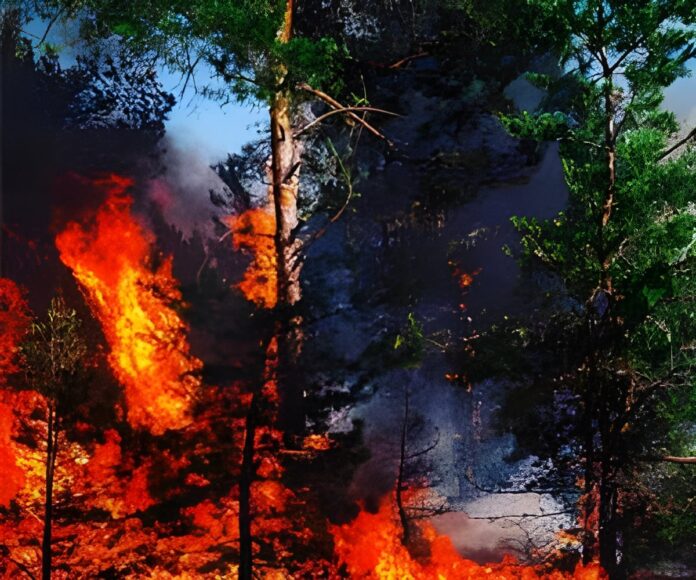
Wildfire smoke is now a major health risk. Experts reveal its effects and ways to stay protected.
Wildfire smoke has stopped being someone else’s problem. Across the United States, communities that once considered themselves far from fire country are now breathing it in — and the health consequences are becoming impossible to ignore. ()
As the crisis grows, researchers at Rutgers University are working to understand exactly what wildfire smoke does to the human body and what can realistically be done to limit the damage.
Leading that work are two experts from the Rutgers School of Public Health: Professor Philip Demokritou and Assistant Professor José Cedeño-Laurent, who are examining both the biological impact of smoke exposure and the practical steps individuals and communities can take to protect themselves.
Why Wildfire Smoke Is No Longer a Regional Problem
Why are wildfires now considered a major public health concern?
Demokritou: Wildfire smoke has become one of the most pressing environmental health challenges today. Once seen as a regional issue, wildfire smoke affects millions of people far from the fires themselves. Smoke travels long distances and reaches densely populated areas, disrupting daily life and exposing new populations to harmful air.
Cedeño-Laurent: Recent events have made the risks more visible. What was once episodic is now recurring, and in some regions, expected.
What makes wildfire smoke different from other air pollution?
Cedeño-Laurent: Wildfire smoke is not a single pollutant. It is a complex and constantly changing mixture of gases and particles. Its composition depends on what is burning, how intensely it burns, and how far the smoke travels.
A key concern is ultrafine particles. These are small enough to penetrate deep into the lungs and may enter the bloodstream. Wildfire smoke can also carry metals and toxic compounds, including some linked to cancer. This means that measuring how much smoke is in the air is only part of the story. Understanding what is in that smoke is just as important.
What do we know about the health effects?
Demokritou: The respiratory impacts are well established. Exposure to wildfire smoke can worsen asthma, trigger breathing difficulties and increase emergency room visits.
But the effects extend beyond the lungs. Emerging research links wildfire smoke to cardiovascular issues, impacts on the nervous system, mental health challenges and potential reproductive risks. Some evidence suggests that wildfire particles may be more harmful than other types of air pollution at similar levels.
There are still important gaps, particularly around long-term exposure and which components of smoke are most dangerous.
Key Unknowns in Wildfire Smoke Health Research
What are the biggest unknowns researchers are trying to answer?
Cedeño-Laurent: Scientists are working to better understand how different types of smoke affect the body over time, especially with repeated exposure. They are also examining how climate change is influencing wildfire behavior and, in turn, health risks. Another key question is how to translate scientific findings into practical strategies that protect communities, especially those most vulnerable.
How is Rutgers contributing to this work?
Cedeño-Laurent: Researchers at Rutgers are bringing together expertise across environmental health, engineering, medicine, and public health to study wildfire smoke from multiple angles. Their work spans exposure science, toxicology, health outcomes, and policy.
Demokritou: As part of this effort, Rutgers will host a national symposium on May 6 focused on wildfires, the environment, and health, bringing together experts to share research and identify solutions.
References:
- Why Wildfire Smoke Is a Rising Health Threat in the U.S. – (https://www.rutgers.edu/news/why-wildfire-smoke-rising-health-threat-us)
Source-Newswise